
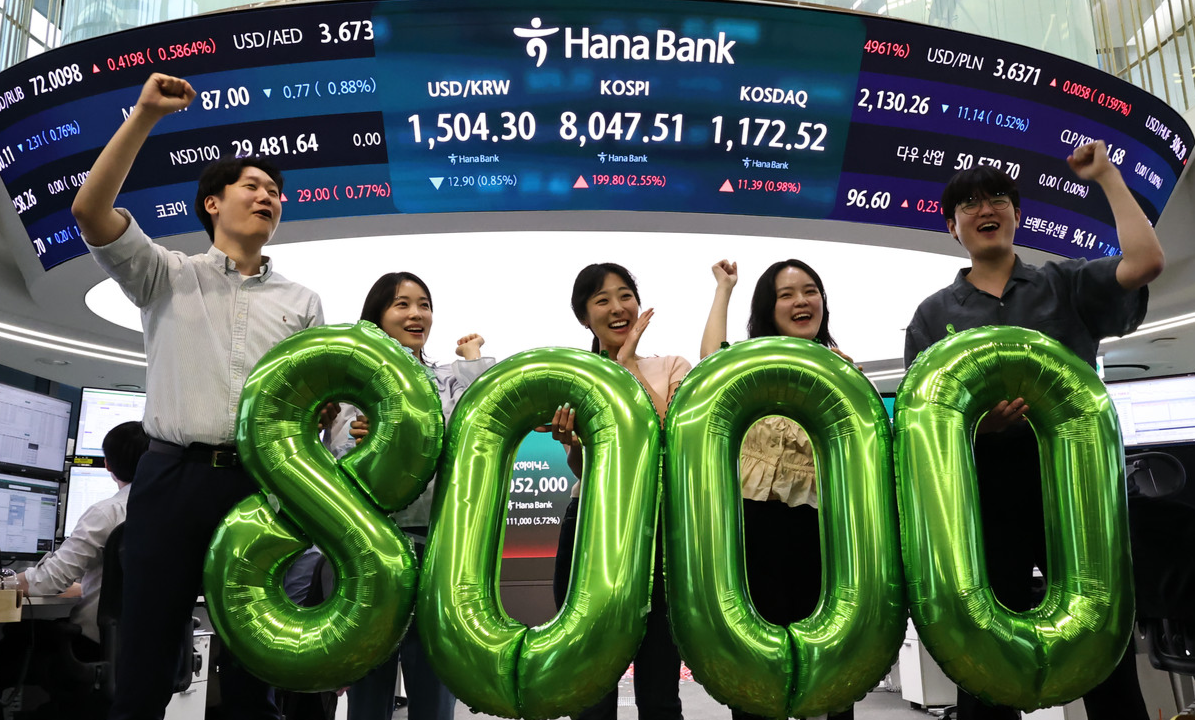
KOSPI Breaks 8000: LG Innotek Crowned as ‘Emperor Stock’ Amid Paradigm Shift in Korean Capital Market
The historic milestone of LG Innotek surpassing 1 million KRW per share to become the new “Emperor Stock” of the KOSPI market, coupled with the KOSPI index comfortably stabilizing above the 8,000 mark, fundamentally proves that the structural paradigm of the South Korean stock market has completely evolved.
Moving away from its historical, singular dependence on memory semiconductors (Samsung Electronics and SK Hynix), the Korean stock market’s value chain has sophisticated into high-performance AI packaging substrates (FC-BGA) and advanced device solutions. As a result, a massive “Money Move” of global capital is flowing into the market.
This article provides an in-depth analysis of the macroeconomic factors that propelled the KOSPI past 8,000. Furthermore, it highlights the core value stocks and blue-chip technology stocks that foreign institutional investors are prioritizing in their portfolios to hedge against a potential “Oil Shock” triggered by escalating tensions in the Middle East.
1. Three Macro Factors Driving KOSPI Past 8,000
The quantum leap of the domestic stock market is the direct result of Korean companies’ proprietary technology aligning with South Korea’s status as a critical global supply chain hub.
- Big Tech-Led Hyperscale AI Data Center Infrastructure Cycle: The explosion of the generative AI and AI Agent markets has led to a chronic shortage of FC-BGA (Flip Chip Ball Grid Array)—the core component connecting high-performance GPUs and CPUs to motherboards. Companies with monopolistic technological prowess, like LG Innotek, are securing long-term supply contracts and driving market re-rating.
- Geopolitical Safety and Secure Supply Chain Status: Amid the US CHIPS Act and European supply chain regulations, South Korea has solidified its position as an irreplaceable, advanced manufacturing partner for Western Big Tech firms. It offers unmatched stability compared to ASEAN markets, which often suffer from weak intellectual property rights and legal infrastructure.
- FX Market Modernization and Government’s Value-Up Program: Chronic factors behind the “Korea Discount”—such as FX market restrictions and insufficient shareholder returns—are being systematically resolved through deregulation and tax incentives. Consequently, global long-only funds have begun treating South Korea as a developed market portfolio rather than an emerging market.
2. Core Value Stocks Favored by Foreign Investors in an ‘Oil Shock’ Scenario
With the risk of a geopolitical energy crisis (Oil Shock) persisting due to Iran’s attempts to formalize control over the Strait of Hormuz, foreign investors are seeking out South Korean value stocks equipped with an economic moat. These companies can not only defend against a high-oil-price environment but convert it into a profitable opportunity.
① Power Grids and Energy Transition Infrastructure: HD Hyundai Electric, LS Cable & System
When an oil shock occurs, countries are forced to accelerate their timelines for renewable energy (RE100) and power grid efficiency investments by several years to reduce reliance on fossil fuels.
Key Investment Value: These companies have already secured several years’ worth of order backlogs in North America and Europe for ultra-high voltage transformers and submarine cables (HVDC). Furthermore, this value chain stands as the primary beneficiary when Middle Eastern oil-producing nations reinvest their petrodollars into massive infrastructure projects, proving robust earnings that defy macroeconomic slowdown pressures.
② Alternative Energy Infrastructure & Shipbuilding Value Stocks: HD Korea Shipbuilding & Offshore Engineering (HD KSOE), Samsung Heavy Industries
As risks at maritime energy chokepoints (such as the Strait of Hormuz) increase, the diversification of offshore oil and gas transportation becomes essential.
Key Investment Value: Amid the halt of the Russia-Europe pipeline and concerns over Middle East maritime blockades, Korean shipbuilders virtually monopolize the global market for eco-friendly LNG carriers, ammonia, and hydrogen carriers. High oil prices strengthen order momentum from shipping lines, making these companies textbook geopolitical defensive stocks with re-rating asset values.
③ Nuclear Power & Baseload Tech Value Stocks: Doosan Enerbility
Surging oil prices translate directly into higher electricity bills, which is fatal for global AI data centers that consume immense amounts of power. Nuclear energy remains the only viable alternative to supplement the intermittency of renewable energy while achieving carbon neutrality.
Key Investment Value: Doosan Enerbility possesses core manufacturing capabilities for next-generation SMR (Small Modular Reactor) foundations and proprietary hydrogen turbine technologies. Aligned with the government’s policies on independent national defense and the restoration of the nuclear power ecosystem, the company sits perfectly in the path of incoming long-term institutional capital.
3. Strategic Investor Takeaways & Market Guide
| Portfolio Position | Recommended Value Chain | Sector | Oil Shock Scenario Response & Stock Price Outlook |
| Core Alpha (Super-Gap Growth) | LG Innotek, SK Hynix | Semiconductor Substrates (FC-BGA) & HBM | Thanks to monopolistic pricing power in the FC-BGA and HBM markets, increased Opex from high oil prices can be fully passed onto Big Tech clients. |
| Defensive Beta (Infrastructure Value) | HD Hyundai Electric, LS Group | Power Grid & Energy Transition | Direct beneficiaries of the accelerated energy paradigm shift. They will act as a strong floor for the stock market during macro shocks. |
| Alternative Hedge (Hedge Assets) | HD KSOE, Defense Stocks | Maritime Logistics & National Defense | Capital gains are expected to outweigh foreign exchange losses due to rising maritime logistics risks and global hikes in defense budgets. |
💡 Conclusion: The Strategic Path Forward
In the KOSPI 8,000 era, the strategy for foreign investors has shifted from passive index-tracking to active stock picking of value companies that simultaneously offer an ‘exclusive technological moat’ and ‘macroeconomic risk resilience.’
While LG Innotek’s rise to an Emperor Stock is an inevitable outcome of the AI infrastructure boom, the foreign capital “Money Move” preparing for a potential oil shock will flow directly into power grid value chains (HD Hyundai Electric) and eco-friendly maritime transport infrastructure (HD Korea Shipbuilding & Offshore Engineering).
Whenever short-term external variables trigger a market correction, utilizing a “Buy the Dip” strategy for these core, blue-chip Korean value stocks—backed by robust global order books and high technological entry barriers—presents a clear answer to offsetting currency volatility and achieving optimal long-term investment performance.