
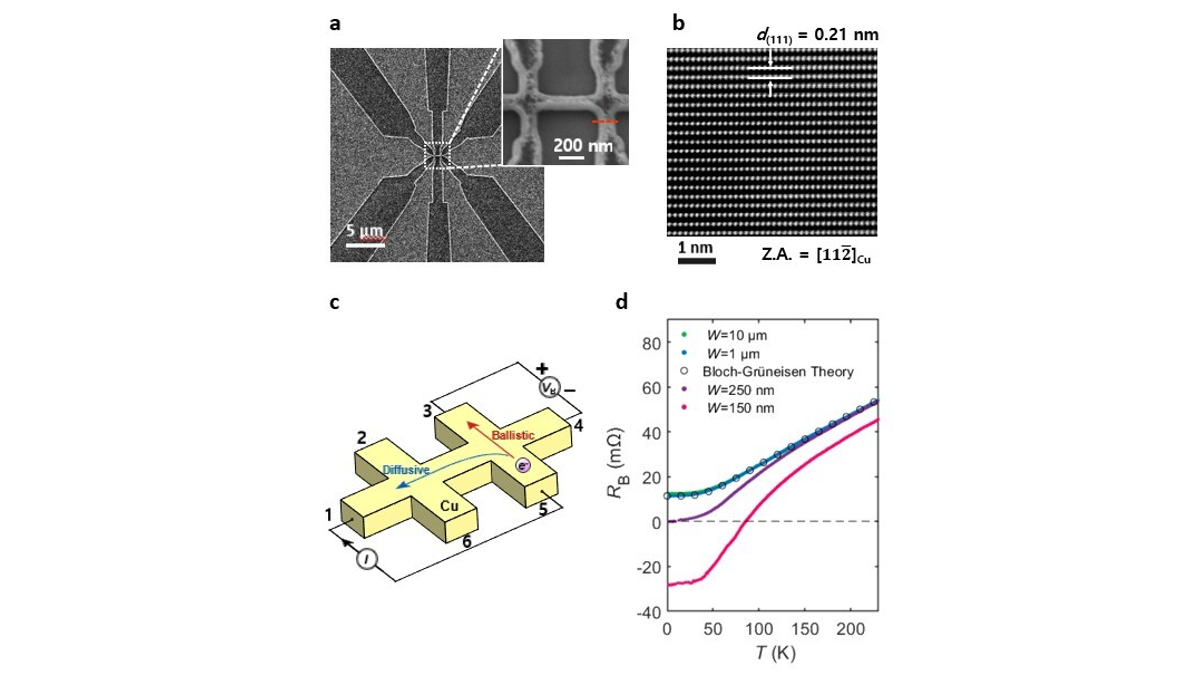
The discovery of “World’s First Experimental Verification of Ballistic Conduction in Single-Crystal Copper Wiring” by Professor Lee Gil-ho’s research team at POSTECH is a massive breakthrough capable of shifting the paradigm of the semiconductor industry.
This is because “thermal heat generation” and “power consumption” are currently the biggest walls facing the AI semiconductor market (such as HBM3E and HBM4). Breaking through these limitations means that the massive, data center-centric AI infrastructure can be completely decentralized into on-device gadgets or humanoid robot-based “Personal Super-Intelligent AI Partners (Personal AI Data Centers).”
Below is a detailed analysis linking the “AI Semiconductor Growth Roadmap and Keyword Predictions”—which will be the most searched and highly anticipated topics on the internet over the next few years—with the stages of technological evolution.
1. 3 Major Search Trends Dominating the Future AI Semiconductor Market
As the AI semiconductor market evolves, these core keyword combinations will see explosive traffic on global search engines like Google and Naver, serving as the benchmark for market forecasting.
- Current to Short-Term (Advanced HBM Stage):
#HBM4_Design,#Custom_HBM,#TSV_Thermal_Control,#Liquid_Cooling_Data_Center - Mid-Term (New Material & Architecture Stage):
#Single_Crystal_Copper_Interconnect,#Ballistic_Conduction_Semiconductor,#Ultra_Low_Power_AI_Chip,#Neuromorphic_3D_Stacking - Long-Term (Autonomous AI Endpoint Stage):
#Humanoid_AI_Data_Center,#Personal_AI_Partner,#On_Device_LLM,#Zero_Heat_AI_Processor
2. AI Semiconductor Growth Roadmap by Introducing Ballistic Conduction Materials
Phase 1: Overcoming HBM4 / HBM5 Limitations & The Rise of Custom HBM (2026–2028)
Starting from HBM4, the Base Die is manufactured using advanced logic processes from foundries like TSMC rather than traditional memory processes. However, the “heat dissipation limit” caused by highly integrated stacking still bottlenecks commercialization.
- Technological Shifts: Before replacing all copper wiring, single-crystal copper processes will likely be partially introduced to the highest-heat areas, such as inside Through-Silicon Vias (TSVs) or at the lowest bonding interfaces between dies.
- SEO & Traffic Predictions: Search volumes for keywords like “HBM4 thermal solutions” and “single-crystal copper thin-film commercialization yield” will surge. Technical comparison articles between existing cooling system providers (liquid cooling, hybrid bonding) and new interconnect equipment manufacturers will rank at the top of search engine results pages (SERPs).
Phase 2: Commercialization of Ultra-Low-Power, Zero-Heat AI Chips Based on “Ballistic Conduction” (2029–2032)
This is the era when the single-crystal copper interconnect process secures stable yields directly on actual semiconductor fab production lines, moving well beyond the laboratory level.
- Technological Shifts: Since electrons move at near-light speeds without colliding, the “RC Delay” phenomenon—where resistance spikes as circuit line widths shrink—will disappear. Power consumption will drop to a fraction of current levels, giving rise to semiconductors that require no cooling devices (fans, heat sinks).
- SEO & Traffic Predictions: “Semiconductors overcoming physics limits,” “zero-resistance copper interconnects,” and “next-gen neuromorphic chip materials” will become the dominant trends. When companies like NVIDIA, AMD, Samsung, and SK Hynix announce their next-generation architectures, whether they adopt this technology or not will be searched as a Key Performance Indicator (KPI) shaking up stock prices and market share.
Phase 3: One Data Center Per Person—The Birth of the “Personal AI Partner” (2033+)
Currently, running generative AIs like ChatGPT requires multi-hundred-million-dollar data centers and massive power plants. Once the heat and power issues are resolved, however, this entire infrastructure will fit inside “your pocket” or “a robot’s brain.”
- Technological Shifts: AI chips embedded inside smartphone-sized devices or humanoid robots will perform hundreds of trillions of operations per second, yet their batteries will last for days with absolutely zero heat generation. A flawless on-device AI data center that operates independently without needing to communicate with external cloud servers will be fully realized.
- SEO & Traffic Predictions: Just as Microsoft opened the PC era with Windows, keywords merging new AI operating systems with hardware will dominate the market. Consumer searches will pivot heavily toward terms like “humanoid AI brain specs,” “personal data center robot price,” and “on-device AI partner subscription.”
3. Comprehensive Outlook and Market Implications
The “ballistic conduction in single-crystal copper” announced by the POSTECH research team is not a simple material swap. It is the discovery of a savior that will sustain the expansion of semiconductor performance just as Moore’s Law is about to hit a brick wall due to physical thermal limits.
| Category | Current (HBM3E / HBM4) | Future (Ballistic Conduction AI Chip) |
| Core Bottleneck | Massive heat generation and signal delay caused by electron collisions | Securing production yield for the early single-crystal thin-film process |
| Infrastructure Type | Centralized data centers requiring massive power and cooling facilities | Decentralized personal AI/robots running independently on battery power |
| Market Dominators | GPU designers and large-scale foundry fine-process companies | Advanced new material equipment and on-device AI architecture pioneers |
If you are planning future technology investments or business roadmaps, tracking the “interconnect innovations inside stacked structures and the single-crystal material equipment supply chain” rather than just “high-stacking HBM technology” itself will yield the highest value insights for your market analysis.