
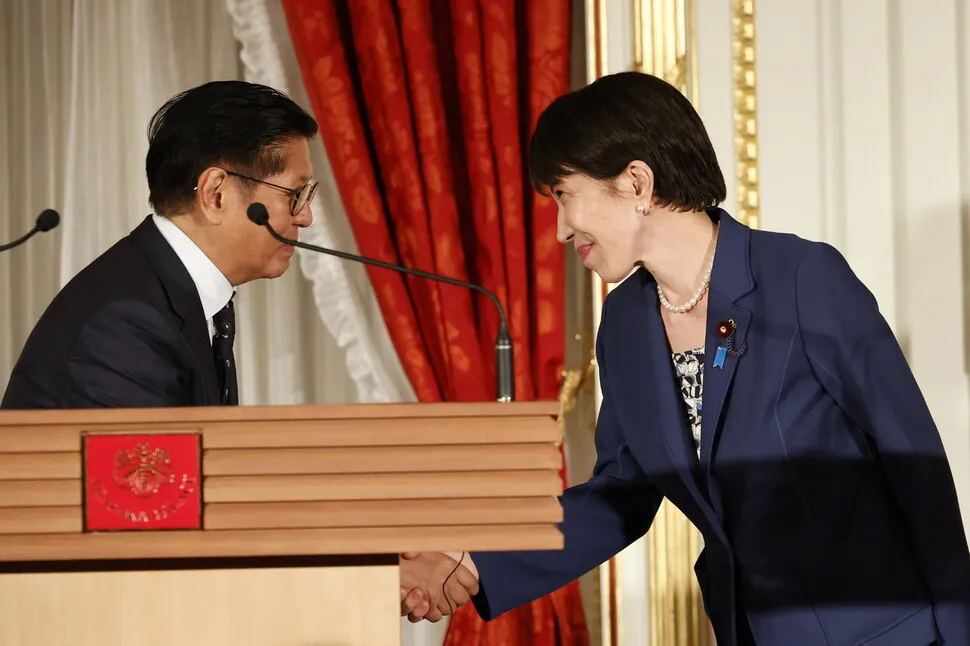
The news regarding the commencement of negotiations for the Japan-Philippines GSOMIA (General Security of Military Information Agreement) marks a highly significant turning point in completing the trilateral maritime security alliance among the U.S., Japan, and the Philippines.
In the event of escalating military tensions in the East and South China Seas linked to China’s attempted annexation of Taiwan, we provide a structured, keyword-optimized analysis of the worsening territorial disputes for Japan and the Philippines, the disruption of logistics flows, and the collision risks between Continental Powers (China-Russia-North Korea) and Maritime Powers (South Korea-U.S.-Japan-Philippines).
Analysis of Taiwan Strait Crisis and Collision Risks: Maritime Powers vs. Continental Powers in the East and South China Seas
1. Core Keywords & Search Intent
- Target Keywords: Japan Philippines GSOMIA, South China Sea territorial dispute, Taiwan invasion logistics disruption, Maritime vs Continental powers collision, US Japan Philippines South Korea security alliance, First Island Chain militarization
- Executive Summary: Military information sharing between Japan and the Philippines serves as a critical “Eye” to deter China’s annexation of Taiwan and maritime expansion. In a crisis, it represents a geopolitical flashpoint that could trigger global logistics paralysis and an all-out bloc-to-bloc war.
2. Detailed Analysis and Scenarios
① Escalation of Territorial Disputes for Island Capture (Militarization of the First Island Chain)
If China launches military action to annex Taiwan, territorial dispute zones in the East China Sea (Senkaku/Diaoyu Islands) and the South China Sea (Spratly Islands/Scarborough Shoal) will instantly transform into full-scale military conflict zones.
- Risks for Japan (Senkaku and Nansei Islands): To encircle Taiwan, China will seek to seize control of the waters surrounding the Senkaku Islands and the Nansei Islands at Japan’s southern tip. This directly infringes upon Japanese sovereignty.
- Risks for the Philippines (South China Sea Outpost): The Batanes Islands within Philippine territorial waters (located just 190 km from Taiwan) serve as a frontline strategic choke point capable of thwarting a Chinese blockade and amphibious assault on Taiwan. China is highly likely to attempt localized island seizures or blockades to neutralize Philippine and U.S. military radars and bases in this area.
② Maritime Sea Lines of Communication (SLOC) Blockade & Control of Global Logistics Flows
The East and South China Seas are the vital arteries for Northeast Asian energy and trade, including South Korea, Japan, and Taiwan. If these waters fall under hostile control, the economic fallout will be catastrophic.
- Paralysis of Choke Points: If the Taiwan Strait and the Bashi Channel (between Taiwan and the Philippines) are controlled by the Chinese Navy, civilian vessels will be forced to detour around Indonesia or southern Australia.
- Logistics and Energy Crisis: Over 90% of the crude oil imported by South Korea and Japan passes through these waters. Controlling these logistics flows will trigger a global supply chain collapse, skyrocketing maritime insurance premiums, and extreme domestic emergencies, such as the shutdown of thermal power plants and industrial operations in both South Korea and Japan.
③ Macro-Level Confrontation Framework: Continental Powers vs. Maritime Powers
The Japan-Philippines GSOMIA is the final puzzle piece that fills the gap in the “Maritime Power Network” centered around the United States. This will inevitably trigger a fierce backlash and deeper alignment among the Continental Powers.
[Continental Powers (Geopolitical Expansion)] Vs. [Maritime Powers (Value & Maritime Alliance)]China (Taiwan Annexation / Inland Sea of SCS) USA (Overalls Indo-Pacific Strategy)Russia (Pressure via Pacific Fleet Alignment) Japan (Nansei Islands Defense & Military Info Hub)North Korea (Localized Provocations in Korea) Philippines (SCS Radar Bases & Frontline Outpost) South Korea (Direct/Indirect Maritime Security Link)
- The Density of the Trilateral Information Network: Following the U.S.-Philippines GSOMIA, the U.S.-Japan Alliance, and the South Korea-U.S.-Japan trilateral cooperation (Camp David Accords), the conclusion of the Japan-Philippines GSOMIA establishes a seamless, real-time “mesh surveillance network” tracking the Chinese Navy’s movements across the entire Western Pacific.
- Coordinated Response from Continental Powers: Rather than facing the Maritime Powers alone, China will attempt to disperse the military strength of the U.S., Japan, and South Korea through joint exercises with Russia (in the East Sea and Philippine Sea) and by inducing localized North Korean provocations on the Korean Peninsula.
Geopolitical Takeaway
This agreement between Prime Minister Sanae Takaichi and President Ferdinand Marcos Jr. goes beyond mere bilateral information sharing; it is a last-line-of-defense maneuver by Maritime Powers to physically block China’s attempts to “change the status quo by force.” In a Taiwan contingency, this tightly woven military intelligence network will serve as a powerful weapon to neutralize a Chinese surprise attack. Conversely, it could also act as a fuse that rapidly expands a minor localized clash into a massive, inter-bloc maritime war pitting South Korea, the U.S., Japan, and the Philippines against China, Russia, and North Korea.