
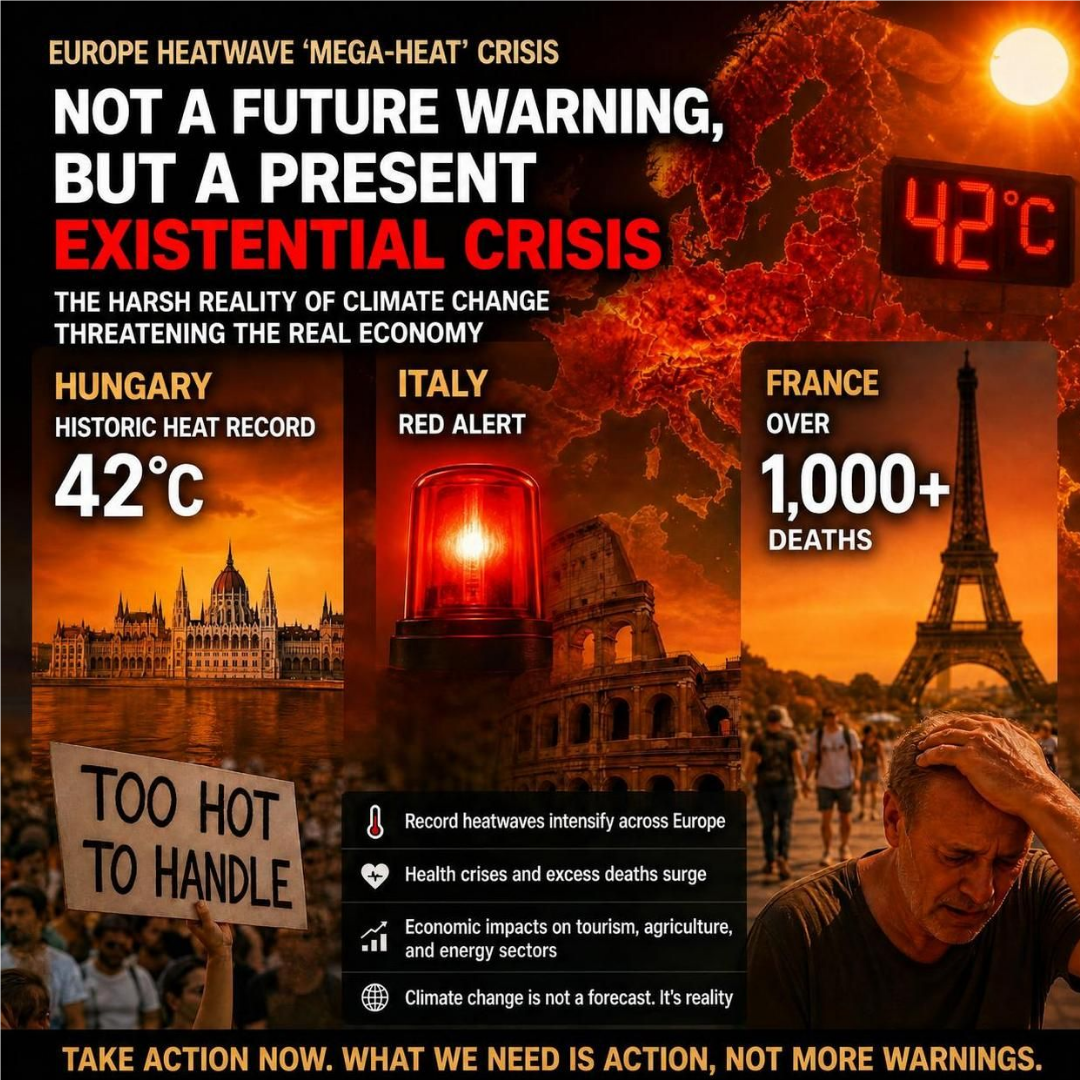
The recent “European Mega-Heatwave”—marked by Hungary recording a historic 42°C (107.6°F), Italy suffering under red alerts, and France experiencing over a thousand excess deaths—signals that climate change is no longer a future warning, but a live crisis impacting the real economy.
Focusing on the 2030–2032 timeline, this report delivers a multi-dimensional analysis of how the total transition roadmap for electric and hydrogen vehicles, combined with the RE100 (100% Renewable Energy) initiatives of global semiconductor and big tech supply chains, can realistically defend against escalating climate degradation. Armed with scientific facts, we outline the structural environmental security hedge portfolios that long-term value investors must preempt.
1. The Underlying Cause of the Global ‘Heat Dome’ Phenomenon: A Scientific View
The “Heat Dome phenomenon” currently turning Europe and the rest of the world into a furnace is not simply caused by intense sunlight. Climate scientists point to a core culprit: the meandering and stagnation of the Jet Stream driven by Arctic amplification.
- Trapped High-Pressure Warm Air Masses: As global warming narrows the temperature differential between the Arctic and the mid-latitudes, the momentum of the upper-atmosphere jet stream—which rapidly circulates and mixes global air—has weakened drastically. Consequently, the jet stream has begun to meander heavily like a slow, winding river and has ground to a near-halt. This causes a massive atmospheric high-pressure system to become locked over specific regions (such as Eastern and Southern Europe) like a lid on a boiling pot.
- Adiabatic Compression and Positive Feedback Loops: The air trapped beneath this atmospheric lid cannot rise; instead, it sinks and undergoes intense compression. This geometric compression drives temperatures up drastically and completely desiccates ground moisture. The parched soil then absorbs even more solar radiation rather than reflecting it, creating a vicious positive feedback loop that generates unprecedented, record-breaking heatwaves of 42°C.

2. Tangible Climate Mitigation Effects of the 2032 Mobility Shift and Semiconductor RE100
The full transition to electric and hydrogen commercial vehicles by 2032, alongside the accelerated RE100 compliance across semiconductor supply chains (such as TSMC, Samsung Electronics, and SK Hynix), serves as a critical line of defense in slowing global climate degradation.
The Climate Protection Chain:
[2032 Mobility / RE100 Realization] ➔ [Global Carbon Emissions Peak Out] ➔ [Suppression of Atmospheric Greenhouse Gas Saturation] ➔ [Restoration of the Jet Stream & Sharp Decline in Heat Dome Frequency]
- Inducing a “Peak Out” in Carbon Emissions: The transportation sector accounts for roughly 15% to 20% of global greenhouse gas emissions. Transitioning this sector completely to electric and hydrogen vehicles will abruptly cut off the influx of carbon into the atmosphere.
- Energy Paradigm Shift in Semiconductor Fabs: A single advanced sub-3nm semiconductor fabrication plant consumes as much annual electricity as a medium-sized city. Shifting the semiconductor supply chain to 100% renewable energy eliminates the immense heat and carbon dioxide spewed by fossil-fuel power plants at the source. According to TSMC’s analysis, when high-performance AI chips are produced and optimized within an RE100 environment, every 1 kWh of electricity consumed yields a paradoxical climate shield effect, reducing global carbon emissions by a factor of 6.8.
- Preventing Tipping Point Breaches: If these global efforts succeed, warming can be held within 1.5°C above pre-industrial levels. This will prevent the permanent collapse of the jet stream and cut the frequency of severe heat domes by more than half.
3. Three Core Sectors and Value Stocks to Strategically Consider for Portfolios
As the climate crisis intensifies, regulatory policies will become harsher. Capital will inevitably migrate toward high-end, blue-chip companies holding genuine “energy efficiency” and “zero-carbon original technologies.” In a structural macro boom, investors should lock the following key sectors into their long-term portfolios.
① Maximum Beneficiary of Supply Chain Decarbonization: Power Infrastructure & Transmission Leader (HD Hyundai Electric)
- Investment Mechanism: The ultimate bottleneck for semiconductor RE100 and EV charging infrastructure expansion is the electrical grid. Because renewable energy sources (solar, wind) suffer from high generation volatility, ultra-high-voltage transformers and smart grid assets are essential to stabilize and control the load.
- Mid-to-Long Term Value: The replacement cycle for aging power grids in North America and Europe, coupled with mandatory RE100 compliance orders from global corporations, is triggering an explosion in order backlogs. Paradoxically, as the climate crisis worsens, this global top-tier value stock sees its earnings profile become increasingly robust.
② Long-Haul Unmanned Transport & Clean Energy Hub: Hydrogen Fuel Cells & Generation (Doosan Fuel Cell)
- Investment Mechanism: Hydrogen fuel cells represent the cleanest form of distributed power generation capable of replacing traditional thermal power plants during heatwave-induced grid overloads. Positioned neatly alongside the 2032 heavy commercial vehicle hydrogen transition roadmap, the company holds a powerful technological moat in the utility-scale hydrogen infrastructure market.
- Mid-to-Long Term Value: With the recent launch of the Clean Hydrogen Portfolio Standard (CHPS) and the roadmap of global oil majors to supply mass quantities of by-product hydrogen, this is a prime long portfolio candidate for institutional investors to accumulate during market dips.
③ Climate Volatility Risk Hedge: Water Management & Eco-Friendly Materials (POSCO International)
- Investment Mechanism: Extreme heatwaves (heat domes) inevitably bring historic droughts and water scarcity. The value of leading general trading companies—which have preemptively secured localized technologies for ultra-pure water (essential for semiconductor manufacturing) alongside overseas eco-friendly green bio and food supply chain assets—is rising rapidly as a prime hedge asset in an era of resource nationalism.
💡 Investor Takeaways: Navigating the Future Climate Economy
| Outdated Investment Noise | Future Value Investor Signal | Action Guidelines & Positioning |
| “Eco-friendly policies are merely a compliance cost that eats away at corporate profits.” | Survival Metric: Failing to achieve RE100 means permanent expulsion from the global supply chains of big tech giants like Apple and Google. | Reduce exposure to legacy manufacturing sectors within your portfolio that are slow to transition to RE100. |
| “To trade the heatwave theme, buy air conditioner or dehumidifier manufacturers.” | Structural Shift: Short-term seasonal theme stocks are merely liquidity bubbles. True alpha lies in investing in grid innovation and global energy restructuring. | Buy the dip on ultra-premium stocks like HD Hyundai Electric, which monopolizes global power infrastructure supply lines despite climate risks. |
📌 Final Analytical Conclusion
The 42°C heatwave suffocating Europe and the entrenchment of the heat dome phenomenon stand as a stark warning to humanity: the 2032 energy transition and semiconductor RE100 are no longer optional green initiatives, but mandatory survival formulas.
Major global asset managers are tuning out short-term market noise. Instead, they are synchronizing their capital with big tech firms that are weaponizing carbon regulations to reshape global supply chains. Value investors should refrain from panic-selling on temporary economic slowdown anxieties. Instead, proactively Buy the Dip on South Korea’s super-gap power transmission infrastructure leaders and premium hydrogen/energy material stocks—the core engines of Earth’s defensive infrastructure—to secure long-term capital gains that outperform the climate crisis.