
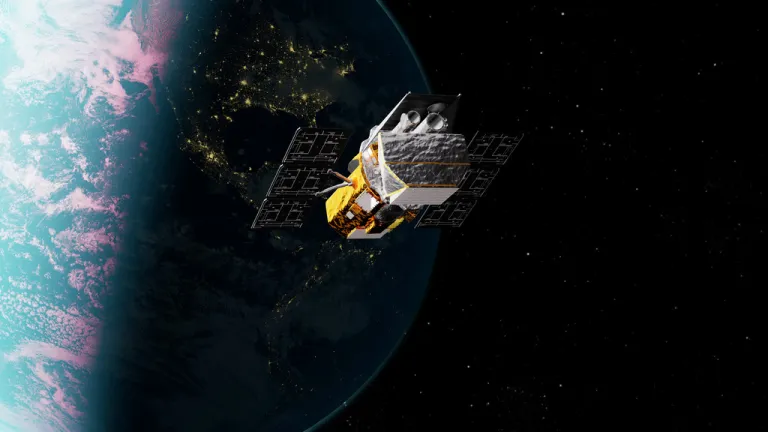
The successful orbital insertion and communication confirmation of the robotic arm spacecraft “LINK”—launched on July 3 by NASA in partnership with Arizona-based private space startup Katalyst Space Technologies—is a historic milestone that goes far beyond saving an aging space telescope.
In the past, satellites without docking mechanisms were treated as disposable consumables once their fuel or components degraded. However, this historic “Swift Reboost Mission”—the world’s first unmanned robotic satellite towing operation—signals that the In-Space Servicing, Assembly, and Manufacturing (ISAM) market has officially entered commercialization. By extending the lifespan of a multi-million-dollar hardware asset using a low-cost, $30 million robotic spacecraft, this technology proves the immense economic viability of future ventures like Lunar mining and Low Earth Orbit (LEO) data centers. It bridges the gap between planetary defense and space macroeconomics.
This deep dive analyzes the macroeconomic roadmap of the Earth-Moon protective ecosystem and highlights the high-value aerospace stocks investors should position themselves in early.
1. From Space Debris Mitigation to Economic Engine: The Capital Efficiency of ISAM Technology
Environmental policies aimed at shielding Earth’s atmosphere and preventing the accumulation of space debris were long criticized as regulatory burdens and cost sinks. The success of the LINK spacecraft transforms space sustainability into a high-margin, cutting-edge service sector.
- Reviving Assets at One-Tenth the Cost: Instead of spending $250 million to manufacture and launch a replacement for the Neil Gehrels Swift Observatory, NASA deployed “LINK”—equipped with three robotic arms and ion thrusters—for just $30 million, successfully restoring the telescope’s orbit to 600 km.
- Scaling Up to Hubble and Commercial Constellations: Capturing an “unprepared satellite” (one built without a native docking fixture) proves a vital point to the capital markets. It paves the way for commercial “on-site repair and orbital adjustment leasing businesses.” This framework could extend the life of the Hubble Space Telescope (facing reentry risks by 2031) and service the tens of thousands of Starlink and commercial communication satellites now filling LEO.
2. A Peace-Based Roadmap for Lunar Resource Extraction and Earth Repatriation
The precise robotic arm manipulation and ion propulsion validated by this telescope rescue form the structural backbone for logistics between Earth and the Moon’s South Pole. Managed under the peaceful and environmentally conscious framework of the Artemis Accords, these processes provide a stable, low-risk environment for private capital.
[LEO: LINK Spacecraft ISAM Validation] ⬇[Lunar Orbit: Establishing Starship-Linked Logistics Hubs] ⬇[Lunar Surface: Autonomous Robotic Mining & Primary Refining] ⬇[Earth Repatriation: Supplying Green Net-Zero Energy & Semiconductor Materials]
- Securing Clean Energy and Critical Minerals: Helium-3 (He-3) embedded in the Lunar subsurface represents the ultimate nuclear fusion fuel capable of solving Earth’s energy crises with zero carbon emissions. Concurrently, natural rare earth elements, tantalum, and niobium located in the regolith layer offer G7 nations a critical supply chain alternative independent of geopolitical choke points.
- Offsetting Logistics Costs via In-Situ Refining: Transporting heavy, unrefined ore to Earth is financially unfeasible. By deploying ultra-precise robotic arms and autonomous AI systems—similar to those proven on the LINK spacecraft—to Lunar bases, operators can execute In-Situ Resource Utilization (ISRU) and primary refining. Returning only high-value, lightweight refined materials to Earth guarantees an incredibly profitable venture that easily offsets initial capital expenditures.

3. Investor’s Playbook: High-Value Space Economy Stocks to Buy and Hold
With NASA’s successful Swift rescue and SpaceX’s ongoing dominance in the private sector, the aerospace sector is shifting from a speculative retail trend to an institutional pillar attracting long-term global funds.
① The Structural Anchor of Infrastructure and Launch Networks: Hanwha Aerospace
- Investment Thesis: As seen with Northrop Grumman’s Pegasus XL used to launch the LINK spacecraft, the valuation of air-launch and precision LEO delivery assets is climbing. As the primary contractor for major space launch vehicle modernization programs, Hanwha Aerospace holds an unrivaled position in proprietary space engine technology, making it an indispensable tier-1 asset.
② Ultra-Precision Robotics Components for Lifespan Extension & Docking: Neuromeka, Robotis
- Investment Thesis: Capturing a massive space asset that lacks built-in docking apparatuses requires advanced AI vision sensors and high-precision actuators (robotic joints). Specialized robotics firms directly integrated into national security innovation initiatives and the aerospace value chain are emerging as hidden gems in the hardware side of the ISAM market.
③ Space Data Control and LEO Communications Leaders: Korea Aerospace Industries (KAI), Contech
- Investment Thesis: KAI’s development of regional aerospace industrial belts, combined with Contech’s private ground station infrastructure, creates a strong software moat for receiving and analyzing real-time data from shifting orbital assets and rescue crafts. These enterprises will be among the first to show visible, recurring revenue streams within the space business ecosystem.
💡 Investor Takeaways: Separating the Signal from the Noise
| Legacy Risk (Noise) | Future Value Strategy (Signal) | Tactical Action Plan |
| “Space exploration is a money sink with no immediate economic return.” | The lifespand-extension market has arrived. The LINK mission proved the commercial viability of ISAM, saving a multi-million-dollar asset for just $30 million. | Rebalance portfolios away from simple defense/artillery manufacturers toward integrated space infrastructure and software service providers. |
| “Lunar resource mining is science fiction and technically unfeasible.” | Cost disruption meets autonomous automation. The combination of reusable launch systems and unmanned robotic refining makes the repatriation of clean energy and rare elements an impending reality for the 2030s. | Accumulate shares of undisputed market leaders and proprietary robotic platform providers on market dips to capture long-term valuation reratings. |
📌 Conclusion
The rescue of NASA’s Swift telescope and the flawless communication link established with the LINK spacecraft offer undeniable proof that the space industry has graduated from the era of single-use launches. It has entered a highly lucrative age of sustainable in-space asset management and resource recycling.
Global asset management firms are deploying capital into this emerging ISAM ecosystem and the peaceful resource zones of the Lunar South Pole. Savvy investors should look past short-term market volatility and avoid panic-selling valuable shares. Instead, maximize long-term capital gains by securing anchor positions in dominant, high-barrier aerospace leaders and advanced robotic powertrain companies that will serve as the backbone of the trillion-dollar space economy.
NASA-Katalyst Swift Orbit Boost Preview
Note: The attached NASA-Katalyst Swift Orbit Boost Preview video provides the essential technical background and briefings detailing how this public-private partnership successfully rescued and boosted the Neil Gehrels Swift Observatory, offering a multi-dimensional look at the core technology discussed above.