
Dynamic Shift in the UK Nuclear Strategy: Fusion Innovation and South Korea-UK SMR Alliance
The following is an in-depth analysis of the UK’s innovative nuclear fusion power strategy and its clean energy transition blueprint, focusing on the development of Small Modular Reactors (SMRs).
1. Commercializing Nuclear Fusion in the UK: Innovation Based on the Spherical Tokamak
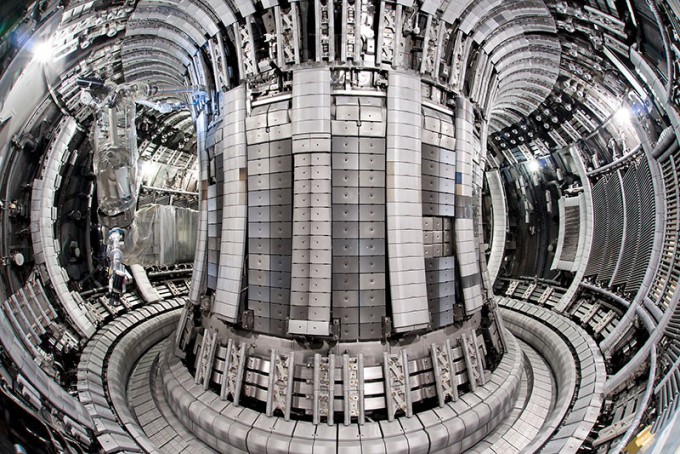
The secret behind the UK being evaluated as the closest country to commercializing nuclear fusion globally lies in its full adoption of the ‘Spherical Tokamak’ design, bypassing intermediate stages to head straight to the demonstration reactor construction phase.
① Technical Superiority of the Spherical Tokamak
- The Apple-Cored Structure: While France’s ITER and South Korea’s KSTAR utilize traditional donut-shaped (D-shape) tokamaks, the UK is developing a spherical tokamak shaped like a cored apple with a highly narrow central column.
- Overwhelming Spatial and Cost Efficiency: The spherical tokamak reduces the physical size of the magnet systems required to confine high-energy magnetic fields. This allows the entire power plant to be manufactured in a much smaller, modular format. This compact footprint drastically lowers construction costs and offers a major advantage in maintaining high-efficiency plasma.
② STEP (Spherical Tokamak for Energy Production) Roadmap
- The UK government is currently constructing STEP, a prototype nuclear fusion power plant, at West Burton in Nottinghamshire—the site of a former coal-fired power station.
- Over recent years, the UK government has committed extensive funding of over £2.5 billion to the nuclear fusion sector, with £1.3 billion of this budget being actively funneled into the STEP program.
- With the goal of starting power transmission by 2040, the project is simultaneously demonstrating a practical clean power supply network and tritium self-sufficiency technologies. This represents the fastest acceleration toward actual “grid connection,” moving far beyond the mere laboratory experiment phase.
2. Decommissioning and Replacement Roadmap of Aging Nuclear Plants & Analysis of ROK-UK Nuclear Cooperation
To align the retirement schedule of its aging nuclear fleet with carbon reduction targets, the UK is pursuing a massive nuclear renaissance. In this process, the deployment of Small Modular Reactors (SMRs) and strategic partnership with South Korea are emerging as key governmental reviews and concrete business realities.
① UK’s Aging Nuclear Replacement and Transition to SMRs
- With many of its existing Advanced Gas-cooled Reactors (AGRs) entering the decommissioning phase, the UK urgently needs to fill the resulting baseline power gap.
- Consequently, the UK government—through GBE-N (Great British Energy – Nuclear) and the Department for Energy Security and Net Zero—is actively matching domestic champion Rolls-Royce SMR with international partners. Recently, a contract was officially signed to begin the construction of three SMR units at the Wylfa site in Wales.
② South Korea’s SMR Capabilities and ROK-UK Joint Investment Status
- South Korean Companies Joining the Supply Chain: South Korea’s Doosan Enerbility has been selected as a strategic supplier to manufacture major components, including the reactor pressure vessels, for the UK’s core SMR project (Rolls-Royce SMR), and is currently handling the design of critical manufacturing processes.
- Joint Partnerships in Third-Country Markets: Backed by the recent trilateral SMR cooperation agreement between South Korea, the United States, and Japan, the South Korea-UK cooperation model is expanding into a global SMR export alliance rather than being confined to the UK mainland. The combination of South Korea’s unrivaled cost competitiveness in equipment manufacturing (highly controlled construction periods and costs compared to European peers) and the UK’s financial and regulatory expertise serves as a vital card that the UK government must evaluate and leverage to lower electricity tariffs.
- Domestic Political Issues (Balancing with ‘Buy British’ Policies): Some factions within UK political and labor circles have raised concerns that outsourcing critical component manufacturing to South Korea (Doosan) might undermine domestic job creation (the so-called ‘Buy British’ backlash). Therefore, future government reviews are expected to focus on balancing technical alliances with a well-coordinated domestic localization ratio.
