
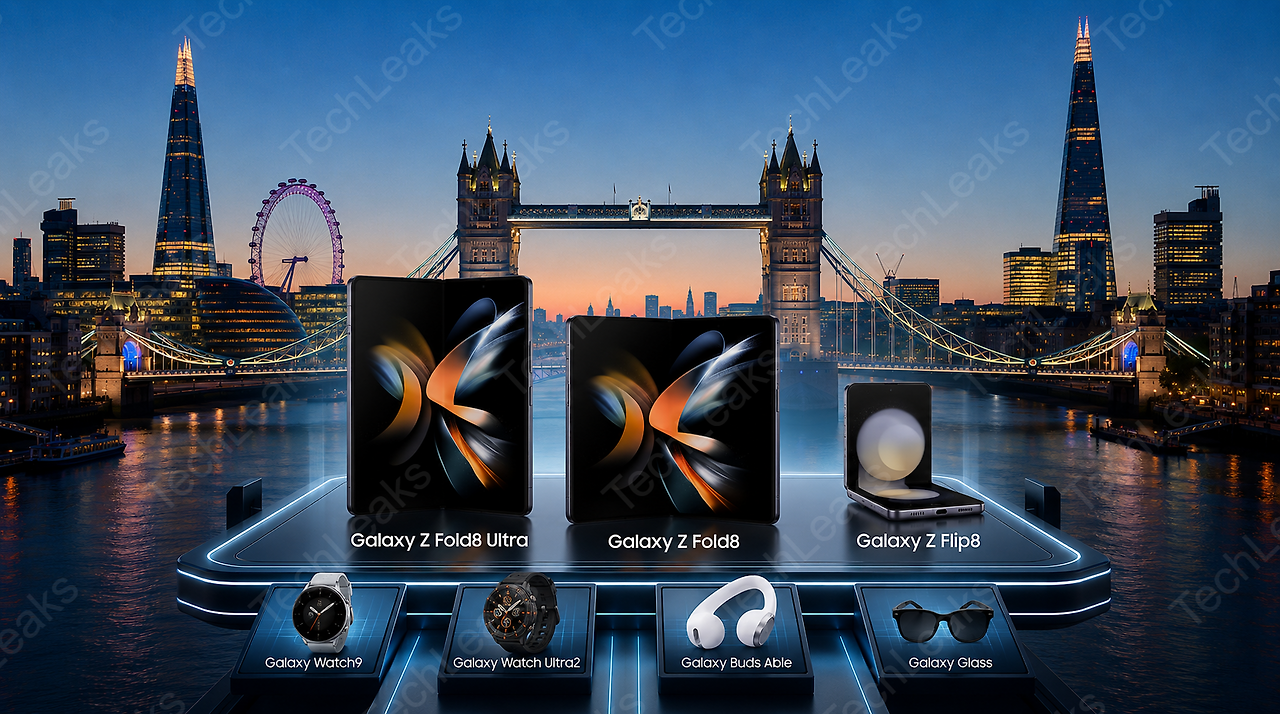
The new product lineup revealed at ‘Galaxy Unpacked 2026’ by Samsung Electronics at Old Billingsgate in London showcases a major technological turning point, marked by the segmentation of its foldable smartphone line (Fold8, Fold8 Ultra, Flip8) and its re-entry into the smart glasses market.
Based on Samsung’s Unpacked specifications and prevailing market trends, this analysis provides a multi-faceted evaluation of:
- The product appeal, pricing, and market share forecast for the Galaxy Z Fold8.
- The privacy vulnerabilities inherent in cloud-based smart glasses.
1. Multi-Dimensional Analysis of the Galaxy Z Fold8 Lineup
① Assessment of Ergonomics, Weight Reduction, and Spec Enhancements
- Radical Weight Reduction to 201g & Form Factor Innovation (4:3 Aspect Ratio): Perfectly resolves the “thickness and weight” issues that were the primary drawbacks of previous foldables. At 201g, it is practically indistinguishable from standard slab-style flagship smartphones. When folded, it adopts a passport-like aspect ratio (10:16), reinstating the natural, ergonomic grip familiar to traditional bar-type smartphone users.
- Flex Titanium & Advanced Display Technology: Combines a titanium alloy film with a high-strength steel plate, dramatically reducing screen crease visibility while securing robust structural durability.
② Reverse Discrimination vs. Existing/Prototype Phones & Price Competitiveness
- Narrowing the ‘Spec Gap’ with Slab Flagships: While past foldables required major compromises in camera or battery performance due to structural limitations, the Fold8 Ultra bridges this performance gap entirely by packing a 200MP main camera, the Snapdragon 8 Elite Gen 5 chipset, and a 5,000mAh battery.
- Price Competitiveness: Incorporating top-tier hardware components (titanium chassis, custom AP, silicon-carbon battery) inevitably pushes pricing into the ultra-premium bracket. However, by establishing a dual-track lineup—[Fold8 Standard (Value & Lightweight Focus)] vs. [Fold8 Ultra (Peak Performance)]—Samsung has secured a strategic pricing rationale that mitigates consumer resistance to high price points.
③ Demand Market Size & Forecasted Market Share (In-Depth Analysis)
[2026 Global Foldable Smartphone Market Landscape]┌────────────────────────────────────────────────────────┐│ Samsung Electronics (Tri-tier: Fold8 / Ultra / Flip8) ││ └─ Dominates premium segment & accelerates mainstream ││ adoption (60–65% Market Share) │├────────────────────────────────────────────────────────┤│ Greater China OEMs (Honor Magic V Series, Huawei, Xiaomi)││ └─ Pursuing via cost-performance & ultra-thin tech ││ (25–30% Market Share) │├────────────────────────────────────────────────────────┤│ New Entrants (Imminent Apple Foldable Entry) ││ └─ Expanding total market pie & intensifying rivalry │└────────────────────────────────────────────────────────┘
| Category | Key Features & Market Impact |
| Target Demand Segment | Replacement demand from existing slab flagship users + B2B/premium users seeking tablet-level productivity. |
| Competitive Dynamics | Defending against ultra-thin hardware pushes from Chinese OEMs (e.g., Honor, Huawei) through superior technical maturity (titanium durability, IPX8 waterproofing) and an integrated AI ecosystem. |
| Expected Market Share | Projected to retain a 60–65% share in the global foldable market. (Note: Upon Apple’s foldable release, total market volume will surge, though unit share may undergo minor adjustments.) |
2. Privacy Vulnerability Analysis of Samsung-Google ‘Smart Glasses’ & Cloud AI
Google’s standalone “Google Glass” previously faced intense market backlash and was withdrawn due to privacy controversies surrounding unauthorized recording and candid filming. The new joint Samsung-Google Smart Glasses operate on Gemini/Bixby AI frameworks, processing real-time camera and microphone input streams.
 [Smart Glasses Camera / Microphone]
         │ (Real-Time Visual & Audio Data Streaming)
         ▼
 ┌─────────────────────────────────────────┐
 │ [Cloud AI Server (Google / Samsung)]    │ ──> [Threat 1] Data Eavesdropping & Hacking Risks in Transit
 │ - Gemini / Bixby Real-Time Inference    │ ──> [Threat 2] Accumulation of Private Data in Central Storage
 │ - Vision & Voice Contextual Analysis    │ ──> [Threat 3] Controversy over Data Reuse for AI Fine-Tuning
 └─────────────────────────────────────────┘

① Core Vulnerabilities of Cloud-Based Architecture vs. On-Device Processing
- Risks of Transmitting Real-Time Visual/Audio Data to Cloud ServersDue to the form factor constraints of ultra-lightweight eyewear, running massive generative vision models locally (On-device) is challenging, making cloud computation indispensable. Because real-time video streams—capturing faces of bystanders, private documents, and computer screens—are continuously uploaded to servers, any interception during transit or server breach poses severe privacy leakage threats.
- Absence of Third-Party Awareness and Consent MechanismsIndependent of the wearer’s consent, third parties (bystanders) have no way of knowing whether their faces or private conversations are being transmitted to and processed by Google/Samsung Cloud AI. This rekindles the “surveillance anxiety” originally raised during the Google Glass era.
- Concerns Over Data Retention and Unauthorized AI Training UseOpacity surrounding whether data sent to the cloud is immediately destroyed or silently repurposed for AI model fine-tuning acts as a critical security vulnerability.
② Essential Safeguards and Countermeasures
- Hardware-Level Safety Mechanisms: Mandating a physical, high-brightness LED recording indicator that clearly alerts third parties whenever the camera is actively capturing.
- Edge (On-Device) Privacy Filtering: Implementing privacy technology within the eyewear’s internal AP (Snapdragon AR1) to anonymize sensitive details (e.g., blurring faces, credit card numbers, national identification numbers) before transmission, passing only sanitized text metadata to the cloud.