
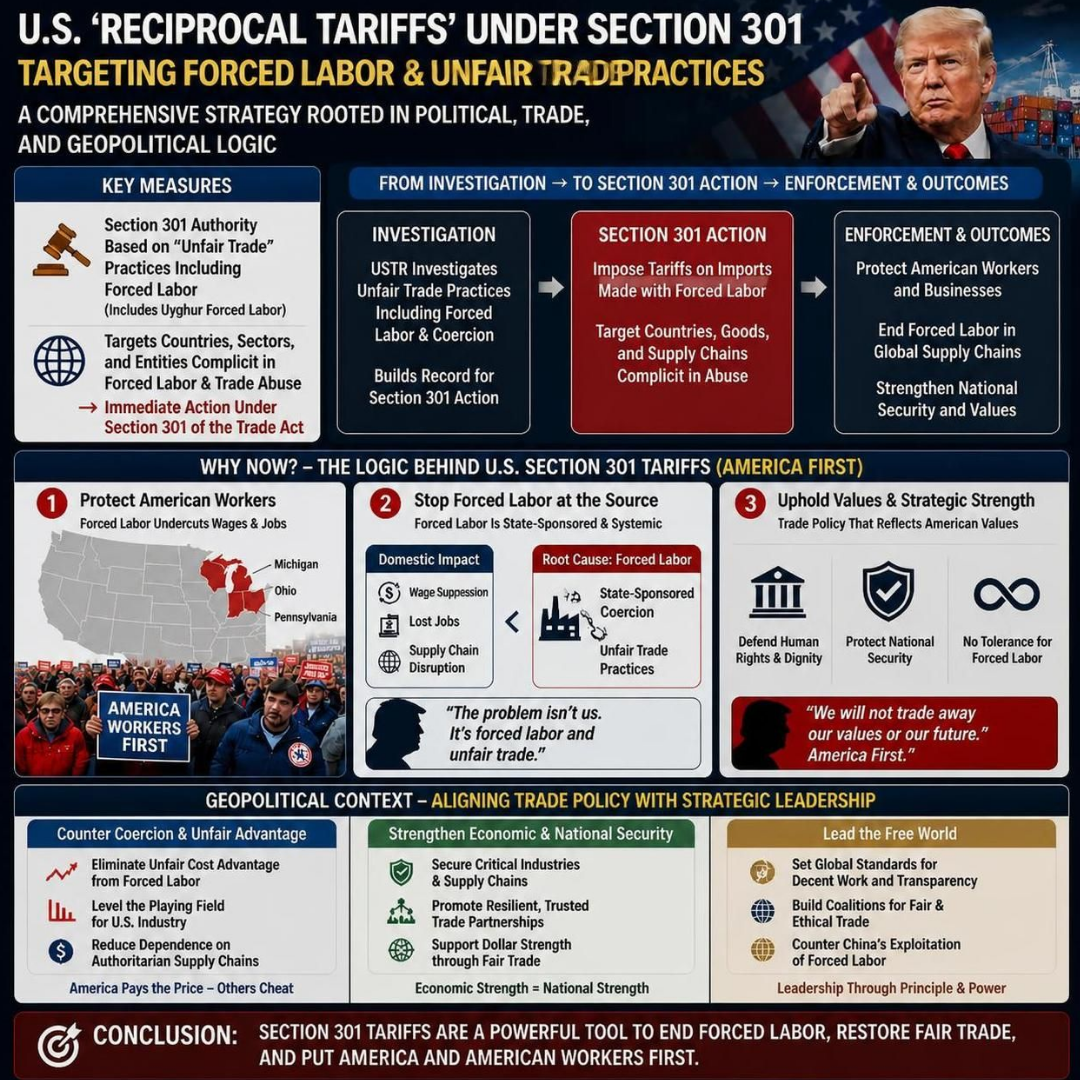
This action—taken by the Office of the United States Trade Representative (USTR) to finalize “forced labor tariffs” under Section 301 of the Trade Act (including a maximum rate of 12.5% for South Korea) right before the expiration of the existing 10% global tariff (as of midnight on the 24th)—is a complex macroeconomic event where concerns over U.S. stagflation, political calculations, and defense strategies for the global petrodollar are intricately intertwined.
From an investor’s perspective, here is a detailed breakdown of the background, hidden motives, and asset allocation strategies surrounding this situation.
1. Analysis of the Risk of Inducing U.S. Stagflation
The U.S. economy currently faces a compound crisis where multiple cost-push inflation drivers are exploding simultaneously.
[Tariff Imposition (Rising Import Prices)] + [Middle East Crisis (Spike in Crude Oil/Energy Costs)] ↓ Increased Production Costs & Shrinking Consumption ↓ Economic Slowdown + Sustained High Inflation = Stagflation
- Direct Stimulation of Import Prices: After relying on Section 122 of the Trade Act (a 150-day temporary tariff) following the Supreme Court’s ruling that reciprocal tariffs were unlawful, the U.S. administration has now institutionalized tariffs of 10% to 12.5% through Section 301. This immediately translates into higher prices for imported intermediate goods and consumer products, exerting upward pressure on both the Consumer Price Index (CPI) and the Producer Price Index (PPI).
- Vicious Synergy with Rising Oil Prices: If supply chain disruptions and global oil prices remain elevated due to instability in Iran and the broader Middle East, a textbook supply shock occurs: “tariff-driven supply chain cost increases combined with soaring energy costs.”
- The Fed’s Policy Checkmate: Rising inflation makes it difficult for the Federal Reserve to cut interest rates. If high interest rates persist, corporate investment and consumer spending will contract rapidly, dramatically increasing the risk of entering a state of “economic stagnation alongside inflation (stagflation).”
2. Is This a Political Calculation Targeted at the U.S. Midterm Elections?
In short, yes—this measure is heavily driven by political engineering aimed at the upcoming midterm elections.
- Rallying the “Protectionist” Vote: Leading up to the midterms, maintaining a firm trade pressure stance is crucial to securing votes across Rust Belt states like Michigan, Ohio, and Pennsylvania.
- Shifting the Blame for Inflation: It creates a political narrative that attributes domestic inflation not to U.S. monetary or fiscal policy, but rather to “structural overcapacity and unfair forced labor practices in foreign countries.”
- Institutionalizing Executive Power: Right before temporary tariffs (Section 122) expired due to Supreme Court rulings, the administration immediately pivoted to Section 301, which offers broader executive discretion, demonstrating an intent to maintain a “seamless tariff barrier.”
3. Defense Against De-Dollarization (Yuan-Based Settlements) and Hidden U.S. Economic Policies
[Tariff Imposition (Rising Import Prices)] + [Middle East Crisis (Spike in Crude Oil/Energy Costs)]
↓
Increased Production Costs & Shrinking Consumption
↓
Economic Slowdown + Sustained High Inflation = Stagflation
[Tariff Imposition (Rising Import Prices)] + [Middle East Crisis (Spike in Crude Oil/Energy Costs)]
↓
Increased Production Costs & Shrinking Consumption
↓
Economic Slowdown + Sustained High Inflation = Stagflation
[Tariff Imposition (Rising Import Prices)] + [Middle East Crisis (Spike in Crude Oil/Energy Costs)]
↓
Increased Production Costs & Shrinking Consumption
↓
Economic Slowdown + Sustained High Inflation = Stagflation
[Tariff Imposition (Rising Import Prices)] + [Middle East Crisis (Spike in Crude Oil/Energy Costs)]
↓
Increased Production Costs & Shrinking Consumption
↓
Economic Slowdown + Sustained High Inflation = Stagflation
[Tariff Imposition (Rising Import Prices)] + [Middle East Crisis (Spike in Crude Oil/Energy Costs)]
↓
Increased Production Costs & Shrinking Consumption
↓
Economic Slowdown + Sustained High Inflation = Stagflation
[Tariff Imposition (Rising Import Prices)] + [Middle East Crisis (Spike in Crude Oil/Energy Costs)]
↓
Increased Production Costs & Shrinking Consumption
↓
Economic Slowdown + Sustained High Inflation = Stagflation
[Tariff Imposition (Rising Import Prices)] + [Middle East Crisis (Spike in Crude Oil/Energy Costs)]
↓
Increased Production Costs & Shrinking Consumption
↓
Economic Slowdown + Sustained High Inflation = Stagflation
[Tariff Imposition (Rising Import Prices)] + [Middle East Crisis (Spike in Crude Oil/Energy Costs)]
↓
Increased Production Costs & Shrinking Consumption
↓
Economic Slowdown + Sustained High Inflation = Stagflation
[Tariff Imposition (Rising Import Prices)] + [Middle East Crisis (Spike in Crude Oil/Energy Costs)]
↓
Increased Production Costs & Shrinking Consumption
↓
Economic Slowdown + Sustained High Inflation = Stagflation
| Asset Class | Outlook & Impact | Investment Strategy (Action Plan) |
| Equities | • Negative for retail/consumer goods with high import reliance • Corporate profit margins squeezed by rising cost burdens | • Beneficiary Sectors: Domestic U.S. energy (oil production/power generation), defense, and reshoring-related infrastructure/equipment providers. • Sectors to Avoid: Consumer electronics and goods with heavy reliance on overseas manufacturing and low pricing power. |
| Commodities | • Middle East risks + rising demand for inflation hedges | • Crude Oil / Energy ETFs: Direct hedging tools during periods of rising oil prices. • Gold & Hard Assets: Core assets for hedging against de-dollarization risks and stagflation. |
| Fixed Income | • Persistent high inflation delays interest rate cuts • Increased yield curve volatility | • Focus on Short-Term Debt: Avoid duration risk associated with long-term bond volatility. • Treasury Inflation-Protected Securities (TIPS): Protect real yields against CPI spikes. |
| FX | • Sustained strong U.S. dollar vs. surge in emerging market currency volatility | • Prepare for weakness in export-oriented currencies like the Korean Won (KRW). • Maintain U.S. Dollar (USD) exposure and consider commodity-linked currencies. |
💡 Key Takeaway: During periods when tariff barriers and surging oil prices overlap, portfolios should be concentrated in “companies with pricing power that can pass tariff and cost increases on to consumers” and “real assets like commodities and gold that serve as inflation hedges.”