
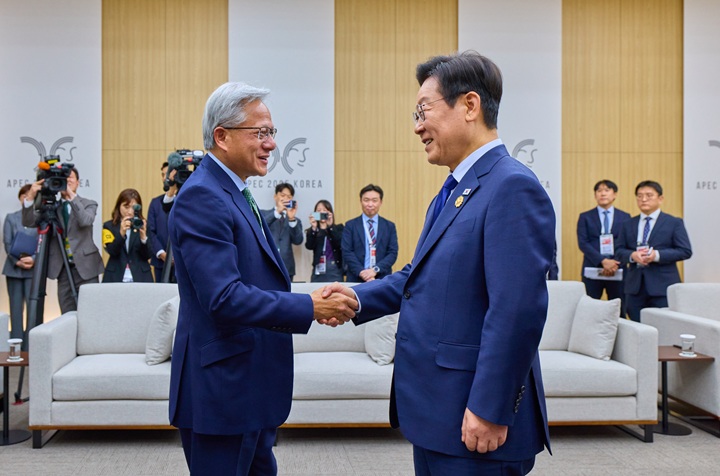
The South Korean President’s summit in San Francisco and subsequent diplomatic tour serve as a powerful signal: Korea is transcending its role as a mere high-bandwidth memory (HBM) supply base to leap forward as a global AI full-stack partner and a central pillar in the next-generation energy (SMR and nuclear fusion) hegemony.
From an investor’s perspective, this analysis breaks down the technological capabilities of K-startups to attract investment and evaluates the feasibility of the multi-diplomatic roadmap connecting the US, South America, and Germany across short-term and mid-term horizons.
1. Beyond HBM: Key K-AI Startup Tech Clusters to Attract Global VC Investment
The core value of Korean AI startups closely watched by Silicon Valley venture capital (VC) and Big Tech lies in “efficient NPU chip design” and “domain-specific AI applications (LLM/SLM).”
💡 Top 3 K-Tech Sectors with High Investment Attractiveness
| Technology Field | Key Technologies & Capabilities | Global VC Value Proposition |
| AI Semiconductors (NPU) (Rebellion, DeepX, FuriosaAI, etc.) | NPU design optimized for inference cost reduction, consuming less than 50% of the power of NVIDIA GPUs. | Evaluated as a practical alternative to resolve power shortages (OPEX) in hyper-scale AI data centers. |
| Lightweight LLM & SLM (Upstage, Wrtn, etc.) | On-device AI and customized Small Language Models (SLMs) for enterprise private AI. | Rapid market entry capability for security-critical sectors such as finance, healthcare, and manufacturing. |
| Physical AI & Robotics (Bear Robotics, Rainbow Robotics, etc.) | Autonomous driving and control infrastructure AI tightly integrated with manufacturing, logistics, and F&B field operations. | Highly reliable Physical AI built on real-world data from Korea’s strong manufacturing base. |
Investment Attractiveness Assessment: Rather than funding companies that merely build massive foundational models, US VCs are allocating capital to “inference chips (NPUs) that break NVIDIA’s cost monopoly” and “industry-specific SLMs that generate actual Annual Recurring Revenue (ARR).” Korean startups possess a compelling differentiator: the ability to rapidly validate proof-of-concept (PoC) high-performance, low-power chips by integrating with Korea’s superior manufacturing and packaging ecosystem.

2. Country-by-Country Cooperation Roadmap & Potential (US, South America, Germany)
In conjunction with government-level policy support commitments, the diplomatic lineup spanning the US, three South American nations (Brazil, Chile, Argentina, etc.), and Germany maps out precisely as: [US = Tech & Capital Alliance], [South America = Resource & Energy Supply Chain], and [Germany = Industrial AI & Manufacturing Fusion].
┌────────────────────────────────────────────────────────────────────────┐│ Building a Global Triangular AI & Energy Belt │├────────────────────────────────────────────────────────────────────────┤│ United States (US) │ South America │ Germany ││ - AI Chips & Big Tech │ - Critical Minerals │ - Physical/Industrial││ - Joint SMR & Fusion │ & Clean Hydrogen │ AI ││ │ Partnerships │ - Manufacturing ││ │ │ Infrastructure │└────────────────────────────────────────────────────────────────────────┘
1) United States: Joint AI Investment & SMR/Fusion Partnership (Short-to-Mid Term)
- AI & Semiconductors: Spearheaded by the San Francisco Declaration, long-term foundry/memory supply contracts with companies like NVIDIA and OpenAI will materialize, alongside the creation of dedicated funds for K-AI startups.
- SMR & Nuclear Fusion: To resolve the energy grid crisis triggered by the explosion of data centers, joint ventures into third-country markets combining Korea’s “SMR main component manufacturing capability” with the US’s “foundational design and licensing expertise (e.g., NuScale, TerraPower)” serve as key agenda items.
2) South American Trio: AI Power Infrastructure & Mineral Security (Mid Term)
- Critical Minerals & Energy: Discussions focus on securing supply chains for lithium and copper—essential materials for AI chips and batteries—while fostering cooperation in clean hydrogen and solar-based data center infrastructure.
- SMR Export Feasibility: This serves as a beachhead to assess the feasibility of deploying Korean-designed Small Modular Reactors (SMART or i-SMR) to strengthen power grids in remote mining regions across South America.
3) Germany: Industrial AI & Nuclear Fusion Cooperation (Mid Term)
- Manufacturing AI Integration: A joint roadmap for smart factories and Physical AI is highly likely, pairing Germany’s manufacturing leadership with South Korea’s IT and semiconductor prowess.
- Nuclear Fusion Energy: Detailed negotiations will advance joint R&D in ultra-high-temperature plasma control (leveraging KSTAR expertise), hydrogen, and fusion technology alongside Germany—a primary axis of European fusion research (ITER, EUROfusion).
3. Comprehensive Investor Outlook: Short-Term vs. Mid-Term Evaluation
- Short-Term Horizon (6–12 Months): The primary momentum will stem from visible Korean AI semiconductor/memory (HBM4) orders from global Big Tech, combined with direct US VC investments into K-AI startups resulting from the San Francisco Summit.
- Mid-Term Horizon (2–5 Years): Tangible performance will be tied to securing supply chain orders for AI data center power via SMRs (US alliance) and securing South American critical minerals. Ultimately, pre-emptively securing commercial fusion technology will determine the valuation re-rating of Korean energy and semiconductor enterprises.