
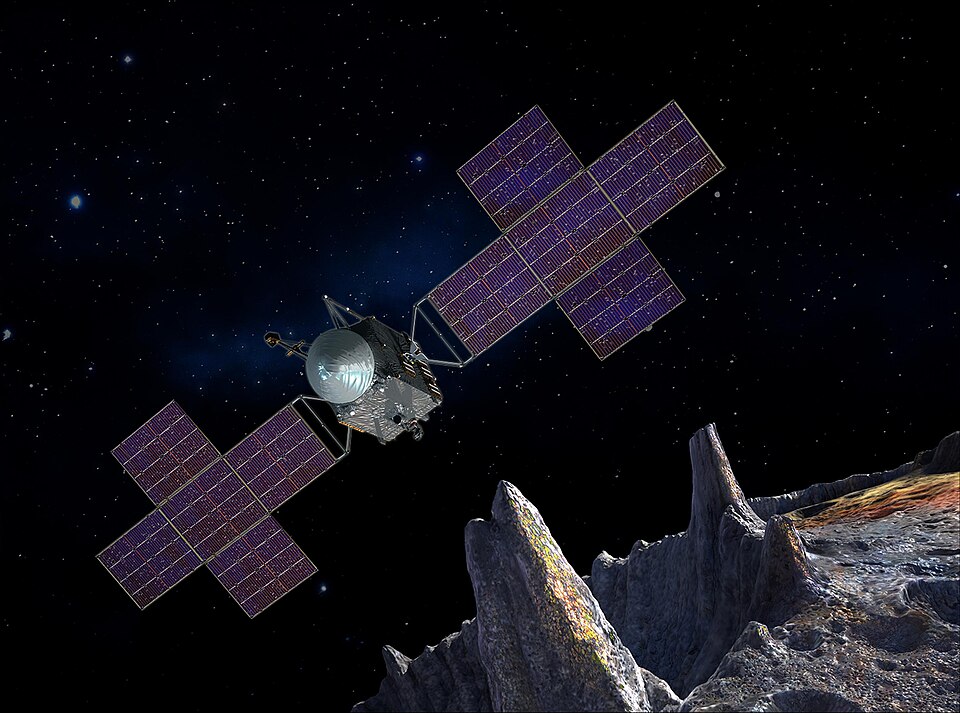
Next-Gen Space Exploration Realism: Moon, Mars, and Asteroid Psyche
The Success of Psyche’s Mars Flyby and Asset Allocation Strategies in the Space Mining Era
The successful Mars flyby and acquisition of high-resolution imagery by NASA’s Psyche spacecraft represent far more than a routine deep-space flight test. This achievement marks a historic turning point, demonstrating that the “Space Mining Era” and “Mars Habitation Projects”—once confined to science fiction—have officially transitioned into realistic commercial business roadmaps.
From developing polar water resources on the Moon and establishing permanent Mars settlements to exploring the metal-rich asteroid 16 Psyche, investors must analyze the feasibility of human space expansion through the lens of planetary sustainability and strategic asset allocation.
1. Feasibility of Next-Generation Space Exploration: The Moon, Mars, and Psyche Roadmap
The technical capabilities demonstrated by the Psyche probe, combined with polar ice data on Mars, provide the solutions to the three greatest hurdles of deep-space expansion. This next-generation space development relies on an interconnected, three-stage roadmap.
The first stage centers on Lunar Polar Resource Development and the Artemis Program. Extracting water ice permanently shadowed near the lunar poles and electrolyzing it into hydrogen and oxygen creates a fundamental off-world refueling infrastructure. By functioning as a deep-space gas station, the Moon drastically reduces the fuel load required to overcome Earth’s gravity well.
The second stage involves Mars Flyby Mechanics and Settlement Infrastructure. Precise water-ice mapping across Martian polar regions dramatically alters the economics of human settlement. In-Situ Resource Utilization (ISRU) technology allows missions to harvest local ice to generate breathable oxygen and rocket propellant on-site, drastically lowering logistical costs from Earth. Furthermore, relying on Martian gravity to achieve a velocity boost of over 1,600 km/h confirms the precision navigation required for the probe’s 2029 rendezvous with asteroid Psyche.
The third stage is Asteroid Resource Extraction at 16 Psyche. Unlike typical icy or rocky asteroids, 16 Psyche is a metallic M-type asteroid rich in iron, nickel, gold, and platinum-group metals. The theoretical economic value of these raw metallic reserves far exceeds the annual gross world product, establishing asteroid mining as the primary focus of long-term space commerce.
2. The Investor Perspective: Environmental Preservation and Nature-Positive ESG
Paradoxically, the strongest commercial justification for asteroid mining stems from terrestrial environmental protection on Earth.
First, Transitioning Extraction Environmental Degradation Off-World. The global transition to clean energy, electric vehicles, and AI data centers requires unprecedented quantities of nickel, lithium, and rare earth metals. Terrestrial mining incurs severe deforestation, water pollution, and ecological devastation. Sourcing raw metals from metallic asteroids shifts the environmental burden away from Earth, fulfilling the ultimate objective of Nature-Positive ESG initiatives.
Second, Mitigating Terrestrial Resource Depletion and Structural Inflation. Sourcing rare elements from orbital supply chains eliminates supply chain bottlenecks and geopolitical monopolies. Securing extraterrestrial metal streams stabilizes raw material costs for advanced global manufacturing and hedges against resource-driven inflation.
3. Three Core Investment Pillars for the Space Economy
As space shifts from scientific exploration into a commercial market, capital allocation should focus on three foundational supply chain sectors.
The first pillar encompasses Deep-Space Launch Vehicles and In-Orbit Infrastructure. Investors should target market leaders developing fully reusable launch vehicles that lower orbital payload costs per kilogram, alongside entities building orbital refueling depots and space stations.
The second pillar focuses on ISRU and Space Mining Robotics. Extreme space environments demand autonomous Physical AI robotics, remote mining systems, and modular refining machinery capable of processing raw materials under microgravity conditions.
The third pillar targets Satellite Communications and Deep-Space Navigation. Establishing seamless data links between Earth, lunar outposts, and deep-space probes requires high-bandwidth optical laser communications and autonomous AI flight navigation systems.