
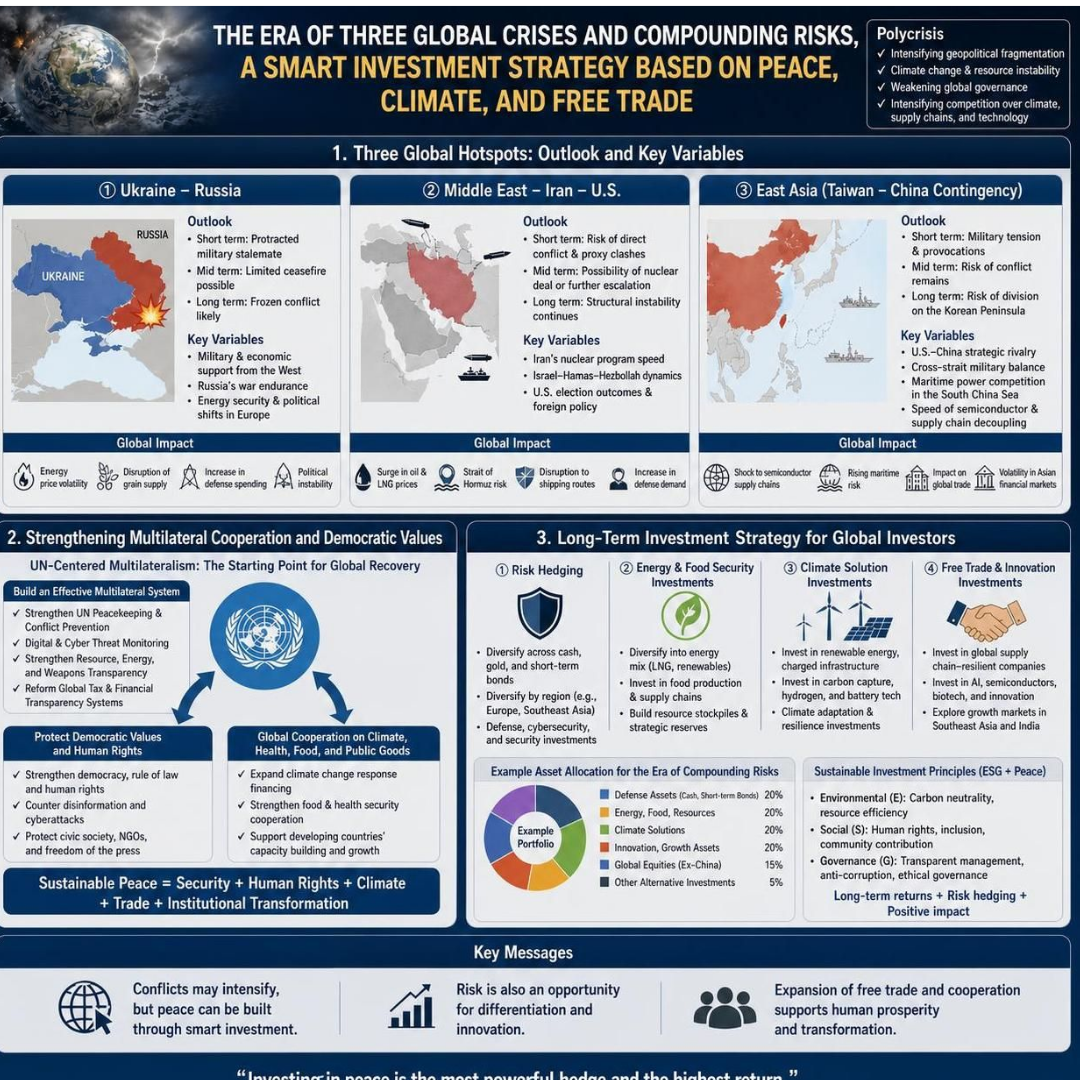
Global Flashpoint Escalation Risks and Climate Crisis: Geopolitics and Asset Allocation Strategies in the Age of Polycrisis
The world is currently confronting an unprecedented “Polycrisis”—a confluence of escalating military tensions across the ‘Three Major Global Flashpoints’ (Ukraine-Russia, Middle East-Iran-US, and East Asia/Taiwan-South China Sea), food and energy inflation driven by extreme climate anomalies, and the aggressive expansion of national self-interest and hegemony.
At a critical juncture where establishing an effective multilateral sanctions framework through international bodies like the UN and restoring democratic values are paramount, this article provides an in-depth analysis of potential scenarios in the three major conflict zones. Furthermore, it outlines strategic asset allocation models designed to safeguard wealth while promoting climate resilience and free-trade sustainability.
1. In-Depth Analysis of Escalation Potential Across Global Flashpoints
Geopolitical conflicts no longer exist in isolation; they trigger complex chain reactions that severely disrupt global supply chains, exacerbate climate vulnerabilities, and impact global financial markets.
[Interaction Structure of the Polycrisis]Three Geopolitical Flashpoints (Conflicts & Hybrid Warfare) │ ├── Supply Chain Paralysis & Increased Defense Spending (Distortion of Resource Allocation) ▼Climate Crisis (Droughts/Heatwaves) ──➔ Food/Energy Inflation ──➔ Downward Economic Pressure & Social Unrest
① Ukraine – Russia Axis: Hybrid Warfare and NATO Eastern Flank Threats
- Risk Factors: To overcome battlefield stalemates, Russia is intensifying sophisticated “Hybrid Warfare” tactics—including cyberattacks, GPS jamming, and the deployment of non-attributable armed groups—specifically designed to bypass NATO’s Article 5 collective defense threshold.
- Cascading Effects: Limited provocations along NATO’s eastern border (e.g., Poland, the Baltic states) force nations across Europe to drastically elevate defense spending. This creates a severe distortion in resource allocation, diverting critical capital away from urgent climate change mitigation and social infrastructure investments.
② Middle East – Iran – US Axis: Maritime Chokepoints and Energy Security
- Risk Factors: Intensifying clashes involving Iran and its proxy networks (Houthi rebels, Hezbollah, etc.) directly threaten to blockade key global maritime chokepoints, most notably the Strait of Hormuz and the Red Sea.
- Cascading Effects: Spikes in crude oil and LNG prices extend beyond energy costs, organically driving up fertilizer production costs and fueling global agricultural inflation (Agflation). This severely erodes real purchasing power for households in both developing and developed economies.
③ East Asia Axis (China – Philippines – Japan – US): Supply Chain Decoupling
- Risk Factors: Territorial disputes in the South China Sea and heightened military friction across the Taiwan Strait represent more than localized conflicts; they threaten to paralyze global semiconductor supply chains and vital maritime trade routes.
- Cascading Effects: Strategic rivalry between the US and China is bifurcating renewable energy supply chains (solar panels, rare earths, battery raw materials). This fragmentation undermines international cooperation on climate action and slows global technological trade.
2. Strategic Investment Frameworks for the Polycrisis Era
Amid spreading hegemony and climate-driven disasters, investors must move beyond passive risk aversion to focus on assets that demonstrate robust “Sustainability” and “Supply Chain Resilience.”
[Four Investment Pillars for the Polycrisis Era]1. Security & Resilience (Defense, Cybersecurity)2. Climate Adaptation & Water (Green Infrastructure)3. Food Security (AgTech, Smart Irrigation)4. Inflation Defense (Commodities, Real Assets)
① Climate Adaptation and Food Security: AgTech & Water Resources
- Core Themes: To counter Agflation caused by prolonged droughts and heatwaves, capital should be directed toward climate-resilient seed technology, smart irrigation systems, and hydroponic farming enterprises.
- Strategic Value: Technologies that guarantee agricultural productivity despite shifting climate patterns are emerging as essential national security assets.
② Energy Transition and Climate Resilience
- Core Themes: To hedge against fossil fuel supply chain vulnerabilities stemming from geopolitical strife, portfolios should incorporate renewable power (solar, wind, geothermal), grid-scale Energy Storage Systems (ESS), and smart grid infrastructure developers.
- Strategic Value: Reducing structural reliance on fossil fuels simultaneously lowers geopolitical risk exposure and accelerates progress toward global decarbonization targets.
③ Cybersecurity and Hybrid Warfare Defense
- Core Themes: Investments should target cloud security providers and AI-driven real-time threat detection platforms that protect critical national infrastructure (power grids, financial networks, water systems) from state-sponsored cyber threats.
- Strategic Value: Defenses against hybrid warfare tactics operating below the threshold of kinetic conflict represent an essential risk-management priority for both corporations and sovereign entities.
④ Inflation Hedges and Multilateral Trade Beneficiaries
- Core Themes: Allocate capital to critical green commodities (copper, lithium, nickel) and infrastructure funds operating in regions benefiting from supply chain re-configuration (Nearshoring/Friendshoring destinations such as Southeast Asia and Mexico).
- Strategic Value: This strategy hedges against persistent inflationary pressures while capturing growth dividends from emerging manufacturing hubs within an increasingly block-oriented global trade landscape.