
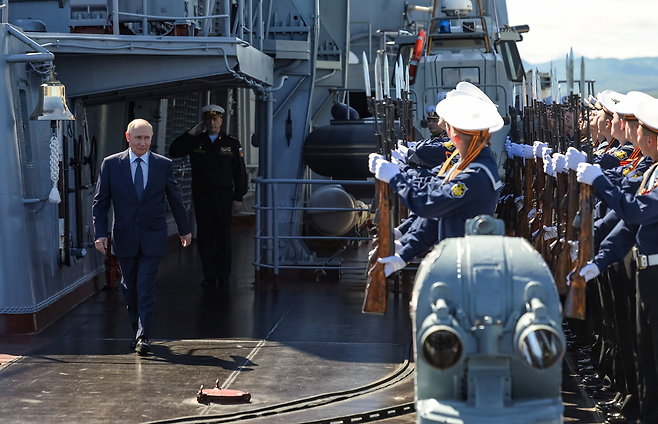
Putin’s Visit to the Kuril Islands and East Asian Geopolitics: Deep Analysis of the ‘Fourth Flashpoint’ and Economic Impacts
Amid the lingering war of attrition along the Ukrainian front and accumulating damage to rear energy infrastructure, Russian President Vladimir Putin’s surprise visit to Iturup Island in the Kuril Islands (known in Japan as the Northern Territories) represents a calculated political and military strategic manifestation designed to maximize geopolitical fractures across Northeast Asia.
This report provides a precise, multi-dimensional analysis of Russia’s external retaliatory response to Ukraine’s massive drone offensives, its internal political consolidation, the risk of establishing a “Fourth Flashpoint in East Asia” through territorial disputes with Japan, and the future outlook for East Asian economic cooperation and Northern Sea Route (NSR) logistics.
1. Retaliatory Pressure Against Japan’s Sanctions and Support for Ukraine
Even as continuous Ukrainian drone attacks inflict tangible damage on key national infrastructure—such as inland oil refineries and grain export terminals—Russia is actively projecting strong domestic control over its Far East frontier to the world via high-definition media coverage.
[Japan's Takaichi Cabinet Sanctions Russia & Supports Ukraine] │ ▼ (Geopolitical Retaliatory Pressure)[Solidification of Non-Compromise Territorial Policy & Far East Militarization]
- Internal Consolidation and “Conqueror Leadership” Projection: This initiative aims to quell domestic social and economic anxieties stemming from the prolonged war while asserting Russia’s historical “conqueror legacy.” Simultaneously, it sends an uncompromising message home and abroad: “Russia will not cede even a single centimeter of its territory.”
- Hardline Warning and Security Pressure on Japan: Russia is visibly accelerating the militarization of the Kuril Islands (Southern Kurils / Northern Territories), specifically targeting the Japanese government (Sanae Takaichi Cabinet), which has been strengthening economic/material support for Ukraine and expanding anti-Russian sanctions. By demonstrating overwhelming military dominance over disputed territories, Moscow seeks to constrain Tokyo’s diplomatic and security maneuverability while delivering a stern warning against the Western alliance in East Asia.
2. Emergence of the “Fourth Flashpoint” in East Asia & Regional Economic Impacts
Alongside existing global conflict arenas—the Ukraine-Russia front, the Middle East-Iran conflict, and the Taiwan Strait-South China Sea tensions—the “Kuril Islands and Sea of Japan / Pacific Front” is rapidly emerging as a geopolitical Fourth Flashpoint.
🌐 Global 4 Major Geopolitical Flashpoints Comparison
| Category | Primary Region | Core Geopolitical Drivers | Economic & Logistics Impact |
| 1. Eastern European Front | Ukraine – Russia | Territorial Dispute & NATO Confrontation | Grain & Raw Materials Supply Chain Disruption |
| 2. Middle East Maritime Front | Iran – Red Sea & Strait of Hormuz | Maritime Blockade & Regional Proxy Conflict | Crude Oil Transport Disruption & Freight Rate Surges |
| 3. Southeast Asian Hegemony | Taiwan Strait – South China Sea | US–China Tech Competition & Territorial Sovereignty | Semiconductor Supply Chain & Shipping Lane Threats |
| 4. Newly Escalating Zone | Kuril Islands – Sea of Japan / Sea of Okhotsk | Russia–North Korea–China Alignment vs. US–ROK–Japan Cooperation | East Asian Resources, Fisheries, & Logistics Paralysis |
① Risks of Forming a Fourth Flashpoint
- Accelerated Militarization: Parallel to the force expansion of the Russian Pacific Fleet, the deployment of state-of-the-art coastal defense missile systems (such as the Bastion-P) and advanced air defense networks across the Kuril Islands is being heavily reinforced.
- Russia–North Korea–China Security Bloc Formation: In response to tightened US–ROK–Japan security cooperation, Russia is expanding and annualizing joint naval and air exercises with North Korea and China in the Sea of Japan and the Sea of Okhotsk, driving military tensions in Northeast Asia to peak levels.
② Impact on East Asian Economic Cooperation
- Long-Term Freeze on Economic Cooperation: Energy cooperation initiatives between Russia and South Korea, China, and Japan—such as the Sakhalin energy development projects—have been frozen, severely impeding efforts to diversify Asian energy supply chains.
- Fisheries and Maritime Freight Disruptions: Heightened conflicts over fishing rights in the rich waters around the Kuril Islands, combined with a sharp rise in the “geopolitical risk premium” for shipping lanes entering the Pacific and Sea of Japan, make regional fishery losses and surging maritime logistics costs unavoidable.
3. Diagnostic Assessment of the Frozen Northern Sea Route (NSR)
The Northern Sea Route (NSR), heavily promoted by Russia as an alternative to the Suez Canal and a core future maritime hub, faces an unpredictable future with near-term commercial recovery rendered virtually impossible due to deteriorating relations with the West and structural sanctions.
[Western Tech & Ice-Class Vessel Supply Blocked] ──┐ ├─► [NSR Commercial Viability Collapses & Shifts to Exclusive Russia–China Route][Major ROK & Japan Shipping Lines Avoid NSR] ──────┘
Key Bottlenecks & Restrictive Factors
- Blockade of Western Technology and Specialized Vessels: Western sanctions on ice-class/icebreaker ship technologies and shipbuilding equipment transfers continue to choke fleet expansion, leaving route maintenance and logistics scaling severely bottlenecked.
- Avoidance by Major East Asian Shipping Fleets: Major shipping lines in South Korea and Japan, which strictly adhere to Western sanctions regimes, are completely bypassing the Northern Sea Route. As a result, the NSR has lost its value as a global commercial shipping corridor, risking degradation into an exclusive resource transport channel for China.
4. Conclusion and Comprehensive Outlook
As long as Russia continues its policy of projecting military dominance and taking an uncompromising stance on territorial sovereignty in the Far East, the likelihood of the Northern Sea Route functioning or normalizing as a pillar of global commercial shipping remains extremely low.
Ultimately, isolated from Western and major East Asian shipping operators, the Northern Sea Route is projected to degenerate into a closed energy and resource corridor exclusive to China and Russia. Furthermore, the emerging New Cold War framework surrounding the Kuril Islands will act as a prolonged, unpredictable geopolitical risk factor impacting the broader economies of South Korea, China, Japan, and East Asia as a whole.