
Lowering the Age of Criminal Responsibility in Sweden vs. Global Youth Crime Prevention Models: Benchmarks for Tax Optimization and Social Stability
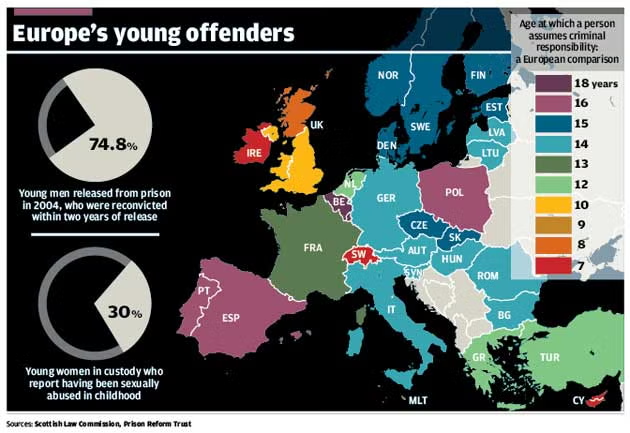
The Swedish Parliament has passed legislation lowering the age of criminal responsibility from 15 to 14 and expanding maximum sentences for juvenile offenders up to 18 years. This measure comes in response to a distorted structural problem where drug cartels recruit teenagers into violent crime, alongside severe prison capacity constraints (such as renting prison space in Estonia).
However, relying solely on penal populism (Punitivism) carries the risk of unintended consequences, where criminal syndicates exploit even younger children. In response, this analysis examines best practices across regions (Europe, East Asia, the Americas) for lowering crime rates and optimizing correctional/detention tax expenditures, presenting a standardized legislative model for global adoption.
1. Regional Benchmarks for Youth Crime Prevention and Fiscal Savings
[The Four Pillars of Global Youth Crime Prevention]
To overcome the physical capacity limits and severe fiscal burdens of punitive detention (Punitivism), these proven regional models focus on early intervention, restorative justice, community integration, and evidence-based treatment.
| Region | Model Name (Country) | Core Mechanism | Tax Savings & Social Impact |
| Europe | SSP Model (Denmark/Norway) | School – Social Services – Police tripartite collaboration framework. • Early identification and management of at-risk youth. | • Early intervention prior to formal judicial proceedings. • Drastically reduces correctional budgets by eliminating high incarceration costs ($10k–$100k+ per youth annually). |
| Oceania / Anglosphere | Family Group Conference (FGC) (New Zealand) | Restorative Justice & Judicial Diversion implementation. • Mandatory pre-trial conference involving victims, offenders, families, and community members. | • Significantly lowers court and detention costs. • Maximizes cost-effectiveness by reducing recidivism rates by 30% to 50%+. |
| East Asia | Community-Based Diversion (Japan/South Korea) | Community integration & Protective Disposition framework. • In-depth diagnosis by Family Court investigators; public-private partnerships (e.g., volunteer probation officers). • Priority on outpatient guidance and community service over detention. | • Maintains detention rates at minimal levels. • Minimizes capital expenditure for building and maintaining new juvenile correctional facilities. |
| North America | Multisystemic Therapy (MST) (USA/Canada) | Evidence-Based Treatment & Reintegration support. • Scientific psychological and behavioral treatment encompassing the youth, family, school, and peer group. | • MST investment (~$4,500 per youth) vs. probation/detention costs ($23,000+ annually). • Proves more than 5x tax savings effect. |
Key Breakdown by Region
① Europe (Denmark) – SSP (Skole, Sociale myndigheder, Politi) Tripartite Model
- Core Mechanism: Schools, Social Services, and Police form a tripartite committee to identify and manage at-risk youth at the earliest stages.
- Tax Savings & Impact: By intervening before youth enter the formal criminal justice system (prison or juvenile detention), it blocks incarceration costs at the source, saving massive amounts in national correctional budgets.
② Oceania / Anglosphere (New Zealand) – Family Group Conference (FGC) & Restorative Justice
- Core Mechanism: Under the Oranga Tamariki Act (Children and Young Persons and Their Families Act 1989), FGCs are mandatory prior to court trials for most juvenile offenders, excluding severe violent crimes, bringing together victims, offenders, families, and community members.
- Tax Savings & Impact: Dramatically reduces trial and institutional detention expenses while cutting recidivism rates by 30% to 50%+, maximizing cost-effectiveness compared to mere custodial operation.
③ East Asia (Japan) – Community-Based Diversion & Guidance Framework
- Core Mechanism: Based on precise evaluations by Family Court probation officers and public-private cooperation (such as volunteer probation officers / Hogo-shi), non-custodial outpatient supervision and community service are prioritized over institutionalization.
- Tax Savings & Impact: Keeps detention ratios at ultra-low levels while maintaining East Asia’s characteristically low crime rates, minimizing the costs required to build and maintain youth correctional facilities.
④ Americas (USA) – Multisystemic Therapy (MST) & Evidence-Based Programs
- Core Mechanism: A scientifically validated psychological and behavioral treatment program tailored to treat not just the delinquent individual, but their entire environment—family, school, and peer group.
- Tax Savings & Impact: US studies demonstrate that the input cost for MST (~$4,500 per youth) delivers approximately 5 times the tax savings compared to traditional probation and incarceration costs (over $23,000 annually).
2. International Benchmark Model Legislation: “Youth Restorative Justice and Early Intervention Promotion Act”
Expanding detention centers and lowering the age of punishment alone cannot stop organized crime from recruiting youth. To reduce prison rental expenses, cut large-scale detention costs, and build a stable social framework, we propose key provisions for an International Benchmark Model Law.
[Draft] Model Law on Youth Restorative Justice and Early Intervention
Article 1 (Purpose)
The purpose of this Act is to reduce judicial costs and strengthen the social safety net through youth crime prevention, preferential application of restorative justice proceedings, and support for community reintegration.
Article 2 (Early Warning & Tripartite Collaboration System)
① Local governments shall establish a “Youth Crime Prevention Tripartite Body (SSP)” comprising local education authorities, police departments, and social welfare agencies.
② Upon identifying at-risk youth, assignment to welfare and customized mentoring programs prior to criminal prosecution shall be mandatory.
Article 3 (Restorative Diversion Proceedings)
① Cases involving juvenile offenders, excluding major heinous crimes, must undergo a “Family Group Conference (FGC)” prior to formal indictment.
② If the juvenile offender and their legal guardians fulfill agreements regarding victim restitution and community service, protective disposition and conditional prosecution diversion shall be granted.
Article 4 (Prevention of Organized Crime Exploitation & Enhanced Penalties)
① Adult members of organized crime syndicates who instruct or recruit minors into criminal activity shall be subject to enhanced sentencing at a minimum of double the existing statutory penalty.
② Protective probation and GPS-tracked protective monitoring shall be provided to youth exposed to threats or coercion.
Article 5 (Fiscal Efficiency & Budget Reallocation)
① A minimum of 30% of the correctional budget designated for facility expansion shall be permanently allocated to community-based non-custodial therapeutic and educational programs (such as MST).
3. Quantitative Comparison: Tax Savings and Social Benefits
| Category | Traditional Punitive Model (Swedish-style Punitivism) | Restorative & Early Intervention Model (Benchmark) |
| Detention & Facility Costs | • High costs for constructing new detention centers or leasing foreign facilities. • Skyrocketing prison guard payroll and inmate management expenditures. | • 40%–60% reduction in juvenile detention and prison populations. • Direct state budget savings via reduced facility maintenance. |
| Recidivism Rate | • Recidivism reaches 50%–70% due to criminal networking/learning inside prisons. | • Recidivism drops to 15%–20% under restorative justice frameworks. |
| Social Costs | • Creates lifelong social costs as juvenile offenders transition into adult career criminals. | • Preserves future productive working-age populations through early societal reintegration. |
💡 Summary & Policy Implications
- Breakthrough Reduction in Detention Costs: Shifting from custodial detention to non-judicial (welfare, therapeutic, community) intervention cuts off the need for prison expansion, facility leasing, and escalating inmate maintenance costs at the root.
- Lower Recidivism Rates: Implementing Restorative Justice (FGC) and Multisystemic Therapy (MST) yields up to a 50%+ reduction in recidivism compared to simple incarceration, preventing substantial long-term economic and social losses.