
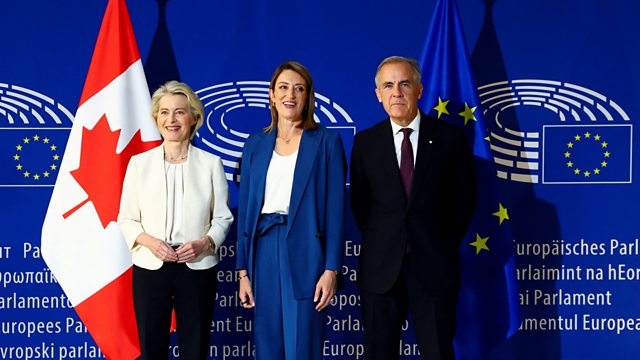
Canada Accepts EU ‘Associate Membership’ to Counter US Tariff Pressure
Canada’s decision to accept the European Union’s offer of its first Associate Membership—standing firm against severe US tariff pressure and threats of trade retaliation—goes far beyond a routine shift in foreign diplomatic strategy. It marks a historic turning point: the practical unwinding of the United States-Mexico-Canada Agreement (USMCA) framework that has anchored North America for decades, and the birth of a new transatlantic geopolitical and economic alliance.
1. Background Analysis: Why the ‘Transatlantic Third Way’ Now?
For decades, Canada operated under an extreme economic single-market dependency, relying on the United States for over 70% of its total exports. However, the aggressive protectionism of the Trump administration and its pressure tactics—including punitive retaliatory tariffs ranging from 20% to 25%—directly threatened the foundation of Canada’s economy.
In response, Canada sought a “Third Way” to drastically reduce its reliance on the US market. This strategy aligned perfectly with the interests of the EU, which has faced severe supply chain vulnerabilities following its departure from Russian energy and China’s tightened export controls on rare earths and critical minerals. Through this landmark agreement, Canada secures control over its resource supply chain, while the EU gains a massive, stable hinterland for energy and raw materials.
2. Impact on the EU and Canada: Securing Resources and Market Diversification
Canada’s entry into EU Associate Membership serves as a powerful geopolitical hedging tool for both economies:
- Maximizing EU Energy and Critical Minerals Security: As Canada integrates into the EU’s economic sphere, Europe secures a stable, zero-tariff or preferential-tariff supply of Canadian Liquefied Natural Gas (LNG), uranium, and essential EV battery materials like lithium, nickel, and cobalt. This serves as a primary catalyst for the European Green Deal and energy independence initiatives.
- Reducing Canadian Dependency on the US and Gaining Diplomatic Autonomy: Canada effectively mitigates the single-country risk inherent in the North American market by diversifying into Europe. Despite increased transatlantic maritime freight costs, bypassing high US retaliatory tariffs renders European market expansion economically sound. Furthermore, Canada solidifies its diplomatic standing as a leading Middle Power that refuses to capitulate to unilateral superpower pressures.
3. Tangible Economic Blows to the US and the Trump Administration
Although US media outlets and policymakers have dismissed this agreement as mere “ineffective political rhetoric,” the actual physical economic and supply chain disruptions will be severe and concrete.
[Impact Structure of Canada-EU Realignment on the US Economy]
| Category | Primary Transmission Channel | Concrete Impact on the US Economy & Industry |
|---|---|---|
| Real Economy Impact | Raw Material & Component Cost Hikes | • Diversion of Canadian crude oil, critical minerals, and aluminum exports directly to Europe • Sharply rising input costs for US manufacturing (Automotive, Construction, Aerospace, Energy Refining) |
| Macroeconomic Impact | Backfire of Retaliatory Tariffs | • Resurgence of inflation driven by surging import prices • Severe constraints on the Federal Reserve’s rate-cutting trajectory, prolonging high interest rates |
| Geopolitical Impact | Fractures in North American Supply Chains | • Near-complete degradation and practical dissolution of the USMCA framework • Triggers collective backlash from global Middle Powers and accelerates multi-polar alliance realignments |
US manufacturers have long relied on inexpensive, stable supplies of Canadian raw materials and intermediate goods to maintain global competitiveness. As Canadian commodities divert to Europe, input cost inflation in the US will be inevitable. Should the Trump administration respond with additional retaliatory tariffs, the financial burden will fall directly on US consumers and businesses, further complicating monetary policy for the Federal Reserve.
4. Key Takeaways for Subscribers and Professional Investors
① Structural Tailwinds for Transatlantic Shipping, Logistics, and LNG Infrastructure
- Market Dynamics: The primary trade axis is rapidly shifting from Pacific and North American overland routes toward transatlantic maritime corridors connecting Eastern Canada to Europe.
- Investment Strategy: Overweight exposure toward LNG infrastructure operators on Canada’s East Coast, global shipping and logistics firms serving transatlantic routes, and shipbuilders holding high-value LNG carrier and eco-vessel technologies.
② Critical Minerals Supply Chain Realignment and Green Value Chains
- Market Dynamics: Critical battery minerals extracted in Canada will flow directly to European EV automakers and energy processing firms, completely bypassing the US market.
- Investment Strategy: Asset values for Canadian junior mining companies and processing firms integrated directly into EU green value chains are set for significant upward revaluations. Conversely, adopt a cautious stance toward traditional North American battery material suppliers that rely solely on US Inflation Reduction Act (IRA) subsidies.
③ Heightened Volatility in Foreign Exchange and Sovereign Yields (CAD, EUR, USD)
- Market Dynamics: US tariff threats coupled with Canadian market diversification will cause short-term volatility spikes in the Canadian Dollar (CAD) and Euro (EUR).
- Investment Strategy: Strengthen FX hedging strategies against a prolonged strong US Dollar (USD). Given the supply chain friction across North America, expect heightened volatility in US trade-sensitive equities and manufacturing stocks. Portfolio managers should rebalance away from short-term momentum plays into core infrastructure and commodity assets that directly benefit from the new Transatlantic Economic Block.