
“Political and Economic Perspectives: A Calculated Strategic Alignment”
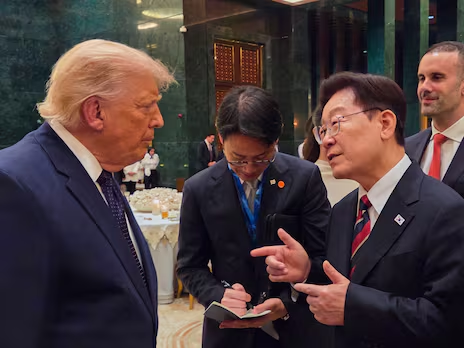
The 30-minute South Korea–U.S. summit, held on the sidelines of the UN General Assembly in New York, was a pivotal diplomatic event that comprehensively addressed core security and economic issues between the two nations. Key agenda items—strategic investment, the transfer of Operational Control (OPCON), fuel reprocessing for nuclear-powered submarines, and naval shipbuilding cooperation—represent complex, interconnected political and economic interests.
1. Economic Perspective: Synergies in Strategic Investment and Shipbuilding Cooperation
- Trade-off Between Strategic Investment and Shipbuilding Cooperation: The Trump administration prioritizes reviving domestic manufacturing and creating jobs. Expanding South Korea’s strategic investments in the United States serves as a critical bargaining chip that delivers a substantial political win for President Trump.
- Conversely, for South Korea, this presents an unparalleled opportunity to leverage America’s urgent need for warship construction, maintenance, repair, and overhaul (MRO) to expand the global dominance of “K-Shipbuilding.” The economic calculations of both nations aligned seamlessly.
- Pragmatic Diplomacy: The dynamic, unscheduled nature of the summit underscores a strong mutual intent to lock in economic benefits early. The omission of the Strait of Hormuz freedom-of-navigation issue further highlights that the meeting focused strictly on economic cooperation and trust-building.
2. Political & Security Perspective: OPCON Transfer and Nuclear Submarine Fuel Reprocessing
- First Leader-Level Discussion on OPCON Transfer: According to the Presidential Office, this marked the first official mention of the OPCON transfer at the head-of-state level. It holds immense symbolic value by drawing the U.S. president’s political attention to South Korea’s long-standing security objective. However, as the alignment remains a high-level agreement focused on “deepening cooperation” rather than establishing a specific timeline, detailed adjustments will be required in upcoming working-level negotiations.
- Nuclear Submarine Fuel Enrichment and Reprocessing: Amid North Korea’s persistent nuclear and missile threats and shifting maritime security dynamics, discussing nuclear submarine capabilities is a highly sensitive yet vital defense topic that could dramatically expand the Republic of Korea Navy’s operational range and defense capabilities.
- Personal Rapport Between Leaders: The reference to golf at both the beginning and end of the summit suggests—given President Trump’s preference for top-down diplomacy—that personal intimacy and trust between the two leaders can serve as constructive leverage for navigating complex security issues moving forward.
Summary and Implications
This summit can be evaluated as a balanced diplomatic achievement that utilized South Korea’s investment commitments as strategic leverage to secure concessions from the U.S., including discussions on OPCON transfer and cooperation in nuclear submarines and naval shipbuilding. To guarantee concrete implementation commitments from the Trump administration and maximize national interests, a thorough follow-up negotiation strategy is indispensable.
If South Korea successfully secures substantial authority for nuclear submarine fuel enrichment and reprocessing through negotiations with the United States, it will mark a major inflection point capable of altering the strategic landscape and diplomatic dynamics across Northeast Asia.
The following analysis examines the diplomatic ramifications and geopolitical dynamics across four key regional axes: North Korea, China, Japan, and the United States.
3. North Korea: Enhanced Asymmetric Deterrence vs. Fierce Backlash
- Increased Strategic Deterrence: Thanks to their stealth and mobility, nuclear-powered submarines are the most powerful asymmetric deterrent against North Korea’s Submarine-Launched Ballistic Missile (SLBM) threats, capable of 24/7 underwater tracking and surveillance. Operating indigenous nuclear submarines would exert immense psychological and military pressure on Pyongyang.
- Fierce Opposition and Strategic Justification: North Korea is highly likely to frame this move as a “violation of the Joint Declaration on the Denuclearization of the Korean Peninsula” and a “step toward South Korean nuclear armament,” intensifying verbal attacks and using it as a pretext for military provocations, such as missile tests.
4. China: Strong Vigilance Against Naval Containment
- Clash with Indo-Pacific Strategy: Beijing will view South Korea’s acquisition of nuclear-powered submarines as a move to reinforce the U.S. maritime containment network against China (interlocking with frameworks like AUKUS) within the broader U.S.–China strategic rivalry.
- In particular, having South Korean nuclear submarines maintain constant readiness against the PLA Navy’s submarine fleet operating in the West Sea and East China Sea imposes a significant security burden on China.
- Potential for Economic and Diplomatic Pressure: China may voice deep concerns through official and unofficial channels regarding sensitive ROK–U.S. security cooperation and consider wielding economic retaliation or diplomatic pressure, reminiscent of its response to the THAAD deployment.
5. Japan: Complex Calculations and “Security Domino” Concerns
- Three Non-Nuclear Principles and Equity Issues: Although Japan officially adheres to its “Three Non-Nuclear Principles” (not possessing, producing, or permitting the introduction of nuclear weapons), the Japan Maritime Self-Defense Force possesses world-class diesel-electric submarine technology and extensive expertise in plutonium and uranium processing.
- Should South Korea gain reprocessing rights for nuclear submarine fuel, conservative voices within Japan calling for “equally modernized naval power and nuclear fuel sovereignty” will likely intensify, potentially triggering an arms race in Northeast Asia.
- Subtle Tension Within Trilateral Security Cooperation: While South Korea, the U.S., and Japan remain aligned within a trilateral security framework to counter threats from North Korea, China, and Russia, the move could ignite underlying strategic rivalry over maritime security and sea control between Seoul and Tokyo.
6. The United States: Balancing the NPT Regime and Alliance Management
- Strict Controls and Demands for Transparency: Even if Washington approves nuclear submarine fuel supplies for South Korea, it will demand rigorous U.S.-led enrichment and reprocessing control mechanisms—exceeding standard IAEA inspections, such as restricting fuel to Low-Enriched Uranium (LEU) under 20%—to prevent any diversion toward nuclear weapons development.
- Maximizing Alliance Assets to Contain China: From the U.S. perspective, South Korea acquiring nuclear submarines can be seen as an ally stepping up defense burden-sharing and extending strategic assets capable of deterring the Chinese navy across the Indo-Pacific region.
💡 Key Takeaways
Securing authority over nuclear submarine fuel reprocessing represents a monumental leap for South Korea’s maritime defense capabilities. However, it simultaneously presents complex diplomatic hurdles, requiring Seoul to navigate fierce opposition from China, heightened threats from North Korea, and delicate security calculations with Japan.