
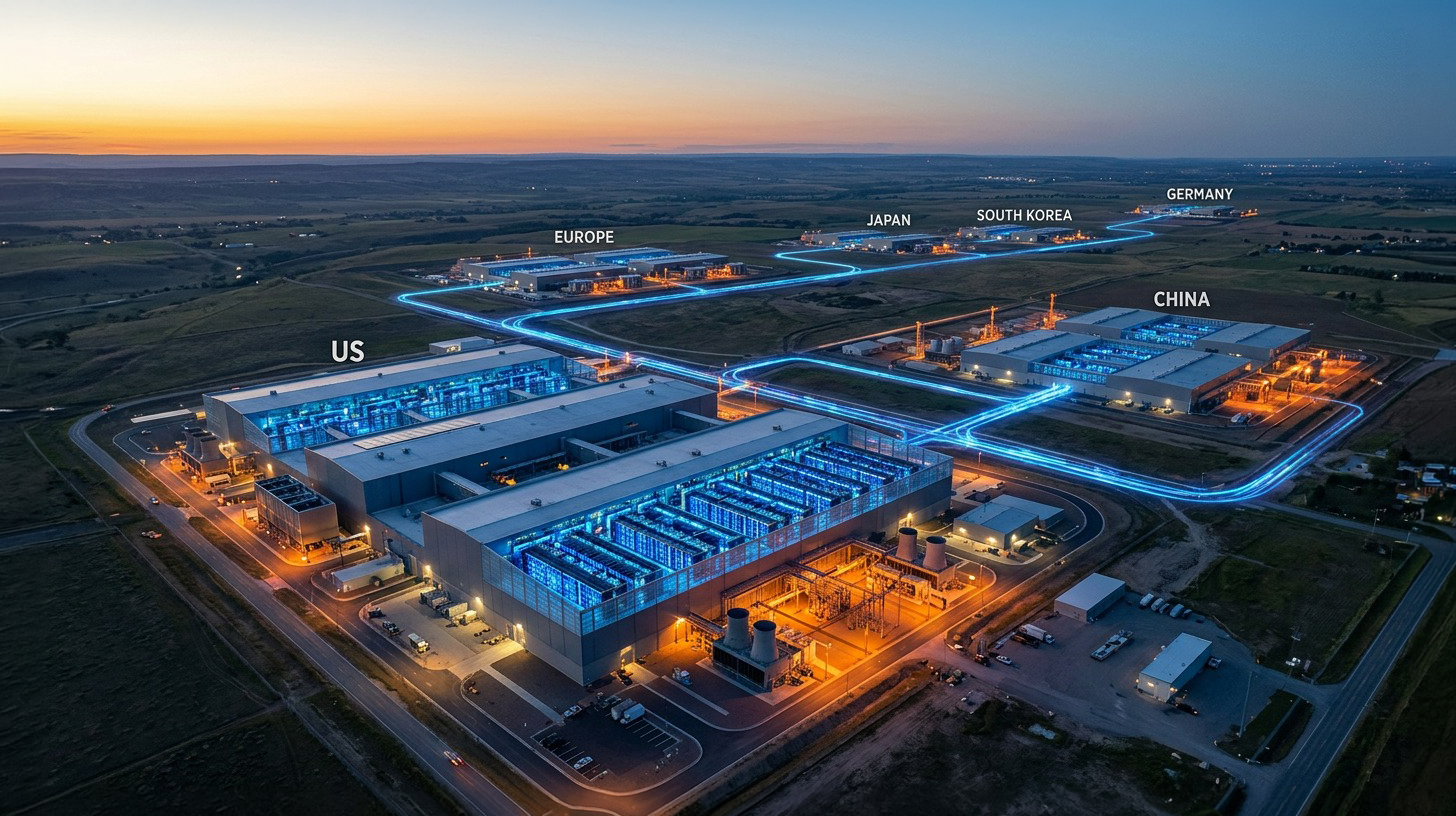
The South Korean government’s nation-wide “3 Mega Projects” (Semiconductors, Physical AI, and AI Data Centers) represent far more than a simple industrial development policy—it is an all-out national strategy for survival in the global war for tech supremacy.
With the establishment of the Office of the Senior Presidential Secretary for Strategic Investment in the Presidential Office, the initiative has transitioned into a joint public-private inspection system. This report provides a comprehensive analysis of the national and industrial significance, core roadmaps, and key actionable insights for both general readers and professional investors.
1. Background: Why the “3 Mega Projects”?
The global industrial paradigm is shifting rapidly from software-centric AI to “Physical AI”—which integrates AI into physical industries such as manufacturing, robotics, and mobility—backed by hyper-scale AI infrastructure.
                 [The Triad of the 3 Mega Projects]
   ┌─────────────────────────────────────────────────────────┐
   │                 AI Data Centers (Infrastructure)        │
   │  • Supplying power & computing power, building regional │
   │    decentralized hubs                                   │
   └──────────────────────────┬──────────────────────────────┘
                              │
               ┌──────────────┴──────────────┐
               ▼                             ▼
┌───────────────────────┐             ┌───────────────────────┐
│ Semiconductors        │  ─────────► │ Physical AI           │
│ (Super-Gap Components)│             │ (End Products)        │
│ • HBM, NPU, Next-Gen  │             │ • Autonomous          │
│   Memory              │             │   Manufacturing,      │
└───────────────────────┘             │   Advanced Robotics   │
                                      └───────────────────────┘
- Semiconductors (Hardware Brains): Maintaining a global “super-gap” lead in next-generation semiconductors essential for AI computing, including HBM (High Bandwidth Memory), NPU (Neural Processing Unit), and PIM (Processing-in-Memory).
- Physical AI (End Application Products): A next-generation growth engine that embeds AI into physical industrial sites where South Korea holds world-class competitiveness, such as manufacturing, robotics, automotive, and shipbuilding, to maximize industrial productivity.
- AI Data Centers (Core Infrastructure): Supplying the massive computing power and electricity required to run semiconductors and Physical AI, while expanding regional hub clusters to relieve power overload in the Seoul metropolitan area and foster balanced regional development.
2. Status & Core Roadmaps for the 3 Key Sectors
① Semiconductors: Completing the Mega Cluster & Securing Next-Gen Memory Dominance
- Core Task: Accelerate the construction of the world’s largest Semiconductor Mega Cluster in Yongin and Pyeongtaek, and secure early commercialization of next-generation memory for hyper-scale AI (HBM4/5, CXL, PIM).
- Roles of Enterprises & Local Governments:
- Samsung Electronics & SK Hynix: Timely construction of advanced foundry and memory production lines, executing capital expenditure (CAPEX) plans.
- Local Governments (Gyeonggi Province, etc.): Provide fast-track administrative approvals and ensure uninterrupted supply of critical infrastructure such as electricity and water.
② Physical AI: Restructuring South Korea as a Manufacturing Powerhouse
- Core Task: Go beyond text-based Large Language Models (LLMs) to build an “Actionable AI” platform and an Autonomous Manufacturing ecosystem that directly controls robots, vehicles, and factory equipment.
- Roles of Enterprises & Local Governments:
- Samsung, SK, Hyundai, LG, etc.: Lead on-site implementation and demonstration projects for robotics, smart factories, and autonomous driving AI.
- Local Governments: Provide regulatory sandboxes and testing infrastructure across regional industrial complexes.
③ AI Data Centers: The Hub for Power Supply & Balanced Regional Development
- Core Task: Resolve electricity shortages in the Seoul metropolitan area by building global hub AI Data Center clusters linked to regional renewable energy and nuclear power grids in provinces like Honam and Yeongnam.
- Roles of Enterprises & Local Governments:
- Big Tech & Domestic Enterprises: Build data center facilities and deploy high-performance AI servers (GPUs/NPUs) at scale.
- Local Governments: Designate Distributed Energy Special Zones, provide land, and streamline administrative procedures for new power transmission lines.
3. Probability of Success Within Presidential Term & Key Variables
Key factors determining whether these projects translate into tangible industrial performance within the presidential term include:
3 Key Determinants of Success
- 1. Regulatory & Licensing Speed(Administrative)
- Core Mechanism: Fast-track execution driven directly by the Presidential Strategic Investment Office.
- Objective: Elimination of inter-ministerial bottlenecks and administrative friction.
- 2. Power & Water Infrastructure(Physical)
- Core Mechanism: Timely completion of high-voltage transmission lines and regional water pipelines.
- Objective: Uninterrupted utility supply for regional AI data centers and mega clusters.
- 3. Private Investment Execution(Capital)
- Core Mechanism: High CAPEX plan implementation rate by industry leaders (Samsung, SK, Hyundai, LG).
- Objective: Translating corporate commitment into actual physical assets and production capacity.
- Positive Factors (Increased Likelihood of Success):
- Strong Presidential Control Tower: Establishing the Office of the Senior Presidential Secretary for Strategic Investment and regularizing joint public-private review meetings chaired by the President provides a one-stop resolution for inter-ministerial delays and local public grievances.
- Alignment of Public & Private Interests: The private sector’s urgency to survive global technology competition aligns seamlessly with the government’s infrastructure support policies.
- Risk Factors (Threats to Success):
- Physical Time-Lag in Infrastructure Construction: Delays in constructing high-voltage transmission lines or securing industrial water supply due to regional resident conflicts or regulatory friction could severely reduce facility utilization rates.
- Overheated Bidding Between Local Governments: Fierce competition among local governments to attract data centers and high-tech parks, along with disparities in regional incentives, could cause schedule delays.
4. Overall Assessment & Key Insights by Audience
| Evaluation Criteria | Content & Outlook |
|---|---|
| Execution Speed | Significant reduction in administrative licensing time expected via the Presidential Office control tower. |
| Corporate Cooperation | High alignment with strategies of major groups (Samsung, SK, Hyundai), ensuring smooth private capital inflow. |
| Key to Final Success | ① On-time supply of power grids and water, ② Legislative and budget support from the National Assembly, ③ Successful execution of regional decentralization. |
This project demonstrates a clear determination by both public and private sectors to break through the four major bottlenecks: land, power, water, and regulation in real time. While complete construction of all facilities within the current presidential term may face physical construction limitations, achieving practical outcomes—such as initial operations, stabilizing core supply chains, and completing real-world Physical AI field testing—is fully achievable through strong governmental infrastructure backing and bold private investment.
💡 Key Viewpoints by Audience
- General Readers:
- Job Creation & Regional Economic Revitalization: Decoupling high-tech infrastructure from the Seoul metropolitan area to provinces like Honam and Yeongnam is expected to create high-quality regional jobs and drive balanced national development.
- Changes in Daily Life: Physical AI technology—such as autonomous driving, manufacturing robotics, and smart factories—will rapidly commercialize into everyday products and services.
- Expert Investors:
- Semiconductor Value Chain: Pay close attention to equipment, materials, and components (SMI) companies related to next-generation memory (HBM4/5, CXL, PIM) and advanced packaging (OSAT) beneficiaries.
- Power & Energy Infrastructure: Long-term growth momentum for companies in ultra-high voltage transformers, transmission/distribution equipment, power cables, and clean energy (nuclear/renewables) driven by large-scale data center expansion.
- Physical AI & Robotics: Monitor contract wins for companies offering on-device AI for autonomous manufacturing, industrial robotics, and control software solutions.