
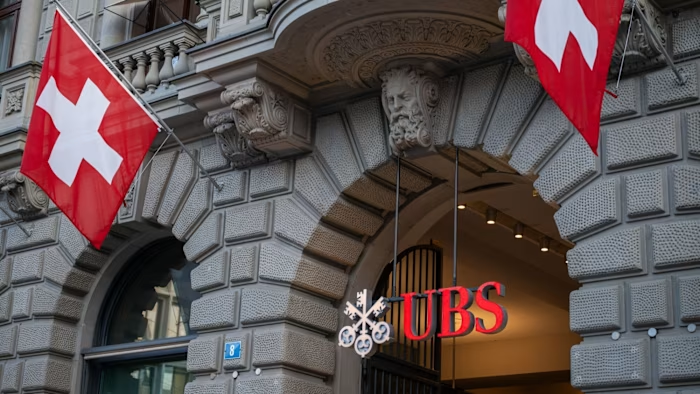
Reports that UBS, Switzerland’s largest investment bank, is considering relocating its long-standing Zurich headquarters to the United States or other overseas locations have sent shockwaves through global financial markets.
This move is far more than a simple geographical relocation. It is analyzed as a sophisticated, dual-track decision combining a “political gambit” to counter a massive capital regulation proposal of approximately $15B–$20B USD pushed by Swiss lawmakers, and a “substantive long-term strategy” to maximize core competitiveness in Wealth Management (WM) and Investment Banking (IB), centered around the US—the world’s largest financial market.
To help general investors and financial subscribers better understand the situation, we break down the background, short-term political calculations, long-term structural realignment strategies, and the potential impact on stock price and corporate value.
1. Short-Term Calculation: A Political Gambit (Bluffing) Toward the Swiss Parliament
From an investor’s perspective, UBS’s “headquarters relocation” card can primarily be interpreted as a powerful bargaining chip designed to neutralize heavy regulatory pressure from the Swiss government and parliament.
- A $15B–$20B USD Capital Requirements Bomb: To prevent a recurrence of the 2023 Credit Suisse (CS) collapse, the Swiss government and parliament are demanding that UBS, which absorbed CS, drastically raise its capital ratio. The additional required capital alone reaches approximately $15B–$20B USD (21 trillion KRW). As a bank holds more idle capital (retained reserves), funds available for shareholder returns decrease, significantly undermining Return on Equity (ROE) and capital efficiency.
- Leveraging Swiss Financial Identity in Negotiations: If UBS actually departs Switzerland and moves its headquarters to the US or elsewhere, Switzerland’s status as a proud “global financial hub” will suffer a critical blow. Furthermore, massive tax revenue losses and job cuts in the financial sector will be inevitable. UBS management is using this national ripple effect as leverage to exert indirect administrative and political pressure on the Swiss parliament to withdraw or drastically soften the rigid regulation bill.
2. Long-Term Calculation: Substantive Structural Realignment Centered on the US Market
However, this announcement cannot be dismissed merely as a tactical bluff to intimidate Swiss politicians. Within UBS, medium- to long-term justifications and incentives to relocate its headquarters or core business units to the US have steadily accumulated.
| 구분 | 스위스 잔류 시(If Staying in Switzerland) | 미국 등 해외 이전 시(If Relocating Overseas – US) |
| 규제 환경 | $15B–$20B 자본 추가 확충 부담 (Severe Capital Requirements) | 규제 완화 및 자본 효율성 제고 (Regulatory Relief & Capital Efficiency) |
| 시장성 | 유럽 금융시장의 저성장 구조 (Low-Growth European Financial Market) | 글로벌 자산관리(WM)·IB 시장 확대 (Expansion in Global WM & IB Markets) |
| 기업 가치 | 스위스 정치권의 은행 때리기 리스크 (Bank-Bashing by Swiss Politics) | 미국 대형 금융주 수준의 밸류에이션 재평가 (Valuation Rerating to Match US Peers) |
- The US: The World’s Largest Wealth Management (WM) & IB Market: UBS’s primary revenue driver and future growth engine is undoubtedly the US wealth management market. The US holds the richest concentration of High-Net-Worth (HNW) capital globally. To compete on equal footing with US financial giants like Morgan Stanley and Goldman Sachs, adopting the flexible governance of US financial authorities—free from cumbersome European or Swiss regulatory frameworks—offers a distinct advantage.
- Resolving Chronic Undervaluation (Valuation Gap): Banks listed on European and Swiss exchanges have historically traded at significantly lower Price-to-Book Ratio (PBR) premiums compared to major US banks, as investors assign lower scores to European banks due to growth constraints and regulatory risks. Relocating its headquarters or restructuring centered on US capital markets could serve as a powerful catalyst for a justified valuation rerating toward US financial stocks, driving up share prices.
3. Key Watch Points for Investors
Depending on the legislative direction of the Swiss parliament and choices made by UBS management, investment scenarios broadly split into two paths:
| Category | Scenario A: Compromise with Swiss Parliament (Regulatory Relief) | Scenario B: Execution of Relocation to the US/Overseas |
| Core Content | Swiss parliament drastically lowers capital ratio demands in response to UBS’s relocation threat | Swiss politicians maintain a firm stance, leading UBS to execute relocation of headquarters and key business units |
| Major Impact | – Short-term regulatory uncertainty resolved via political compromise – Reduced burden of keeping ~21T KRW in unnecessary voluntary reserves | – Weakening of Swiss corporate identity and short-term political friction – Drastic reduction in regulatory costs & accelerated US market expansion |
| Stock Price & Shareholder Value | [Short-Term Upside] Reduced regulatory costs allow stable maintenance of existing shareholder return policies (dividends, share buybacks) | [Medium- to Long-Term Upside] Short-term execution risks (relocation costs, etc.) exist, but capital efficiency is maximized alongside potential valuation rerating to US bank levels |
💡 Final Summary & Investment Strategy
In summary, the “consideration of headquarters relocation” put forward by UBS management is primarily a first-stage bargaining chip to dodge the looming $15B–$20B (21 trillion KRW) capital regulation bomb.
However, should Swiss politicians persistently enforce strict capital rules, UBS is highly likely to execute its long-term contingency plan—relocating its headquarters or spinning off and listing key business divisions—to defend shareholder value and secure growth engines centered on the US market.
Therefore, smart investors should view this event not as mere media gossip, but as a crucial inflection point to evaluate mid- to long-term buy/sell strategies by monitoring the final stance of the Swiss parliament’s banking law amendments and changes in UBS’s capital allocation efficiency.