
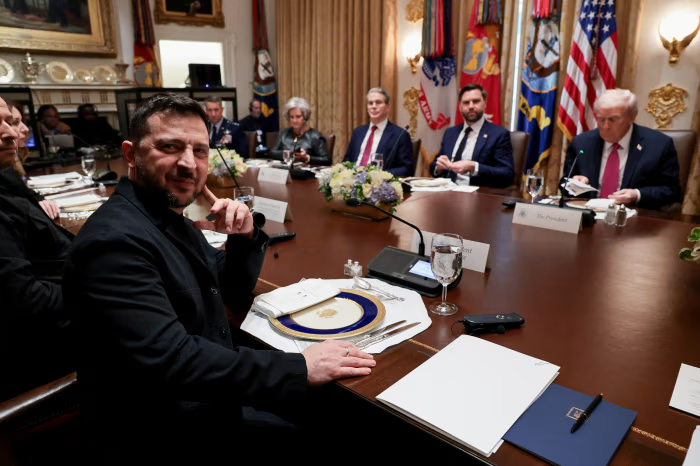
This article analyzes Ukraine’s resumed strikes on Russian oil refineries, friction between the US and Ukraine, and the limits of “America First (transactional hegemony)” intertwined with Middle East tensions and global financial markets, alongside an assessment of the future crisis mitigation timeline based on factual evidence and market mechanisms.
1. The Trump Administration’s ‘Transactional Diplomacy’ and Ukraine’s Declaration of an Independent Course
President Volodymyr Zelenskyy’s interview with the Financial Times (FT) formalized Ukraine’s transition to an independent survival strategy, no longer passively accommodating US pressure.
- Weaponization of Starlink and US Pressure: To finalize an “energy truce” and a deal on Russian diesel, the US Trump administration demanded that Ukraine cease strikes on Russian refineries. The US exerted pressure by suspending intelligence sharing and imposing speed throttles on the Starlink (Starshield) tactical communications network.
- Reasons for Ukraine’s Backlash: While the US urged a halt to strikes, Russia continued its attacks on Ukraine’s energy grid. Determining that complying with US demands would only multiply unilateral agreements between the US and Russia while destroying Ukraine’s bargaining power, Ukraine resumed strikes on Russian oil refineries using its independent long-range drone and missile capabilities.
- Rise of Europe as an Alternative Pillar: As the US attempted commercial deals by taking its security umbrella hostage, the UK, Nordic countries, and EU nations significantly increased support for Ukraine’s defense network and self-weapon production funding, accelerating a “European security realignment without the US.”
2. Why Has America’s US-First (Hegemonic) Diplomacy Reached Its Limits?
Currently, US foreign policy pushes traditional allies and international norms into the background to serve short-term political goals: curbing domestic inflation (lowering oil prices) and securing victory in the November midterm elections. However, this approach is reaching its limits.
📊 US Energy Policy Pressure and Its Ripple Effects
                 [Cause: US Pressure]
• Demand for Ukraine to halt strikes on Russian oil refineries
• Pursuit of resuming Russian oil imports for oil price stabilization
                          │
         ┌────────────────┴────────────────┐
         ▼                                 ▼
 [Erosion of Allies' Trust &      [Dual Instability in the
     Independent Course]              Energy Market]
🔍 Detailed Impact Comparison
| Category | Security Landscape for Allies | Global Energy Market |
| Core Change | Loss of trust in the US & reinforcement of independent courses | Resurgence of oil price spikes & heightened supply chain instability |
| Detailed Impact | • Accelerated self-armament of Europe and Ukraine • Departure from US-led security structures & securing independent defense capabilities | • Worsening oil refining bottlenecks upon resumed strikes • Increased international oil price volatility & risk of price surges |
- Absence of Geopolitical Efficacy: Attempts were made to temporarily cover up geopolitical risks through backroom deals between major powers. However, failing to forcibly block the asymmetric strike capabilities of a warring nation (Ukraine) fighting for its survival has caused oil price instability to resurface.
- Entrenched ‘Security Distrust’ Among Allies: The realization that security assets (Starlink, intelligence sharing) can be weaponized at any time for US self-interest has prompted European and Asian allies to reduce reliance on US weapons and assets, embarking on a “self-centered security realignment” by bolstering their own national defense.
3. Easing of Hegemonism and Outlook for Easing Global Wartime/Financial Crises (When Will It Peak Out?)
The core focus for investors and general subscribers is the “timing and signals for when global instability will ease.”
[Step 1: November 2026] ──► Conclusion of US Midterm Elections (Restraint on surprise political shocks & securing rationale for monetary policy) ▼[Step 2: Late 2026 – Early 2027] ──► US Federal Reserve Rate Cuts & Downward Stabilization of Treasury Yields ▼[Step 3: First Half of 2027] ──► Institutionalization of 'European/Multilateral Deterrence' in Europe & Middle East, with risk turning into a constant
① Political Timeline: Immediately After the US Midterm Elections in November 2026
- Reason: Many of the Trump administration’s unilateral diplomatic measures stem from aggressive policy moves targeting voter sentiment (inflation control achievements) ahead of the November midterm elections. Once the elections conclude, sudden policy announcements from the US administration are likely to decrease, opening up possibilities for pragmatic negotiation tables.
② Economic Timeline: US Federal Reserve Rate Cuts and Treasury Yield Stabilization (Late 2026 – Early 2027)
- Reason: Financial instability—such as US Treasury sell-offs driven by high US interest rates and soaring mortgage rates worldwide—will only calm down when the US Federal Reserve begins cutting its benchmark policy rate. Mortgage repayment burdens in Europe and Asia will ease only after US Treasury yields stabilize downward.
③ Geopolitical Timeline: Institutionalization of Multilateral Security Agreements (First Half of 2027)
- Reason: The war in Ukraine and conflict in the Middle East will enter a long-term lull not through unilateral US mediation, but when a “new balance of power” takes root, with the EU and Middle Eastern regional powers directly confronting challenges using their own funds and defense capabilities.
4. Future Predictions and Asset Management Implications for Investors
- Prolonged Commodity (Energy) Volatility: Risks of short-term price spikes in oil and diesel persist due to Ukraine’s resumed strikes on Russian refineries and geopolitical instability in the Middle East. Continuous risk management regarding energy sector commodity indices remains necessary.
- Rising Value of Defense and Security-Self-Reliance Beneficiaries: In the face of US unilateralism, increased national defense budgets across European and Asian nations are inevitable. The long-term value of European defense firms and South Korea’s (K-defense) supply chains for special-purpose vessels and advanced weaponry is projected to rise.
- Monitoring US Treasury Yield Trends: As the resolution of global financial entanglements (high inflation, high interest rates, surging mortgage costs) begins with a downward pivot in the 10-year US Treasury yield, watching whether the Federal Reserve shifts its monetary policy post-US midterm elections should be prioritized as a key indicator.