
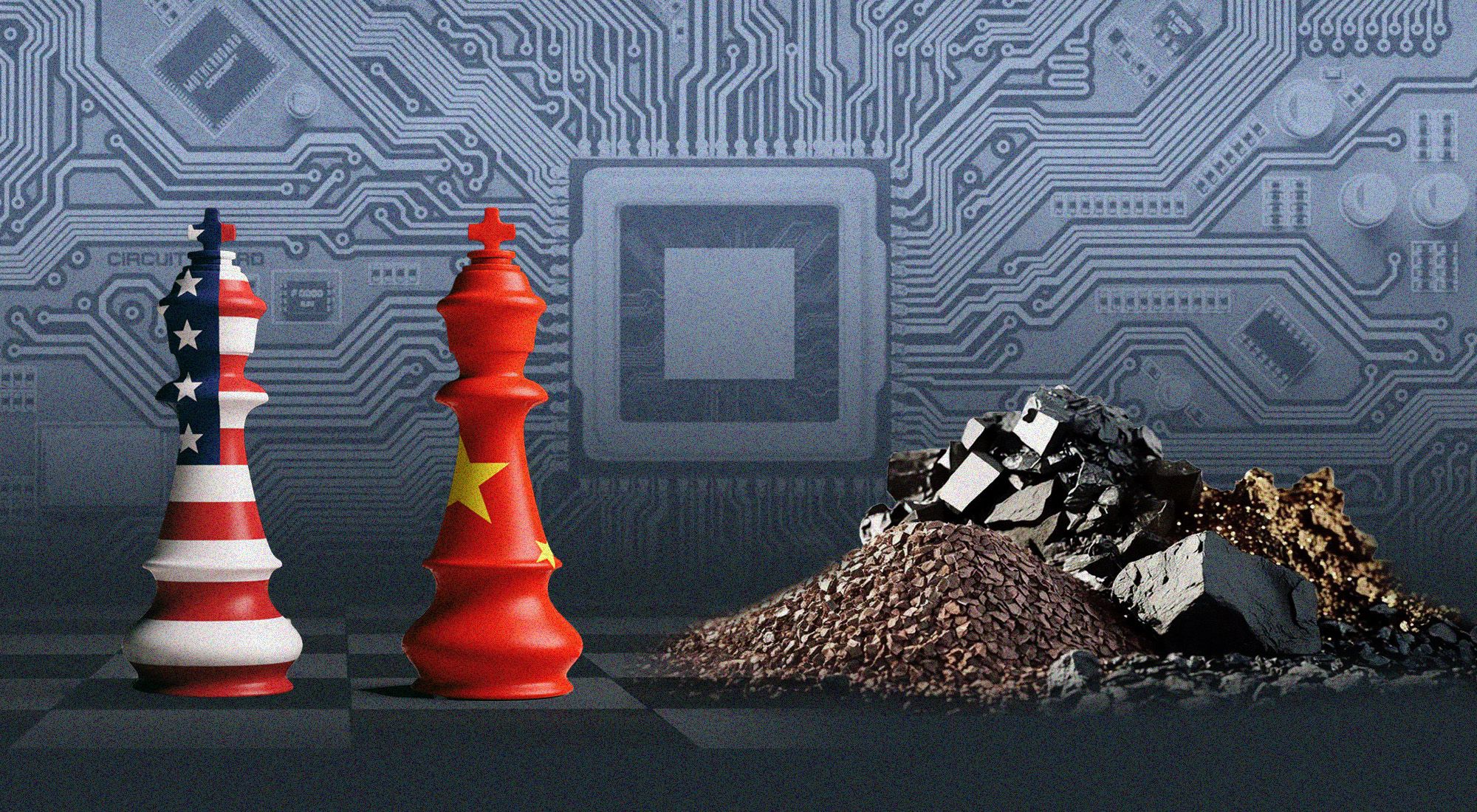
💡 South Korea’s Deadly Weapon Neutralizing China’s ‘Rare Earth Hostage Situation’: “Dug Up ‘Technology’ Instead of ‘Soil’”
From electric vehicles and wind turbines to advanced robotics and missile guidance systems—there is a crucial substance serving as the core engine of modern high-tech industries. It is none other than ‘Rare Earth Elements (REEs).’
Currently, the global rare earth market—especially the market for ‘Heavy Rare Earth Elements (HREEs)’ that prevent demagnetization in high-performance motors under high temperatures—is monopolized by China by over 90%. When China locks its doors declaring “No rare earth sales!”, global automakers and defense corporations are left helpless in a critical ‘supply chain hostage situation.’
However, South Korean researchers and enterprises, possessing virtually no underground mineral resources, are shaking China’s monopolistic structure at its roots using ‘next-generation material synthesis technology’ instead of mineral mining. Without mines, their innovative counteroffensive is clear: ‘erase the required quantity of minerals itself through technology.’
💡 1. Why Are Heavy Rare Earths Necessary, and How Is Korean Technology Different?
❓ Easy Analogy: “A Magnet Like an Earthenware Pot That Doesn’t Melt at High Temperatures”
When an EV drives at high speeds or a wind turbine spins rapidly, internal motor temperatures surge to 150–200°C. Ordinary magnets lose their magnetism when exposed to such heat (demagnetization). Heavy rare earths like Dysprosium (Dy) and Terbium (Tb) act as ‘heat-dissipating remedies’ that prevent this phenomenon.
Until now, making these magnets meant mixing large amounts of expensive heavy rare earths throughout the entire material batch. Naturally, dependency on Chinese minerals skyrocketed.
🛠️ Counterattack by Korean Researchers: “The Salt-Sprinkling Technique (Grain Boundary Diffusion, GBD)”
Korean research teams at the Korea Institute of Materials Science (KIMS) and the Korea Institute of Industrial Technology (KITECH) have developed a groundbreaking process called ‘Grain Boundary Diffusion (GBD).’
- Conventional Method: Adding a massive amount of salt throughout the entire soup ➔ Heavy mineral consumption and deepening reliance on China.
- Korean Method: Lightly diffusing salt only onto the surfaces and grain boundaries where the food contacts the tongue ➔ Microstructure control.
👉 Result: Reduces heavy rare earth usage by over 70–80% while preserving magnetic strength at high temperatures of 200°C! This establishes a ‘China-decoupled security sandbox’ that remains unaffected even if China turns off the mineral tap.
🧪 2. Three ‘Next-Gen Alchemy’ Products Under Development in South Korea
South Korean research institutes and corporations are not stopping at merely reducing heavy rare earths; they are creating alternative magnets containing 0% rare earths.
① Heavy-Rare-Earth-Diet Magnets (HREE-Free / Lean NdFeB)
Engineers have completed high-strength magnets that withstand high temperatures by completely eliminating Dysprosium and Terbium or replacing them with relatively abundant and cheaper Cerium (Ce) or Lanthanum (La).
② Dream Magnet Found in Space Meteorites: Artificial Synthesis of ‘Tetrataenite’
Originally, ‘Tetrataenite’ is a special iron-nickel (Fe-Ni) crystal structure created as meteorites from space cool slowly over hundreds of millions of years. It exhibits powerful magnetism without containing any rare earths.
- Korea’s Feat: The research team attracted global acclaim by successfully synthesizing this bonding structure artificially in just a few seconds, a process that naturally takes hundreds of millions of years on Earth.
③ King of Cost-Effectiveness Made from Soil and Iron: ‘High-Performance Ferrite’ Magnets
By technically boosting the magnetic flux density of ordinary black ‘ferrite’ magnets (iron oxide-based) often seen on refrigerator doors, researchers raised their performance to 70–80% of rare earth magnets. Major Korean component firms like LG Innotek and Hyundai KEFICO are accelerating the commercialization of ‘rare-earth-free motors for appliances and vehicles’ using this technology.
📊 3. Paradigm Shift in the Resource War at a Glance
| Category | Conventional (China Monopoly Centric) | After Applying Korea’s Next-Gen Tech |
| Key Raw Materials | Heavy addition of costly HREEs (Dy, Tb) | 80–100% reduction in HREE usage |
| Supply Chain Risk | Vulnerable to China’s weaponization/export controls | Compliant with US & EU green regulations (IRA/CRMA) |
| Resource Acquisition Strategy | Scramble for mine stakes and mining rights (Upstream) | Replacing raw materials via technological prowess (Downstream) |
❓ 4. Frequently Asked Questions (FAQ)
Q1. Can these rare earth alternative magnets be applied directly to electric vehicles right now?
A1. Yes, HREE-reduced magnets utilizing Grain Boundary Diffusion (GBD) technology are already in the mass-production validation phase. They are rapidly expanding their footprint by meeting the bidding criteria (compliance with IRA requirements) of global automakers.
Q2. If China drastically cuts rare earth prices, won’t Korean technology lose its competitiveness?
A2. Even if China launches a price-dumping offensive, the US and the EU legally restrict the use of minerals with a ‘Chinese supply chain origin’ through the Inflation Reduction Act (IRA) and the Critical Raw Materials Act (CRMA). Therefore, beyond simple pricing, Korea’s alternative technology holds a powerful premium in terms of ‘supply chain security.’
🔮 5. Future Challenges and Outlook
Korea’s endeavor represents an intelligent substitution strategy demonstrating that “a resource-poor nation can overcome resource superpowers if it possesses superior technology.”
However, for these ‘dream magnets’ proven in laboratories to reach millions of EVs on the streets and across industrial sites, continuous large-scale capital investment must overcome the final hurdles: securing cost competitiveness (yield) in mass production and controlling motor enlargement.
It is time to extend ongoing attention and support to the fruits of South Korean researchers and enterprises, who are rewriting the rules of the global resource war!