
[Global Cybersecurity Report] From ‘Laptop Farms’ to ‘AI Hacking’: North Korea’s Illicit Revenue Generation, Cyber Exploits, and Global Countermeasures
Recently, the U.S. Department of the Treasury’s Office of Foreign Assets Control (OFAC) imposed additional sanctions on North Korea. While on the surface it appears to target a few individual IT workers operating overseas, a massive “Intelligent Autonomous Threat” lies beneath—a dangerous fusion between North Korean developers proxy-hired by global IT companies and state-sponsored hacking groups.
This report delivers an in-depth analysis of North Korea’s cyber operations—which extend far beyond simple hacking into corporate penetration, core technology exfiltration, and funding for weapons of mass destruction (WMD) and ballistic missile programs—alongside the global multilateral defense network built to stop them.
1. Three Core Pillars of North Korean Hacking and Proxy Hiring via China and Russia
North Korea’s cyber-attack ecosystem leverages the infrastructure of geographically and geopolitically adjacent China and Russia as safe havens, operating across three primary pillars:
[China/Russia Hubs (Dandong, Shenyang, Vladivostok, etc.)] │ ├─① Laptop Farms (Remote Control) ──> Proxy Hiring in Global IT Firms (Salary Extortion + Backdoors) ├─② Dark Web/AI Exploitation (Lazarus) ──> Zero-Day Trading, AI Phishing, Crypto Theft & Mixing └─③ Asymmetric State Protection ──> Neutralizing UN Sanctions & Tacit Complicity
① ‘Laptop Farms’ and Proxy Hiring via Identity Theft
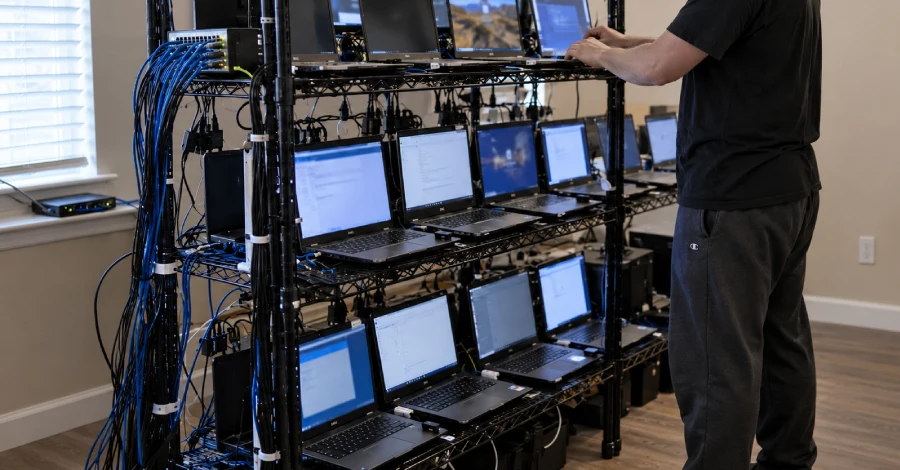
- What is a Laptop Farm? North Korean IT developers residing in locations like Dandong and Shenyang (China) or Vladivostok (Russia) send dozens of laptops to the homes or offices of local facilitators (identity providers) in the U.S., South Korea, or Europe. This setup is known as a “Laptop Farm.”
- Evasion Method: North Korean personnel connect remotely to these laptops using Virtual Private Networks (VPNs) and remote desktop software such as AnyDesk or TeamViewer. From the employer’s perspective, it appears as though a legitimate local developer is working, while in reality, a North Korean operative is controlling the device.
- Severe Threat: Beyond garnishing 80–90% of worker salaries for the North Korean regime, operatives infiltrate internal corporate networks to plant backdoors in source code, steal sensitive intellectual property, management data, and customer records. When facing termination, they resort to extortion, demanding cryptocurrency under the threat of releasing stolen data publicly.
② Dark Web Exploitation by State-Sponsored Hacking Groups like Lazarus
- Trading Hacking Tools: Elite hacking units under the Reconnaissance General Bureau—such as Lazarus, Andariel, and Kimsuky—operate across the Dark Web and closed networks (such as I2P) hidden from standard search engines. They trade unpatched ‘Zero-Day’ vulnerabilities, exploit web server flaws (such as PHP Remote Code Execution), and run simulated penetration attacks.
- Exploiting Generative AI: Recently, these groups have weaponized Large Language Models (LLMs) like ChatGPT to craft natural, fluent spear-phishing emails and automatically generate tailored corporate attack scenarios to bypass security defenses.
- Money Laundering: Stolen cryptocurrency is routed through Command and Control (C2) servers in China and Russia, cleaned via crypto mixing services like Tornado Cash and Sinbad, and ultimately funneled into state weapons development funds.
③ Informal Complicity by China and Russia
- Under UN Security Council resolutions, all North Korean overseas workers were mandated to be repatriated. However, China and Russia continue to turn a blind eye to or actively protect their presence.
- Particularly amid the emerging New Cold War dynamic and deepening North Korea-Russia ties, international law enforcement and judicial efforts face severe structural bottlenecks on the ground.
2. Four Strategic Pillars of Global ‘Active Cyber Defense’
In response to these escalating threats, the international community—led by South Korea, the U.S., and Japan—is shifting its paradigm from passive defense to “Active Cyber Defense,” proactively eliminating threats before they materialize.
① Strengthening Unilateral and Multilateral Financial/Personnel Sanctions
- Consecutive Sanctions by OFAC and South Korea: The U.S. Treasury’s OFAC and the South Korean Ministry of Foreign Affairs have executed successive sanction rounds, freezing assets and blocking financial transactions of Chinese/Russian shell companies, identity facilitators, and North Korean IT managers aiding proxy hiring schemes.
- Blocking Crypto Laundering Networks: Mixing services and Dark Web crypto wallet addresses utilized by Lazarus are swiftly blacklisted, with immediate asset freezes executed in coordination with major global exchanges.
② Mandating Know Your Customer (KYC) Verification and Zero Trust Remote Security
- Source Prevention during Hiring: The FBI and South Korea’s National Intelligence Service (NIS) have issued Joint Cybersecurity Advisories on identifying North Korean IT workers to tech companies and HR platforms:
- Mandatory real-time biometric and facial recognition during video interviews
- Enhanced monitoring of IP access logs and remote desktop software on company-issued laptops
- Comprehensive audits to catch mismatches between payroll account holders and hired personnel
- Implementing Zero Trust Security Models: Enforcing a strict “never trust, always verify” architecture across corporate networks. Even if a proxy worker gains internal access, their permissions are minimized and re-authenticated continuously, isolating them from core source code and sensitive data.
③ Trilateral Security Cooperation and Multilateral Information Sharing
- US-ROK-Japan Cyber Security Working Group: The three nations utilize frameworks like the ROK-US-JPN Cyber Working Group and Cyber Summit Korea (CSK) to share real-time threat intelligence regarding emerging software vulnerabilities and blacklisted IT worker rosters.
- NATO and Five Eyes Alignment: Joint Cybersecurity Advisories are published regularly alongside NATO and Five Eyes partners to bolster the resilience of both private enterprises and public institutions against North Korean, Chinese, and Russian state-sponsored cyber threats.
④ AI and Big Data-Driven Cyber Threat Intelligence (CTI)
- Automated Dark Web Monitoring: AI-driven security monitoring systems run 24/7 to collect and analyze malicious code, C2 server addresses, and North Korea-related hacking activity across Dark Web channels.
- Public-Private Tech Partnerships: Global tech giants including Microsoft and OpenAI proactively suspend accounts tied to state-sponsored hacking groups and reinforce guardrails to prevent AI models from generating malicious code.
3. Remaining Challenges and Future Outlook
| Category | Primary Bottleneck | Strategic Countermeasure |
| Judicial Limitations | Inability to extradite criminals due to non-cooperation from China/Russia | Sustained multilateral financial sanctions and diplomatic pressure |
| Pace of Tech Evolution | Sophisticated deepfake identity fraud and AI-driven attack simulations | Full deployment of AI-based real-time anomaly detection and Zero Trust |
North Korea’s cyber threat is no longer a movie storyline—it is an immediate, operational danger threatening corporate survival and national security.
Mitigating this threat requires the continuous execution of a three-pronged defense: ① Rigorous hiring and remote-work Zero Trust security, ② Complete blockade of cryptocurrency laundering networks, and ③ Real-time threat intelligence sharing led by South Korea, the U.S., and Japan.