
What Is Happening in Space Right Now?
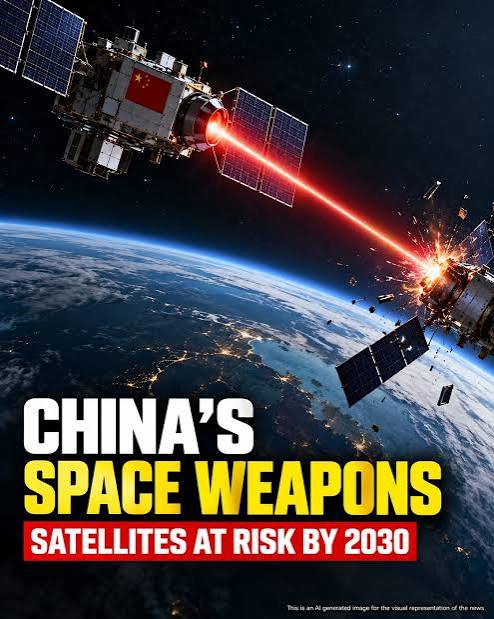
“Space warfare,” once considered a storyline confined to movies, has materialized as a real-world security threat. The core issue is that China is turning outer space into a battlefield where weapons can be deployed to strike targets at any moment, rather than keeping it purely as a realm for launching satellites.
On the surface, China claims that “space belongs to everyone and must be used peacefully.” Behind the scenes, however, it employs a policy of “Civil-Military Fusion,” instantly integrating cutting-edge technologies developed by private space companies and research institutes into the operational capabilities of the People’s Liberation Army (PLA).
1. China’s Three Stages of Space Weaponization
① Explosive Growth of Space Surveillance “Eyes”
- What does this mean? As recently as 2018, China operated a relatively small number of surveillance and reconnaissance satellites. Today, that number has surged more than threefold to over 510 units.
- Why is it dangerous? It means China has established a full-scale surveillance network capable of monitoring the movements of U.S. aircraft carriers, naval vessels, and air bases across the globe—particularly around the Korean Peninsula and the Indo-Pacific region—in real time, 24/7.
② A Versatile “Arsenal” Targeting Satellites
China is preparing a wide array of techniques to neutralize rival satellites:
- Ground-Based Lasers & Missiles: Firing high-power lasers from the ground to blind satellite camera lenses or launching direct-ascent missiles to shatter satellites into pieces.
- Orbital Weapons (Targeted for Deployment by the Late 2020s): Chinese satellites in orbit approaching rival satellites to fry internal circuitry with high-power microwaves, or spraying black aerosols (similar to paint spray) onto solar panels to sever power supplies. China is also developing stalking capabilities (Rendezvous and Proximity Operations – RPO) that use robotic arms to capture and cast away adversary satellites from their orbits.
- “Rods from God” Falling from Space to Earth (Kinetic Energy Weapons): Stationing heavy metal rods in orbit that can be dropped toward enemy ships or bases on land or sea at hypersonic speeds upon command, destroying targets through pure kinetic impact without explosive warheads.
③ Reusable Unmanned Spaceplanes (Drone Spacecraft)
China operates unmanned spaceplanes similar to the U.S. X-37B that can reach orbit and return to Earth autonomously. These spacecraft can conduct precision operations in orbit, such as covertly releasing small attack satellites or jamming rival satellites.
2. Why Is This Fatal to Global Peace and International Security?
[Real-Time Land/Sea Surveillance] ➔ [Satellite Neutralization via Space Weapons] ➔ [Blinding Rival C4ISR] ➔ [Preemptive Land/Sea Strikes]
The integrated space management framework pursued by China goes beyond simple defense enhancement. It represents a dangerous strategy aimed at monopolizing space dominance and securing preemptive strike capabilities to alter the geopolitical balance in a crisis.
- Terrestrial Security Collapses Instantly: Modern smartphone GPS, internet communications, and military precision-guided missiles all rely on satellite networks. If China paralyzes an adversary’s satellite network in an instant, even nations with superior military power will be blinded, deafened, and rendered incapable of taking action.
- Outer Space Face Permanent Destruction (Kessler Syndrome): Destroying satellites with missiles or direct collisions generates hundreds of thousands of sharp pieces of space debris. Traveling at speeds of 7 to 8 km per second, these fragments cause chain-reaction destruction among other satellites, potentially leading to a “space lock-in” phenomenon where humanity can no longer launch satellites.
- Exploiting Legal Loopholes: The 1967 UN Outer Space Treaty only prohibits placing weapons of mass destruction (WMD), such as nuclear weapons, in space. China takes advantage of these outdated loopholes to develop non-nuclear yet lethal systems—such as lasers, microwaves, and kinetic energy weapons—under a guise of legality.
3. How Should the International Community Respond?
To prevent an authoritarian regime from dictating the rules of outer space and aiming weapons at Earth, the international community must implement four robust countermeasures:
① Amending International Rules and Strengthening Sanctions
Under the leadership of the UN, new “Space Security Rules of Conduct” must be established to prohibit unauthorized close approaches to foreign satellites or disruptive activities in orbit. Severe international economic and diplomatic sanctions should follow any violations.
② Integrating Space Surveillance Networks and Public Naming & Shaming
Space security allies—including the U.S., South Korea, Japan, Australia, and European nations—must consolidate their orbital tracking data. When Chinese satellites exhibit suspicious movements, their locations and intent should be publicly exposed in real time to exert international pressure and deter illegal actions.
③ Building Satellite Network Resilience via Constellations
Relying on a few large, expensive satellites leaves systems vulnerable; losing just one causes major damage. The industry is shifting toward deploying hundreds of small, low-cost satellites networked together into constellations. Under this architecture, even if China disables a few satellites with lasers, the overall communication and reconnaissance network remains fully functional.
④ Restricting the Inflow of Critical Components and Advanced Technologies to China
International export control regimes (such as the Wassenaar Arrangement) must be tightened to block dual-use items—such as high-performance laser components, high-power semiconductors, and precision sensors essential for space weapons—from being transferred into China.
Outer space is a global commons belonging to all humanity, not a stage for the military hegemony of any single nation. Halting the unilateral space weaponization pursued by authoritarian regimes requires public awareness of these realities and collective support for international security cooperation.