
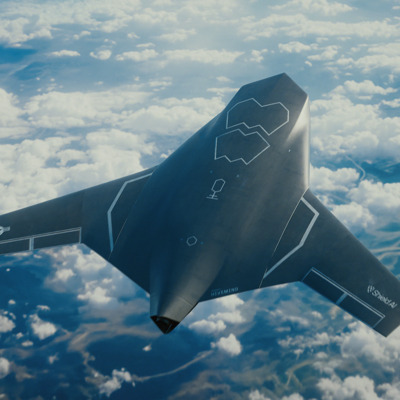
The consecutive declarations by the UK’s Chief of the Air Staff (Harv Smyth) and Defence Secretary (Wes Streeting) regarding the “Last Manned Fighter Jet (GCAP)” and “Autonomous Unmanned Combat Aircraft (CCA)”—alongside calls for national emergency preparedness—mark a historic inflection point. Modern warfare and the aerospace industry are shifting completely from a “human-pilot-centric” model to an “AI, autonomous weapons, and space-integrated network” paradigm.
To make this accessible to general readers, this post systematically analyzes the scientific and physical rationale behind this shift, next-generation aerial combat command systems (Human vs. AI division of labor), and the future aerospace defense roadmap leading into the space industry era.
1. Scientific Rationale: Why Next-Generation Fighter Jets Must Leave Human Pilots Behind
The transition from Manned to Unmanned fighter development is not merely about reducing pilot casualties. Rather, it is driven by the fact that human biological limits can no longer keep pace with rapid advancements in modern aerodynamics and sensor technology.
| Physical & Biological Factor | Limitations of Human Pilots | Overwhelming Advantage of AI Unmanned Fighters (CCA) |
| Gravitational Force (G-Force) | Loss of consciousness (G-LOC) and blackout occur around 9G, creating physical limits on turning radius and evasive maneuvers. | Capable of extreme high-G maneuvers exceeding 15G–20G due to no onboard pilot, physically outmaneuvering enemy missiles. |
| Cognition & Reaction Speed | Takes roughly 0.2 to 0.5 seconds from threat recognition to flight control input; unable to process dozens of radar/drone feeds simultaneously. | Fuses and analyzes hundreds of sensor and satellite data streams in milliseconds (0.001s) to calculate optimal evasion and strike paths instantly. |
| Airframe Design & Endurance | Cockpits, oxygen systems, ejection seats, and life-support gear add heavy weight and restrict stealth shaping. | Elimination of life-support systems allows compact airframes and extreme stealth geometry; continuous flight for tens of hours as fuel permits. |
| Cost & Mass Production | Cutting-edge manned fighters (F-35, GCAP) cost $110M–$220M+ (150B–300B+ KRW) per unit and require years of pilot training. | Can be mass-produced at 10–20% the cost of a manned jet (tens of millions of dollars), enabling deployment as “Attritable” vanguard assets. |
2. Future Aerial Combat Command: Does AI Decide 100%, or Do Humans Command?
To the question, “Are all next-generation fighter jets moving toward a system where AI analyzes and humans give the final command?”, the global defense science community offers a clear answer: aerial warfare is evolving into a “Human-on-the-Loop” autonomous system, where AI handles tactical flight and engagement analysis, while humans retain final lethal authority.
| Category | Tier 1: Manned 6th-Gen Fighter (GCAP · Tempest) | Tier 2: Autonomous Drone Wing (3–5 Stormfighter CCAs) |
| Tactical Role | Airborne Quarterback (Command & Control) | Frontline Vanguard & Shield (Execution & Protection) |
| Force Composition | 1 Human Pilot + Onboard AI Co-Pilot | 3 to 5 AI-Driven Autonomous Combat Drones |
| Core Responsibilities | • Sets strategic battlefield objectives • Assigns autonomous swarm missions • Holds final weapons-release authority | • Recon: Stealth scouting & electronic jamming • Strike: Deep-penetration missile attacks • Defense: Decoying missiles & shielding the command jet |
| Data Link | High-Speed LPI Datalink & LEO Satellite Comms (Jam-resistant & encrypted) | ◀ Real-time sensor fusion & autonomous execution |
- Initial Phase (2027–2035, Manned-Unmanned Teaming): Both the UK’s Stormfighter (CCA)—slated for prototype flight next year—and GCAP (the 6th-generation fighter co-developed by the UK, Italy, and Japan entering service in 2035) operate on a structure where one manned jet commands a wing of 3 to 5 unmanned combat drones. Rather than manually piloting each drone, the pilot assigns high-level missions—such as “Neutralize enemy radar in that sector”—and the AI drones autonomously form formations, adjust flight paths, and execute the mission.
- Full Automation Phase (Post-2040): Once AI autonomous decision-making reliability is proven and anti-hacking technologies like quantum-encrypted communications mature, even manned command fighters will phase out. Warfare will transition to a fully unmanned air force where human commanders direct swarms of dozens of AI combat drones from ground stations or orbital space control centers. (Due to international law and ethical accountability, retaining the final authority to “pull the trigger” in human hands remains a core principle of Western defense doctrine.)
3. Global Next-Gen Unmanned Fighter (CCA & Stealth UCAV) Comparison: US, UK, and South Korea
The market for Collaborative Combat Aircraft (CCA) and unmanned stealth combat aerial vehicles (UCAV) is a fierce battleground where traditional defense giants (Lockheed Martin, Boeing, BAE Systems) clash head-on with Silicon Valley AI defense startups and South Korean aerospace leaders.
| Country | Key Projects & Platforms | Lead Contractors | Technical Features & Deployment Roadmap |
| United States | USAF CCA Program – YFQ-44A (Fury) – YFQ-42A (Gambit) | Anduril Industries General Atomics (GA-ASI) | Mid-sized and startup firms beat legacy giants (Boeing, Lockheed Martin) for Increment 1. Following maiden flights in 2025–2026, operational deployment is targeted for 2028–2029. Key features include Lattice AI mission software and modular airframe architecture. |
| United Kingdom | Stormfighter & GCAP-Linked Drones | BAE Systems Rolls-Royce | Low-observable autonomous combat drone designed to escort the 6th-gen GCAP (UK-Italy-Japan), Eurofighter Typhoon, and F-35. Undergoing rapid development targeting a prototype maiden flight in 2027. |
| South Korea | LOWUS (Low Observable Unmanned Wingman) & Kaori-X (Stealth UCAV) | Korean Air (Aerospace Division) Korea Aerospace Industries (KAI) Agency for Defense Development (ADD) | Integrates with the 4.5/5th-gen KF-21 Boramae via Manned-Unmanned Teaming (MUM-T). Leveraging tailless flying-wing stealth tech from Kaori-X, LOWUS aims for prototype maiden flights in 2026–2027 and operational fielding in the early 2030s. |
4. Deep Dive: Key Developers in the US and South Korea
① United States: Silicon Valley AI Defense (Anduril) vs. Drone Pioneer (General Atomics)
- Anduril Industries: Founded by Oculus creator Palmer Luckey, this defense tech firm secured the USAF CCA Increment 1 contract not merely through airframe manufacturing, but on the strength of its proprietary AI battle management OS, Lattice. Anduril is setting the standard for Software-Defined Defense, enabling dozens of YFQ-44A drones to autonomously identify targets and reconfigure formations without pilot intervention.
- General Atomics Aeronautical Systems (GA-ASI): Dominant in the global drone market with the Predator and Reaper, GA-ASI achieved mass producibility and low cost (one-fifth the price of a manned fighter) with its Gambit Series (YFQ-42A)—a modular design allowing reconnaissance, electronic warfare, or air-to-air strike wings and engines to be swapped onto a common core chassis like building blocks.
② South Korea: Korean Air’s ‘LOWUS’ and KAI’s ‘KF-21 MUM-T’
- Korean Air Aerospace Division: Building upon radar-absorbing structures (RAS) and tailless stealth aerodynamics proven through South Korea’s flagship stealth drone demonstrator Kaori-X (developed with ADD), Korean Air leads the LOWUS system development. The operational concept pairs one manned fighter with 3 to 4 stealth unmanned wingmen to conduct preemptive strikes against enemy air defenses.
- Korea Aerospace Industries (KAI): KAI is building the core platform for Manned-Unmanned Teaming (MUM-T) by integrating an AI pilot (K-AI) and satellite datalinks into its flagship KF-21 and FA-50 fighters, enabling human pilots to command unmanned drones in real time.
5. Global Defense Supply Chain: Key Beneficiary Sectors & Stocks (Investment Perspective)
Because the unmanned combat era requires 3 to 5 times more airframes than manned fleets, value and market share will concentrate heavily on component and subsystem suppliers providing compact high-efficiency jet engines, AI autonomous flight sensors (AESA radar & electro-optics), and Low Earth Orbit (LEO) satellite datalinks, rather than pure airframe assemblers.
[Next-Gen Unmanned Fighter (CCA) Global Core Supply Chain Value Chain]

1. AI Autonomous Flight & Mission SW ──► Palantir, Anduril (Private), Shield AI (Private)
2. Propulsion (Compact Turbofans)    ──► Rolls-Royce (UK), Kratos (US), Hanwha Aerospace (Korea)
3. Radar, Electronic Warfare & Sensors ──► Northrop Grumman, L3Harris, LIG Nex1, Hanwha Systems
4. Airframe Integration & Mass Prod. ──► BAE Systems, Kratos (KTOS), Korean Air, KAI
6. Future Defense Roadmap: From Aerial Warfare to the Space Industry Era
The UK’s designation of its 6th-generation fighter as the “last manned fighter jet” signifies that the arena of aerial defense is expanding beyond the atmosphere into the stratosphere and Low Earth Orbit.
| Timeline | Core Development Phase | Key Technologies & Operational Concepts | Connection to the Space Industry |
| Phase 1 (Present–2028) | Unmanned ISR & CCA Prototype Flights | Deployment of UK Protector drones, Stormfighter flight testing, and validation of AI autonomous flight algorithms. | Real-time ultra-long-range drone control via LEO satellite constellations (Starlink, OneWeb) becomes essential. |
| Phase 2 (2030–2035) | 6th-Gen Fighter (GCAP) Deployment & Full MUM-T | Real-time battlefield data fusion between manned command jets and AI drone wings; hypersonic missile interception. | Space-based early-warning satellites transmit enemy missile coordinates directly to airborne AI drones. |
| Phase 3 (Post-2040) | Stratospheric/Orbital Platforms & Full AI Air Force | End of new manned fighter development; commercialization of High-Altitude Pseudo-Satellites (HAPS) and reusable orbital drones. | Blurring of aviation and space (Aerospace integration); operating space-based ISR/strike assets via reusable rockets like SpaceX Starship. |
- Why This Is the Gateway to the Space Industry Era: Because unmanned combat jets carry no pilot, losing communication links (via jamming or hacking) renders them useless. Exchanging massive volumes of real-time battlefield data with drones thousands of kilometers away is impossible using ground stations alone; it strictly requires thousands of LEO communications and reconnaissance satellites backed by AI satellite control networks. Consequently, the race for next-generation unmanned air power is directly tied to supremacy in orbital launch vehicles and space communications networks.
Key Takeaways
- Surge in Component Orders Driven by “Attritable” Mass Production: While legacy manned fighters were ordered in the dozens per nation, pairing 3 to 5 CCA drones per manned jet opens a mass-production market of hundreds to thousands of units. This directly fuels explosive demand for compact turbofan engines (Hanwha Aerospace, Rolls-Royce), precision-guided munitions (LIG Nex1), and tactical datalinks (Hanwha Systems, L3Harris).
- Value Shift from Hardware to AI Software: As demonstrated by Anduril and Palantir, 70% of a future unmanned fighter’s performance will be determined not by airframe shape, but by AI software capable of autonomously locating targets and completing missions amid heavy enemy jamming. Companies combining hardware manufacturing scale with AI battlefield network software will capture next-generation defense dominance.
The consecutive warnings and declarations from the UK’s defense leadership mark a strategic national turning point: removing human lives from the frontlines of combat and fundamentally redesigning national defense around AI, unmanned aircraft, and space satellite networks.
We are currently passing through a monumental historical gateway—the twilight of the century-long “Era of the Human Pilot” and the dawn of the “AI Autonomous Aerospace Era.” Future aerial defense will be perfected as a collaborative system where AI analyzes and navigates the battlespace at hyper-speeds, while humans exercise strategic judgment and ethical accountability.