
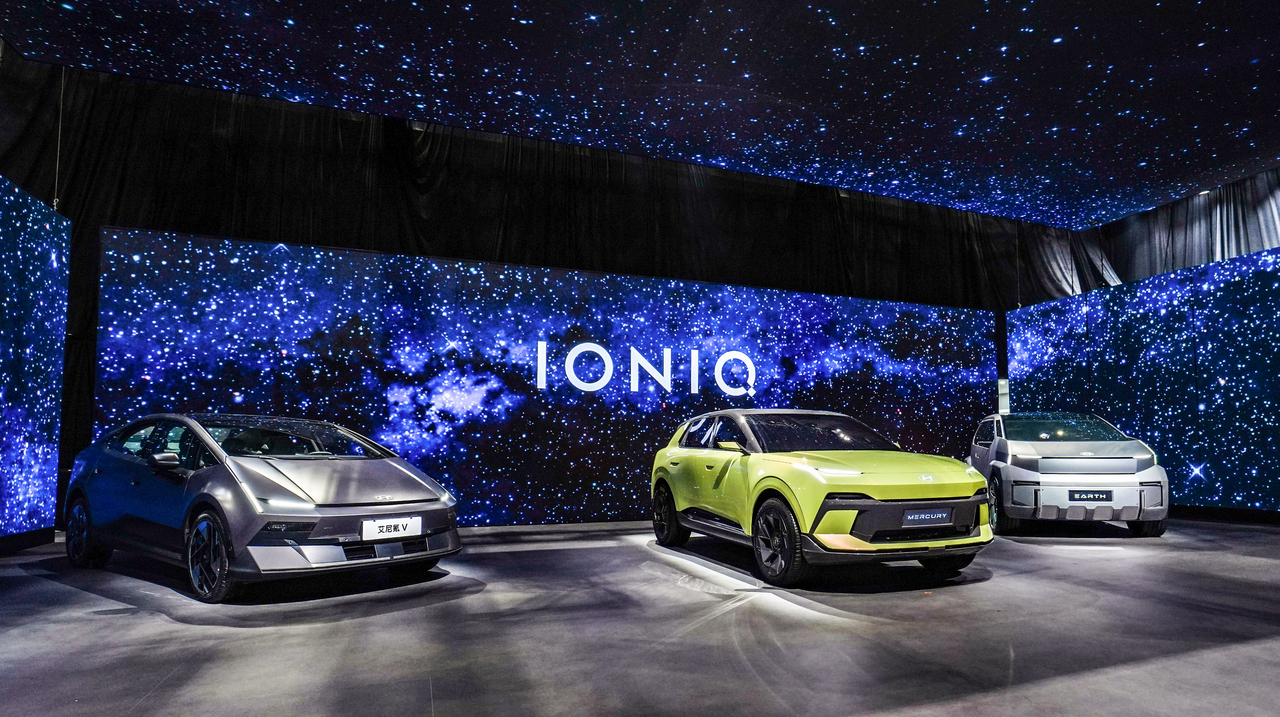
The “30% cost gap against Chinese EV makers” acknowledged by Hyundai Motor Group Vice Chairman Jaehoon Chang at the Guangzhou Auto Show goes far beyond simple labor cost differences. Instead, it is a structural cost gap driven by vertical integration of the battery supply chain, differing design and development philosophies, and overwhelming domestic market scale.
Below is a systematic analysis of the four core causes behind this 30% EV cost gap, the actual weight of tact time and wages, and the practical limits and breakthroughs of deploying AI humanoid robots to close the divide.
1. Four Real Reasons Behind the 30% Korea–China EV Cost Gap
Direct labor typically accounts for only 8% to 12% of total automotive manufacturing costs. Therefore, even if Chinese factory workers earned half the wages of South Korean workers, the resulting overall cost difference would only be 4% to 6%. The remaining decisive 24% to 26% cost gap stems from four structural factors:
| Cost Gap Factor | Contribution to Cost Gap | Korean Automakers (Hyundai & Kia) Structure | Chinese EV Makers (BYD, Geely, Xiaomi, etc.) Structure |
| 1. Vertical Integration of Batteries & Minerals | Approx. 12–15% (Largest share) | Imports core minerals (lithium, graphite, precursors) from China and procures cells via Korea’s Big Three battery makers (LG, SK, Samsung). High multi-tier margins and high reliance on costly ternary (NCM) batteries. | A single company (e.g., BYD) handles 100% of production in-house—from lithium mining to cathodes, anodes, LFP battery cells, and vehicle assembly—eliminating intermediate distribution margins. |
| 2. Development Period & Spec/Standard Philosophy | Approx. 6–8% | Over-engineered to meet strict global safety and durability standards (North America, Europe, etc.) simultaneously. Takes 36–48 months to develop a new vehicle with massive testing costs. | Focuses on features domestic consumers immediately experience (displays, autonomous driving) while setting underbody and component durability standards to practical levels. Launches new models in 18–24 months. |
| 3. Component Modularization & Integrated Design | Approx. 4–5% | Assembles individual parts sourced from hundreds of Tier-1, Tier-2, and Tier-3 suppliers. Incurs costs to maintain legacy internal combustion engine (ICE) supplier ecosystems. | Cuts part counts by over 30% using Gigacasting (large-scale die-casting that stamps front/rear underbodies in one piece) and ultra-integrated “8-in-1” modules combining drive motors, inverters, and reducers. |
| 4. Labor Costs & Plant Utilization (Economies of Scale) | Approx. 4–6% | High-wage structure averaging over 100 million KRW annually in Korea, alongside labor-management constraints on line conversions and volume adjustments. | Full plant utilization (economies of scale) backed by the world’s largest domestic EV market (over 10 million units annually), plus government subsidies and low-interest financing. |
2. Is South Korea Falling Behind in Manufacturing “Tact Time”?
- To get straight to the point, South Korea does not lag behind in raw assembly speed (tact time) itself. The productivity (Hours Per Vehicle, or HPV) of Hyundai Motor Group’s state-of-the-art smart factories in Ulsan, Asan, Singapore (HMGICS), and the U.S. (HMGMA) ranks among the best in the world—matching major Chinese automakers and even surpassing them in precision.
- The real difference lies in “Design for Manufacturing (DFM),” which reduces the total number of processes: While a Korean plant rapidly assembles 100 individual parts at a pace of one every 50 seconds, Chinese automakers have reduced the total number of parts requiring assembly from 100 down to 60 through Gigacasting and 8-in-1 integrated modular designs. Fewer parts to assemble simultaneously slashes factory floor space, capital expenditure (CapEx), headcount, and defect rates, causing manufacturing costs to plummet.
3. Can Deploying “AI Humanoid Robots” Overcome the 30% Cost Gap?
Hyundai Motor Group plans to gradually deploy AI humanoid robots, such as Boston Dynamics’ all-electric “Atlas,” onto real production lines—including its Georgia plant (HMGMA) in the U.S.—starting around 2028. The impact of this technology on restoring cost competitiveness carries both “half hope and clear limitations.”
  [Real Impact of AI Humanoid Robot Deployment on Cost Reduction]

[Direct Reduction: Capped at 4–6%] ──► Cuts assembly line wages and night/overtime pay
                                      (Limited by labor's small share of total cost)

[Indirect Synergy: +5–8%]         ──► ① 24/7, 3-shift non-stop operation drastically lowers equipment depreciation
                                      ② Forces "modular design" to reduce part counts for easier robot handling
                                      ③ Near-zero human error (assembly defects) slashes recall and quality costs
- The Promising Factors (“24/7 Full Utilization” and “Design Innovation” Beyond Labor Costs): If AI humanoids replace 30% to 50% of final assembly (trim and chassis) processes, they will not only cut high wages and shift differentials, but also enable factories to run non-stop 24 hours a day, 365 days a year—drastically lowering fixed costs (depreciation) per vehicle.
- More importantly, simplifying and modularizing vehicle architecture so robots can easily assemble parts will naturally drive a transition toward Chinese-style ultra-integrated designs.
- The Clear Limitation (Robots Alone Cannot Solve the 15% Battery and Mineral Cost Gap): Even if a factory were filled entirely with AI humanoids to bring labor costs down to zero, robots cannot resolve the procurement costs of battery cells and core minerals—which account for half of the total cost gap—nor the expenses of over-engineered specifications.
- This is precisely why Vice Chairman Jaehoon Chang declared at the Guangzhou Auto Show that “we cannot win unless we change everything from specifications to standards,” announcing both the utilization of local Chinese LFP batteries and parts ecosystems alongside a complete overhaul of global development standards.
Summary
The 30% EV cost gap between South Korea and China is not merely a result of factory assembly speeds (tact time) or labor wages; rather, it is the combined outcome of: 1) China’s vertical integration of batteries and minerals (approx. 15%), 2) pragmatic, rapid design and development standards (approx. 8%), and 3) ultra-integrated modular manufacturing processes (approx. 5%).
While Hyundai Motor Group’s push to deploy AI humanoid robots is a powerful weapon capable of reclaiming roughly 8% to 12% in manufacturing cost competitiveness through labor savings and maximized 24-hour plant utilization, closing the remaining 20% gap will strictly require internalizing low-cost LFP batteries, adopting integrated modular designs like Gigacasting, and overhauling vehicle specifications to fit local market realities.