
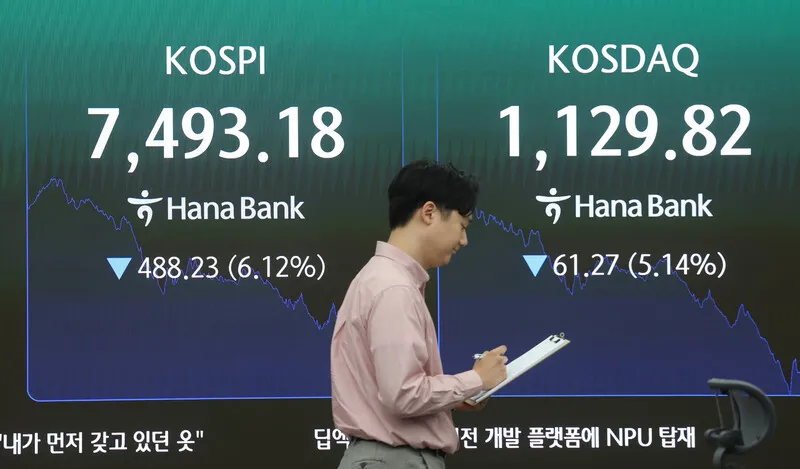
Complex Global Headwinds and Geopolitical Crises: Decoding the KOSPI Crash
The crash of the KOSPI to an intraday low of 7,371, which left the market in a state of shock, was caused by a simultaneous eruption of complex global headwinds and geopolitical crises that the South Korean stock market currently faces.
Here is the precise English translation of the sharp analysis detailing the real hidden reasons why market optimism looking toward “KOSPI 8,000” dissolved overnight, causing foreign capital to pull out like an ebb tide, along with the fatal impact of the U.S.-China summit’s outcome.
The aggressive sell-off by foreign investors is not simply because “prices have rallied significantly.” Their capital flight is backed by precise risk calculations.
1. The Core Hidden Reasons Behind Foreign Capital Flight
① The Samsung Electronics Strike Risk and Fear of GVC (Global Value Chain) Collapse
- The Hidden Reason: For foreign investors, the KOSPI is essentially synonymous with “semiconductors.” As the full-scale strike by the Samsung Electronics labor union—scheduled for May 21—shows imminent signs of becoming a reality, foreigners are deeply terrified of a potential shutdown of South Korea’s semiconductor production lines.
- The Impact: In semiconductor manufacturing, once a production line stops, it incurs astronomical financial losses. To proactively mitigate risk (de-risking) ahead of the scheduled strike date, foreign investors are aggressively offloading large-cap IT stocks, including Samsung Electronics.
② Paralysis of Logistics in the Strait of Hormuz and the “Plunge of the Won (FX Losses)”
- The Hidden Reason: Recent maritime logistics bottlenecks, highlighted by the sinking of an Indian cargo ship near the Strait of Hormuz, have dealt a direct blow to countries heavily dependent on energy imports like South Korea.
- The Impact: Surging oil prices worsen South Korea’s trade deficit, which immediately translates into a sharp rise in the USD/KRW exchange rate (a plunge in the value of the Won). From the perspective of foreign investors, even if stock prices remain flat, they suffer massive foreign exchange losses due to the weakening currency. Consequently, they are selling Korean stocks to convert their capital back into US dollars before the exchange rate deteriorates further.
③ Uncertainties Regarding the Transition to “Physical AI” and Advanced Manufacturing Bases
While domestic companies have recently accelerated their humanoid-based automation strategies—such as Hyundai Motor Group’s plans to deploy Atlas—foreigners are growing concerned. The uncertainty that immediate labor conflicts and raw material supply chain blockades could bottleneck these future growth engines has further fueled the foreign sell-off.
2. 🇺🇸🇨🇳 The Decisive Impact of the U.S.-China Summit Results
The direct fuse that ignited this KOSPI crash was the “breakdown-style conclusion” of the U.S.-China summit. As news broke that President Donald Trump boarded his plane without holding a final press conference or releasing a joint statement with President Xi Jinping, the market immediately began pricing in the worst-case scenario.
① Escalation of Taiwan-related “Geopolitical Risk”
Despite President Xi Jinping’s warning at the summit that “the two nations will clash if the Taiwan issue is mishandled,” Trump left without giving a definitive answer. This led the market to judge that military tensions in the Taiwan Strait have reached a boiling point. The fear that a paralysis of Taiwan’s TSMC would lead to the mutual destruction of the South Korean market—which is tightly bound to the same supply chain—triggered a panic-sell among foreign investors.
② Concerns over a Prolonged Blockade of the Strait of Hormuz
The U.S. expected China to leverage its influence over Iran to reopen the Strait of Hormuz, but the two leaders failed to reach an agreement. As the outlook for prolonged high oil prices and global logistics paralysis solidified, global hedge funds rapidly reduced their exposure to emerging markets, particularly focusing their cuts on the highly export-dependent South Korean stock market.
3. 📈 Future Outlook and Market Watershed
| Support Level (KOSPI) | Core Variables | Market Scenario |
|---|---|---|
| 7,000 ~ 7,200 Range | The May 21 Samsung Electronics Strike | If labor and management reach a dramatic agreement, short-covering (buying pressure) could trigger a rapid rebound. If the strike is pushed through, there is a risk of breaking below the 7,000 mark. |
| Long-term Direction | Trump’s Additional Messaging on China | If Trump opens up the possibility of a “backdoor deal” via social media after returning to the White House, the market is likely to stabilize quickly. |
💡 Summary Opinion: The sudden cancellation of the “KOSPI 8,000 ceremony” vividly demonstrates that the South Korean stock market is currently caught in a massive trap of “geopolitical crises (U.S.-China conflict/Middle East war)” and “internal risks (labor conflict/plunging currency).”
A return of foreign capital will only be possible once signals of easing tensions between the U.S. and China emerge, and labor-management conflicts within domestic core IT companies are resolved. For the time being, rather than making aggressive bottom-fishing bets, a defensive strategy aimed at securing cash while monitoring the May 21 strike milestone and oil price trends is absolutely necessary.