
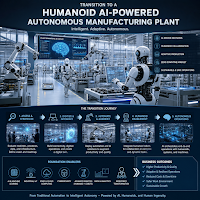
Transition to a Humanoid AI-Powered Autonomous Manufacturing Plant- Samsung
The humanoid-based AI-Driven Factory system envisioned by Samsung Electronics goes beyond simple automation. It is a strategic roadmap designed to drastically reduce reliance on human labor and directly tackle management uncertainties, such as labor union strikes and the “population cliff,” through advanced technology.
As of 2026, here is the detailed plan for building the production automation system currently being pursued by Samsung Electronics.
1. 🛰️ Samsung Electronics 2030 AI Autonomous Factory Transition & Unmanned Strategy
Overview: Why a “Humanoid-Based Autonomous Factory”?
Samsung Electronics aims to transform its major global production bases into AI autonomous factories with “Zero Human Input” by 2030.
- Overcoming Management Crises: Defending against the risk of recurring labor strikes and the weakening of cost competitiveness due to rising labor costs.
- Maximizing Productivity: Ensuring 24/7 uninterrupted operation and real-time yield optimization driven by AI.
- Technological Pre-emption: A “Manufacturing First, Commercialization Later” strategy—applying humanoid robots to manufacturing sites first to accumulate data and technical prowess before launching a full-scale robotics business.
2. Roadmap for Building the Production Automation System
| Phase | Period | Key Implementation | Core Technology |
|---|---|---|---|
| Phase 1: Infra Advancement | ~2026 | Digital Twin-based virtual factory construction & Agentic AI deployment | Real-time simulation, Quality control AI agents |
| Phase 2: Humanoid Deployment | 2026–2028 | Phased deployment of humanoids and specialized robots in all processes | Operating Bots, Logistics Bots, Assembly Bots |
| Phase 3: Full Autonomy | 2029–2030 | Completion of an autonomous factory where AI judges and operates without human intervention | Agentic AI-based decision-making systems |
3. Core Automation Solutions: The Triple Humanoid Robot System
Samsung is building a system that can be deployed immediately without modifying existing facilities designed for humans by utilizing human-shaped robots.
- Operating Bot: Responsible for production line operation and equipment inspection. It prevents line shutdowns by replacing essential maintenance tasks even during labor strikes.
- Logistics Bot: An autonomous mobile robot that goes beyond standard Automated Guided Vehicles (AGVs), capable of picking up and carrying materials through complex terrains.
- Precision Assembly Bot: An intelligent robot that mimics human dexterity to assemble micro-components for semiconductor packaging and home appliances.
4. Strategic Measures to Eliminate Corporate Concerns
Specific countermeasures to remove the “Achilles’ heel” of the company, such as labor strikes and the shortage of skilled workers:
- Digital Twin-based Emergency Operation: In the event of a strike, the process is simulated in a virtual world, and robots are controlled remotely to maintain production with minimal personnel.
- Strengthening Industrial AI Governance: Internalizing safety devices and control systems during robot deployment to prevent risks such as equipment damage or process interference by striking personnel.
- Transition to R&D-centric Human Resources: Reducing simple manufacturing labor through natural attrition while reassigning existing personnel to robot operation and software R&D roles to minimize employment conflict.
5. Conclusion and Future Outlook
Samsung Electronics’ humanoid automated production system represents a new paradigm in manufacturing where “technology replaces labor uncertainty.”
- MWC/CES 2026 Announcement: Samsung has officially confirmed that it is already deploying humanoids at manufacturing sites to accumulate technology.
- Expected Effects: Securing resilience to keep production disruptions within 5% even during strikes and reducing manufacturing costs by more than 30%.
💡 Summary Opinion: Samsung’s unmanned strategy will serve as the most powerful “technological deterrent” against unreasonable labor demands. By 2030, when robots fully replace human labor, Samsung is expected to complete a true “24/7 non-stop production system” free from human-related risks.
[Reference]
In March 2026, at MWC in Spain, Samsung Electronics announced its “2030 AI Autonomous Factory Transition Strategy,” declaring the introduction of humanoids across all manufacturing processes. If this project succeeds, labor management—historically the company’s greatest risk—will shift from being an object of management to an object of “technological overcome.”