
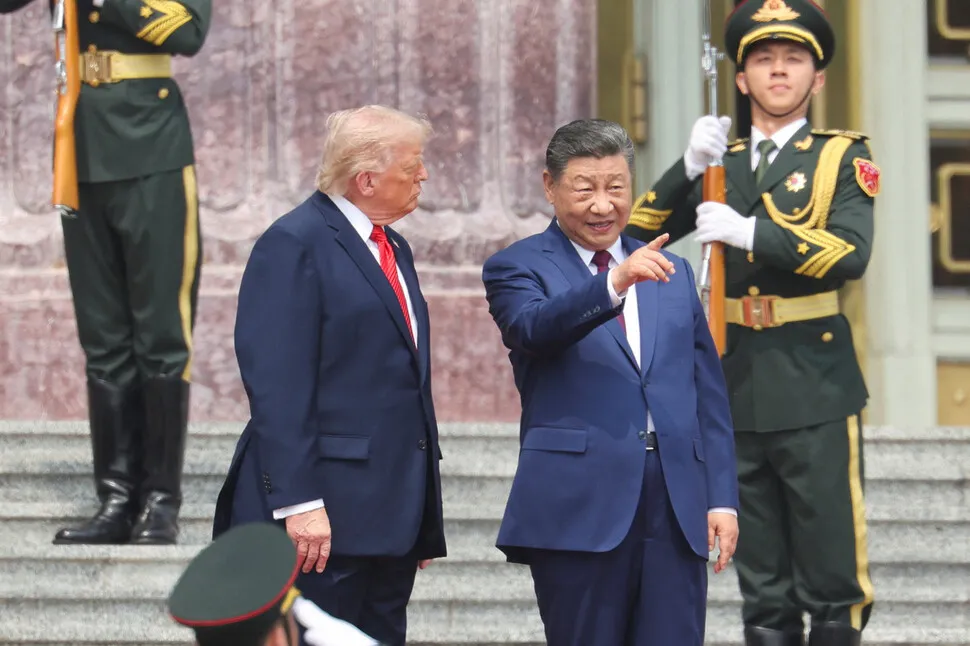
at the USA-China summit
Inference on the Ideal Solution to the Taiwan Issue
President Xi Jinping’s remarks serve as a powerful warning regarding the Taiwan issue, which remains the most volatile powder keg in U.S.-China relations in 2026. Effectively, China has reaffirmed its “red line” against the Trump administration’s use of Taiwan as a bargaining chip.
Here is an in-depth analysis of the ideal solutions to this issue and the potential changes in the IT industry and international landscape under a war outbreak scenario.
1. 🕊️ Ideal Solutions for the Taiwan Issue
In the current climate of extreme confrontation, the most realistic and ideal solution is a “Status Quo 2.0” agreement.
- Redefining Strategic Ambiguity: Mutual assurances are needed where the U.S. respects the “One China” policy while supporting Taiwan’s self-defense, and China formalizes the principle of “peaceful unification,” thereby deferring the use of force.
- Leveraging Economic Buffers: Taiwan should be defined not as a political bone of contention, but as a “public good” for the global semiconductor supply chain. This strengthens the “Silicon Shield,” as both the U.S. and China must acknowledge that attacking or blockading Taiwan would be economically catastrophic for themselves.
- Multilateral Security Dialogue: It is ideal to move beyond a bilateral U.S.-China framework and establish a regional security council involving neighboring countries (South Korea, Japan, ASEAN) to create a permanent channel for preventing accidental clashes.
2. 💻 Impact on IT Companies and the Industry if China Attacks Taiwan
An invasion of Taiwan would trigger a “Digital Dark Age” for the global IT industry.
- Immediate Collapse of the Semiconductor Supply Chain: Operations at TSMC, which holds over 60% of the global foundry market and 90% of the advanced process market (3nm and below), would cease. This means production for major fabless companies like Apple, NVIDIA, AMD, and Qualcomm would come to a complete standstill.
- Global IT Inflation: Prices for graphics cards, smartphones, and server CPUs would skyrocket by dozens of times. Beyond mere price hikes, this would lead to extreme shortages where products simply vanish from the market.
- Crisis and Opportunity for Samsung & SK Hynix: While demand might shift to Korean firms to fill the void, South Korea would likely fall within the war’s influence zone (logistics blockades), risking an inability to procure raw materials.
- Stagnation of Software and Service Industries: As hardware distribution stops, cloud expansion and AI service advancements by companies like Google, Meta, and Microsoft would hit physical limits due to a lack of infrastructure.
3. 🌏 Predicted Scenarios for Regional and International Geopolitics
Should China proceed with military action, the world order would undergo its greatest upheaval since World War II.
🔴 Scenario A: Direct U.S.-China Collision and Total War (The Worst Case)
- U.S. and Japan: Per the U.S.-Japan alliance, U.S. forces stationed in Japan would intervene, with the Japan Self-Defense Forces providing rear support, turning all of Northeast Asia into a battlefield.
- South Korea’s Dilemma: The risk of a second Korean War escalates as the deployment of U.S. Forces Korea (USFK) meets potential provocations from North Korea. South Korea would face the double burden of an economic cliff with China and a national security crisis.
🟡 Scenario B: Maritime Blockade and Economic Warfare (Long-term Attrition)
- Paralysis of Maritime Logistics: The South China Sea and Taiwan Strait are routes for one-third of global shipping. A blockade would cut off energy (oil, gas) imports for South Korea and Japan, paralyzing their economies.
- Completion of Bloc-based Decoupling: Strong Western sanctions against China met by China’s weaponization of resources would solidify a “New Cold War,” completely dividing the world into “Democratic” vs. “Authoritarian” blocs.
🔵 Scenario C: Short-term Occupation and a “Fait Accompli” (Grey Zone Strategy)
- Neutralization of International Order: If U.S. intervention is delayed or fails, U.S. global hegemony effectively ends.
- Accelerated Armament of Neighbors: Doubts about the U.S. security umbrella would cause calls for independent nuclear armament to surge in South Korea and Japan, plunging Northeast Asia into an extreme arms race.
💡 Summary Opinion
President Xi’s remarks were clearly aimed at the “transactional diplomacy” style of the Trump administration, making it certain that “Taiwan is not a subject for trade.”
If China actually attacks Taiwan, it would represent a “crisis of survival” for IT companies and a “crisis of national existence” for neighboring countries. Therefore, the installation of “guardrails” through high-level U.S.-China channels to prevent accidental conflict is more urgent now than ever before.