
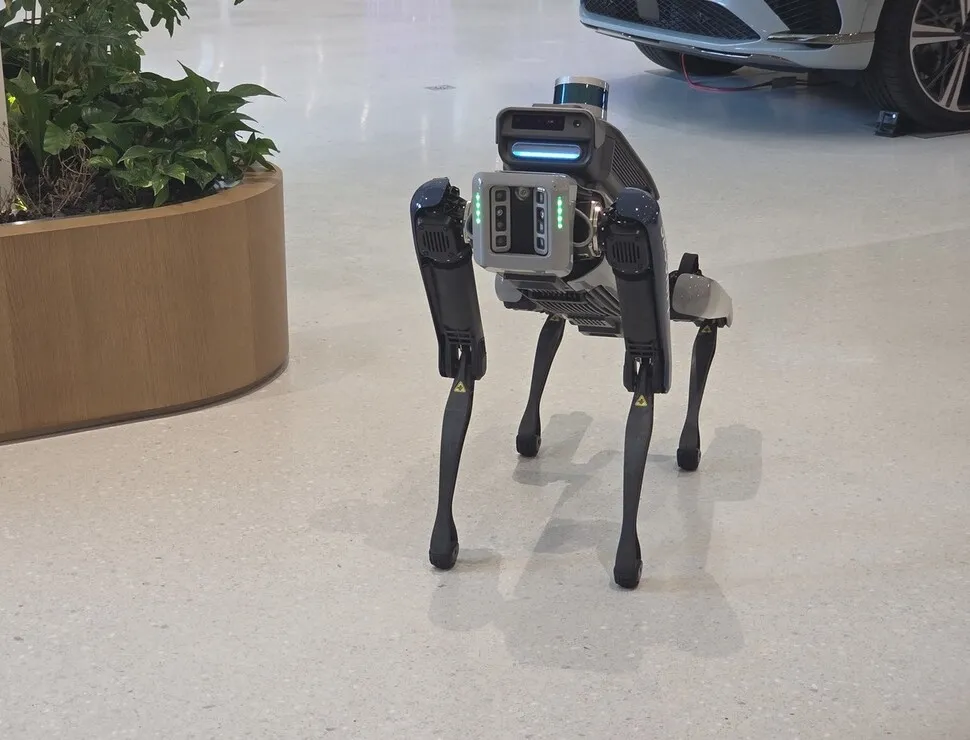
Serving as a Hub for Physical AI: Hyundai Motor Group’s Vision
It is highly symbolic that Hyundai Motor Group’s “Yangjae Headquarters” is transforming beyond a simple workspace into a front-line base for Physical AI. This expresses a strong commitment to opening an era where robots understand and interact with the human physical environment.
Here is an analysis of the current status of humanoid robots in real-life contact points, prospects for acceleration by sector, and the key companies involved.
1. 🤖 Current Status of Humanoid Robots in Real Life (As of May 2026)
Humanoid robots have now moved out of the “lab” and are just beginning to enter “special-purpose commercial facilities.”
- Airports & Hotels: In May 2026, Japan Airlines (JAL) deployed humanoids at Haneda Airport to begin baggage loading and cabin cleaning tasks.
- Logistics & Manufacturing: Models like Agility Robotics’ “Digit” in Amazon fulfillment centers and Figure AI’s “Figure 01” in BMW/Mercedes plants are demonstrating early human-robot collaboration by performing simple, repetitive tasks.
- Everyday Penetration: Their use as domestic helpers in general households remains limited due to price (approx. $30,000–$50,000+) and safety concerns. However, they are narrowing the psychological gap by providing customer-facing services in exhibition halls and corporate lobbies (such as Hyundai’s Yangjae HQ).
2. 🚀 Acceleration Outlook by Service Sector
The point at which humanoids fully integrate into daily life will depend on the “mass production of hardware” and the maturity of “AI capable of handling unstructured environments.”
① Logistics & Manufacturing (2025–2027: Early Adoption)
- Outlook: The first sector to accelerate. Operations will begin in standardized spaces, focusing on moving uniform boxes and part assembly.
- Acceleration Point: With Tesla announcing the mass production of “Optimus” starting around July–August 2026, the deployment of humanoids in large-scale factories worldwide will become commonplace by 2027.
② Delivery & Small Business Assistance (2027–2029: Expansion Phase)
- Outlook: Deployment in “Last Mile” delivery—moving goods from delivery trucks to the customer’s front door. The ability to climb stairs and use elevators is the core requirement.
- Acceleration Point: A major turning point will occur in 2028, when Hyundai Motor Group releases commercial models based on data accumulated from deploying Atlas in manufacturing facilities.
③ Medical & Caregiving (2028–2030: Professional Service Phase)
- Outlook: Sectors requiring precise and gentle movements, such as patient transport, walking assistance for the elderly, and medication management.
- Acceleration Point: Acceleration is expected around 2030, primarily in countries with aging populations, as safety regulations for physical contact with humans become established.
④ Domestic Housekeeping (Post-2030: Mass Market Phase)
- Outlook: Handling the most complex and unstructured tasks, such as making beds, washing dishes, and sorting laundry.
- Acceleration Point: The dawn of the “One Robot per Household” era is expected in the early 2030s, when prices drop to the level of a mid-sized car (approx. $20,000).
3. 🏢 Key Companies Leading the Physical AI Era
| Company | Core Model | Strategy & Strengths |
|---|---|---|
| Boston Dynamics (Hyundai) | New Atlas (All-Electric) | Combining unrivaled control technology with Hyundai’s manufacturing infra. Aiming for field deployment by 2028. |
| Tesla | Optimus | Implementing automotive mass-production know-how into robotics. A leader in intelligent robots via AI training (FSD tech). |
| Figure AI | Figure 02 | Capable of human conversation and task execution via ChatGPT (OpenAI). Massive investment from Big Tech like NVIDIA and MS. |
| Agility Robotics | Digit | Optimized for logistics. Accumulating real-world operational data within Amazon fulfillment centers. |
| Physical Intelligence | P-0 (AI Model) | Focused on developing a “General-Purpose Brain” for robots that can be ported to any hardware, not just a specific robot. |
💡 Summary Opinion
The “Physical AI” emphasized by Hyundai Motor Group Chairman Euisun Chung means more than robots just understanding human language; it means robots acting naturally like humans in physical spaces.
If the present is the “Learning Phase in Factories (2025–2027),” the deployment of Hyundai’s Atlas in 2028 will mark the beginning of the “Era of Robots Commuting to Commercial Facilities (2028–2030).” It is only in the 2030s that we will truly enter “Robot Normalization,” where we wake up to coffee prepared by a robot every morning.
The robot station in the Yangjae HQ lobby is not a simple exhibit; it is a “Countdown Watch” signaling that the future is closer than we think. The performance of Hyundai’s Atlas in manufacturing sites in 2028 will be the accelerator for this entire timeline.
Leave a Reply