
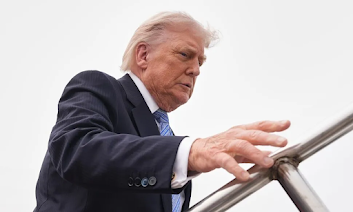
An Intractable Stalemate: Unpacking Trump’s No-Press-Conference Exit
President Donald Trump’s departure from Beijing without a “joint statement” or a “final press conference” following the U.S.-China summit can be interpreted as a classic Trump-style, thoroughly calculated “business-style pressure strategy.”
In diplomatic circles, exiting without releasing an agreed document usually signals a “breakdown.” However, in Trump’s playbook, it sends a powerful message: “Since I did not get all the concessions I wanted, I am going to shake the table before I leave.”
Here is an analysis of Trump’s hidden motives broken down into a few key scenarios.
1. 🇺🇸 Trump’s 3 Hidden Agendas for Leaving Without a Press Conference
① “Unyielding Deadlock” on the Taiwan Issue (Taiwan Redline)
Just before the summit, President Xi Jinping drew a firm red line, stating that “if the Taiwan issue is mishandled, the two nations will clash.”
- Trump’s Hidden Motive: Trump views Taiwan as the ultimate “bargaining chip” to destabilize China in trade negotiations and the battle for semiconductor hegemony. He likely did not want to give a definitive answer on the Taiwan issue under pressure from Xi’s warning, nor did he want to overstimulate China and trigger an immediate military conflict.
- Strategy: Knowing that a press conference would inevitably draw a barrage of questions regarding Taiwan, his calculation was to maximize “strategic ambiguity” and maintain the upper hand by avoiding the briefing altogether.
② “Action, Not Words” (Hormuz and Trade Pressure)
The U.S. pressured China to leverage its influence over Iran to reopen the Strait of Hormuz and engage in peace talks. China likely stuck to its textbook stance of “mediation through dialogue.”
- Trump’s Hidden Motive: This reflects a cold business mindset: “Until China takes tangible action (such as a total ban on Iranian oil imports), I will not hand over any diplomatic achievements as a gift.” Signing an agreement would give China breathing room, so his goal is to keep the leash tight by leaving the alliance in an “unresolved” state.
③ “Showmanship” for Domestic Politics
What matters most to Trump is how he is perceived by voters back home in the United States.
- Trump’s Hidden Motive: Instead of standing side-by-side with President Xi to announce a lukewarm compromise, showcasing that “I walked out on my own feet because China failed to cooperate properly” is far more effective at rallying hardliners and voters in the U.S. It is a highly sophisticated political staging to maintain his “strong leader” frame regarding the U.S.-China trade deficit and job market issues.
2. 📈 Anticipated Impact on Markets and International Relations
| Category | Predicted Scenario | Market Reaction |
|---|---|---|
| Short-term Conflict | The U.S. and China immediately announce additional tariffs or retaliatory measures against each other. | Global stock markets plunge; safe-haven assets (USD, Gold) surge. |
| Logistics & Oil Prices | Uncertainty persists due to delays in negotiations to reopen the Strait of Hormuz. | WTI oil prices attempt to break through the $110–$120 per barrel range. |
| Semiconductors/IT | Prolonged Taiwan risk accelerates supply chain diversification. | Anxiety over TSMC heightens; Samsung and SK compete to secure semiconductor inventory. |
💡 Summary Opinion
The message Trump delivered as he boarded his plane is clear: “The ball is now in your court, Xi. Come to Washington with a card that satisfies me.”
While there was no joint announcement, fierce back-and-forth negotiations (backdoor deals) among working-level officials will continue behind the scenes.
The short-term direction of global oil logistics and IT supply chains will depend heavily on whatever bombshell statements or conditions Trump drops via his signature social media platforms (such as Truth Social) the moment he arrives at the White House. There is a very high probability that the real invoice will be delivered via “Trump’s mouth” in the near future.