
Global Geopolitics 2035: CRINK Bloc vs. Maritime Alliance, New Energy, and AI Semiconductor Supply Chains
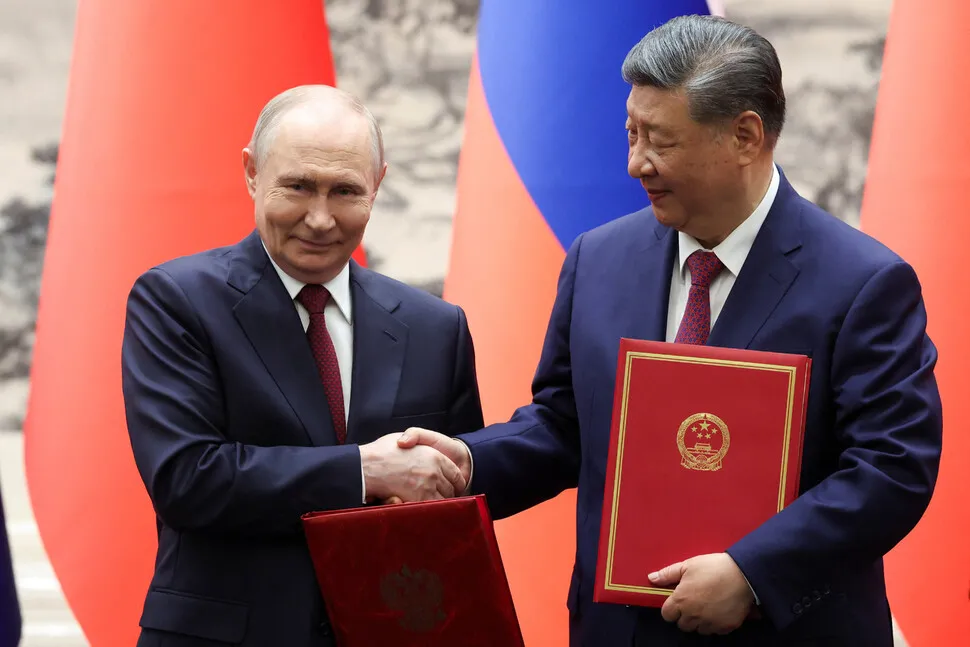
The summit between Chinese President Xi Jinping and Russian President Vladimir Putin, held in Beijing on May 20, 2026, starkly illustrated the massive fault lines in the global power landscape. Traveling closely on the heels of US President Donald Trump’s visit to China, this snap meeting saw both leaders unleash a fierce joint critique of US-led unilateralism, branding it the “law of the jungle,” while formalizing an ultra-close alignment known as the “CRINK” (China-Russia-Iran-North Korea) alliance.
This analysis delves into how this sweeping geographical realignment will organically intertwine with the race for new energy dominance and the hyper-sophistication of AI semiconductor supply chains over the next decade (up to 2035).
1. Geopolitical Realignment: Continental Power (CRINK) vs. Maritime Power (ROK-US-JPN-ASEAN)
The China-Russia summit has cemented a massive, overarching geopolitical axis traversing the Eurasian continent. This development is driving an all-out confrontation with established maritime powers.
The Solidarity of the CRINK Continental Axis
- Energy-Military Interdependence: In the wake of the Israel-Iran war, which pushed the Strait of Hormuz to the brink of a total blockade, China successfully secured a stable supply of Russian oil and gas (including the Power of Siberia 2 pipeline). This structural synergy effectively offsets Iran’s geopolitical liabilities with Russia’s vast land-based resources.
- A Shield Against North Korean Risks: By explicitly stating their “opposition to external pressure on North Korea,” both leaders signaled a firm resolve to maintain a robust tactical buffer zone in Northeast Asia to counter the trilateral cooperation of South Korea, the United States, and Japan.
The Containment Strategy of the ROK-US-JPN and ASEAN Maritime Axis
- Fortification of the South China Sea and Taiwan Strait: Led by the trilateral security alliance of Washington, Seoul, and Tokyo, the US is weaving a tight, lattice-like security network by integrating key ASEAN nations like the Philippines and Vietnam to restrain China’s maritime expansion.
- The Crux of the Power Shift: Moving forward, the geopolitical struggle will not pivot on outright military clashes, but rather on the mastery of key maritime choke points and the velocity of supply chain localization.
2. New Energy Production and Commercialization Trends (2026–2035)
Intensifying carbon-neutrality mandates from the US, Japan, and Europe—juxtaposed with chronic Middle East volatility—are paradoxically acting as a powerful catalyst, accelerating global energy independence and the commercialization of alternative energy sources.
| Category | Core Energy Sources & Technologies | Geopolitical Dynamics & Supply Chain Flows |
| Continental Power (CRINK) | Localization of Traditional Fossil Fuels + Monopolization of Solar & Hydrogen Infrastructure | Blends Russian natural gas and Iranian crude directly into China’s manufacturing engine. Attempts to build a self-reliant hydrogen and clean-energy belt based in Central Asia to bypass Western Carbon Border Adjustment Mechanisms (CBAM). |
| Maritime Power (ROK-US-JPN-ASEAN) | SMRs (Small Modular Reactors) + Next-Gen Batteries & Maritime Hydrogen Logistics | Shaken by vulnerabilities in gas and crude supply chains due to the Strait of Hormuz crisis, this bloc has aggressively pulled forward the commercialization of decentralized SMR networks to the early 2030s. South Korea and Japan are wagering heavily on securing green hydrogen maritime networks linked to Australia and Southeast Asia. |
3. The Great Shift in AI Semiconductor Production and Consumption Lines
By 2035, the AI semiconductor industry—the definitive brain of the global economy—will undergo a fierce “Techno-Nationalism” (or technological balkanization), shattering production (supply) and consumption (demand) lines based on hard security alliances.
[Production Supply Chain: Diversifying the Sourcing Footprint]Taiwan (TSMC) / S. Korea (Samsung/SK) Frontier Nodes ──> Gradual migration to US-based manufacturing fabs (Early Stabilization) └──> Explosive rise of ASEAN (Vietnam/Malaysia) as OSAT packaging hubs[Consumption Mechanism: A Binary Market Split]Western Bloc ──> Mega AI Data Centers driven by US Big Tech(Monopolization of HBM4 / 1.6nm to 2nm chips)Continental Bloc ──> China-centric native AI ecosystem & heavy consumption of legacy or custom-designed chips for Russia/Iran resource management
Fragmentation and Relocation of Production Lines
In response to risks surrounding the Taiwan Strait and the compounding proximity between Beijing and Moscow, the US is enforcing the domestic and near-shore relocation (to friendly zones like Japan and Europe) of South Korea’s HBM (High Bandwidth Memory) technology and Taiwan’s foundry hubs. Notably, Southeast Asia (Malaysia, Vietnam) is rapidly emerging as a critical geopolitical buffer zone in the outsourced semiconductor assembly and test (OSAT) sector.
The Dependence of Consumption Lines
The primary demand centers for AI semiconductors remain artificial intelligence supercomputers and hyper-scale data centers. While the US and its allies seek to lock down advanced nodes at or below 2nm to sustain an absolute monopoly over frontier AI, China will aggressively counter this by weaponizing its massive domestic market to deploy and entrench a proprietary consumption ecosystem built on Internet of Things (IoT) hardware and legacy-node processes.
4. Conclusion: The Three-Way Osmosis of Geopolitics, Energy, and AI
“There is no future tech without geopolitical security.”
The next ten years will be defined by a new paradigm where geographic bloc-formation completely dictates the flow of technology and energy.
- Energy Dictates AI: Post-2030, the sheer volume of electricity consumed by global AI data centers will defy imagination. If fossil fuels are destabilized by Middle Eastern bottlenecks like Hormuz, only those nations that pre-emptively lock down SMRs and next-generation clean energy supply chains will hold the keys to next-gen AI supremacy.
- AI Dictates Geopolitical Security: Mastery over advanced AI semiconductor hardware translates directly into absolute military superiority (autonomous drones, satellite interception, and cyber warfare). The CRINK alliance is an attempt to offset technological deficits via resource coercion; conversely, the ROK-US-JPN alignment is a strategy to shatter resource blocs through overwhelming, asymmetric technological superiority.
South Korea sits squarely at the absolute frontline of this massive geopolitical fault line. To survive the dawning international order of 2035, Seoul must firmly anchor itself within the US-led advanced AI semiconductor value chain while rapidly diversifying its energy portfolio—accelerating SMR deployment and securing overseas hydrogen strongholds—to insulate itself from the risks of geopolitical isolation.
Leave a Reply