
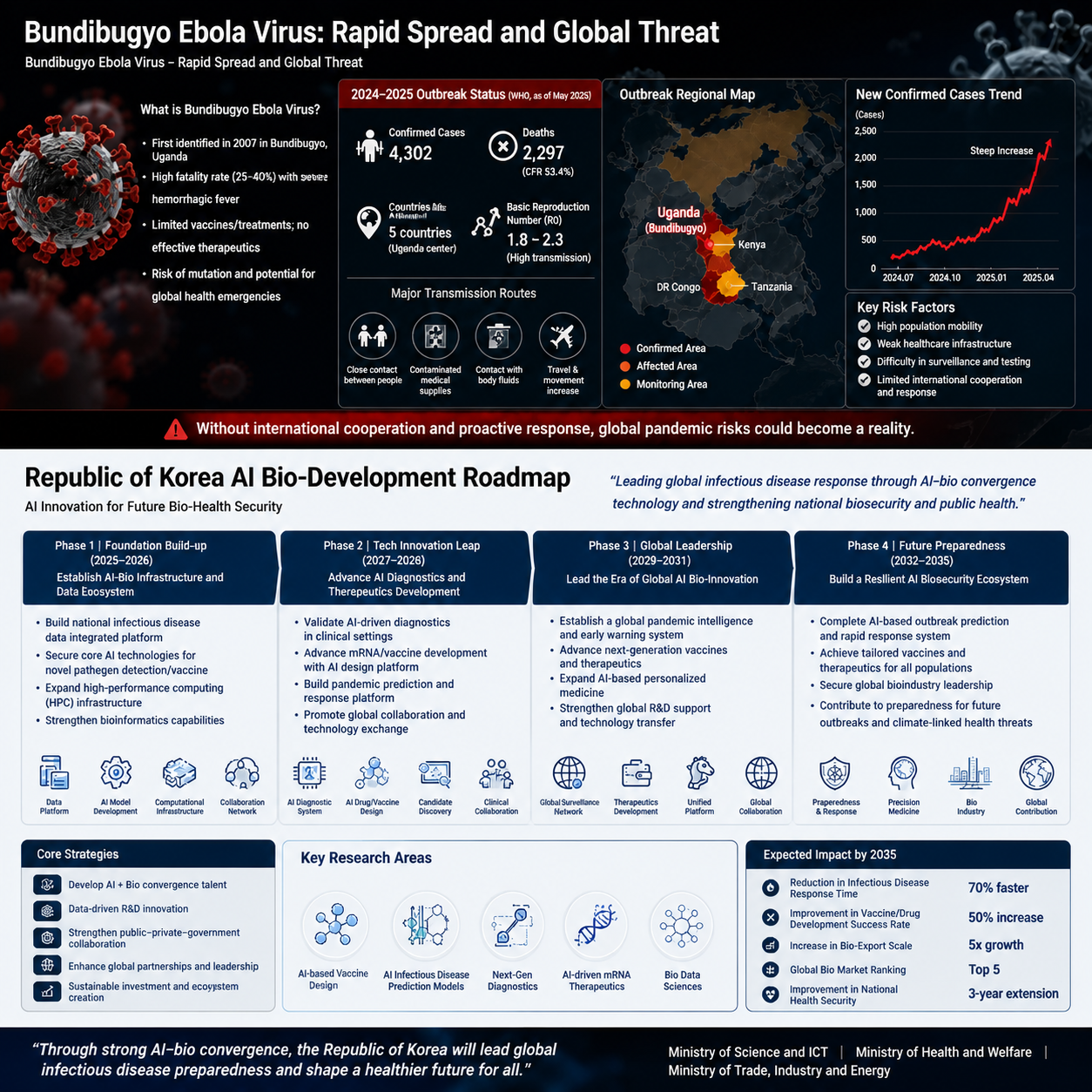
Virus Spread – The Current State of the AI Bio Industry and Its Future Investment Value
The rapid spread of the Bundibugyo Ebola variant in the Democratic Republic of the Congo (DRC) is heightening international anxieties over yet another global health security crisis. Due to the lesson learned from the past COVID-19 pandemic—which triggered global supply chain disruptions and economic contraction—the international community is now singling out “AI bio-technology” as a core weapon to counter emerging infectious diseases.
Amid this global health crisis, we analyze the current status of South Korea’s AI bio-industry, government-backed R&D roadmaps, and future investment value.
1. South Korea’s AI Bio-Industry: Current Status
Backed by an exceptional medical IT infrastructure and high-quality healthcare datasets (such as clinical data from major hospitals and the National Health Insurance Service), South Korea’s AI bio-industry is rapidly distinguishing itself in the global marketplace.
- Advancement of AI-Driven Drug Discovery Platforms: Platforms that utilizing AI algorithms to compress the traditional decade-long drug candidate discovery period into mere months are entering the commercialization phase. Even when a novel virus with no existing vaccine or treatment emerges, such as the Bundibugyo variant, the industry possesses the technical expertise to analyze viral protein structures via AI and design inhibitors at ultra-high speeds.
- Global Competitiveness in Digital Healthcare and Diagnostic AI: South Korea’s flagship AI medical firms, including Lunit and Vuno, have already achieved widespread recognition for their technical prowess in international markets. AI solutions that diagnose pulmonary diseases or critical changes in vital signs triggered by infectious diseases are performing pivotal roles at the absolute forefront of pandemic quarantine efforts.
- Convergence with Traditional Bio (Biosimilars/CMO): Integrating AI technology with South Korea’s globally dominant Contract Manufacturing Organization (CMO) capabilities for biopharmaceuticals is actively driving process optimization and maximizing production yields.
2. Government-Backed AI Bio Development Plans: R&D Roadmap
The South Korean government has designated the digital transformation of the bio-health supply chain as a national strategic priority, aggressively expanding both policy and financial framework support.
- Federated Learning-Based Drug Discovery Activation Project (K-MELLODDY): The government is constructing a Federated Learning infrastructure designed to safely train algorithms across multiple institutions while resolving medical data privacy concerns. This initiative is dramatically accelerating the development speed of vaccines and therapeutics tailored to novel variants.
- Creation of Government-Led Bio Transformation Funds: Hundreds of billions of won in government-matched venture funds are being deployed to intensively support startups and SMEs developing AI medical devices, digital therapeutics (DTx), and generative AI drug discovery platforms.
- Regulatory Sandboxes and Accelerated Review Systems: To respond swiftly to international public health emergencies like the Ebola outbreak, the government is streamlining fast-track protocols to shorten clinical trial approval and licensing procedures for AI-based diagnostic kits and therapeutic candidates.
3. Future Investment Value Outlook for South Korea’s AI Bio-Industry
Geopolitical and biological hazards, such as the Ebola outbreak in the DRC, paradoxically function as investment catalysts that strengthen the long-term growth momentum of the AI bio-sector.
① Soaring Value of Ultra-Fast Drug Discovery (Generative AI) Platforms
The emergence of the Bundibugyo Ebola variant—for which no vaccine exists—directly elevates the corporate valuation of enterprises equipped with mRNA platforms and generative AI design technologies. Platform companies capable of executing large-scale virtual screening to preemptively identify antibodies or chemical compounds that bind to mutated viruses are poised to capture market dominance.
② Benefiting from the Realignment of Global Supply Chains
In the post-COVID-19 era, global Big Tech firms and multinational pharmaceutical corporations are aggressively diversifying their supply chains. South Korea, which simultaneously boasts a stable IT infrastructure and a powerful manufacturing base, is highly regarded as an attractive partner for AI-bio convergence businesses, dramatically increasing the likelihood of foreign venture capital (VC) inflows.
③ Risk Factors and Investment Caveats
Core Conflict: While AI bio investments offer substantial high-yield potential, investors must dispassionately evaluate actual clinical trial success rates and global commercialization viability.
- Verifying Tangible Milestones: Investors should verify whether a company is merely stuck at the initial stage of “discovering candidates via AI,” or if it possesses a robust pipeline capable of entering Phase 1/2 clinical trials or securing global Licensing-Out (L/O) agreements.
- Global Regulatory Barriers: Securing data reliability and Explainable AI (XAI) technologies capable of navigating the stringent licensing benchmarks of the US FDA or European EMA will be the ultimate yardstick determining long-term corporate value.
In conclusion, while the spread of the Ebola variant in Africa poses a profound threat to humanity, South Korea’s AI bio-industry—fortified by comprehensive government backing—is transcending a simple market theme. It is evolving into essential infrastructure for the global market, positioning itself as a premium arena for high-value long-term investment.
Leave a Reply