
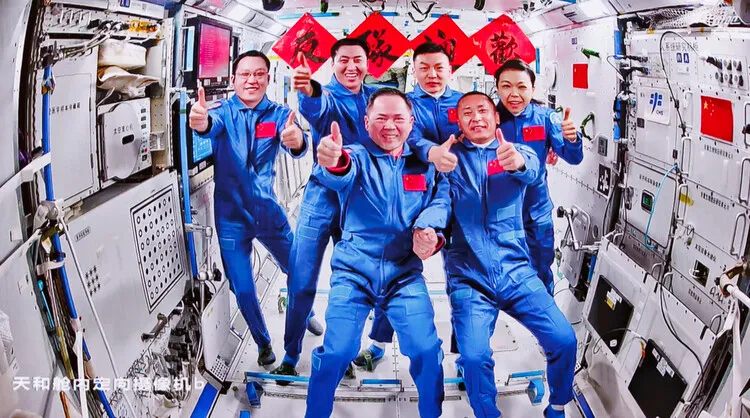
China’s “one-year long-term space station residency experiment” via the crewed spacecraft Shenzhou 23 is not merely for breaking records. It is a final rehearsal designed to test the limits of the human body under microgravity and space radiation environments, ultimately aiming for massive economic territory expansion through lunar subsurface resource mining and the construction of manned bases on the Moon and Mars.
From the perspective of capital markets and technological innovation, this analysis provides an in-depth look into the future roadmap for space territory development, autonomous robotic infrastructure deployment, and mid-to-long-term investment outlooks.
1. Roadmap for the Development of Lunar Subsurface Resource Special Zones (Lunar SEZ)
The Moon is being redefined from a mere object of exploration into a “space mineral territory” capable of solving Earth’s energy and resource crises. The core targets are Helium-3 ($\text{He}^3$), a raw material for future clean nuclear fusion power generation, and water (hydrogen and oxygen), which will be converted into fuel for deep-space navigation.
[Phase 1: Territory Preemption & Resource Mapping (2026–2028)]
- Key Events: China’s Chang’e 7 (scheduled for launch in 2026) and Anglo-American Artemis unmanned probes will conduct intensive surveys of permanently shadowed regions at the lunar South Pole.
- Roadmap Core: This stage involves creating precise 3D geological maps of promising resource-rich areas and delineating boundaries for de facto Special Economic Zones (SEZs) where exclusive resource rights can be exercised in the future.
[Phase 2: In-Situ Resource Utilization (ISRU) Pilot Testing (2028–2030)]
- Key Events: Missions like Chang’e 8 (scheduled for launch in 2028) will conduct 3D printing experiments to build base structures by melting lunar regolith, alongside hydrogen/oxygen extraction tests.
- Roadmap Core: Perfecting infrastructure deployment technologies that utilize 100% local resources to eliminate the astronomical costs of shipping heavy construction materials from Earth.
2. Unmanned Robotic Mining & Autonomous Operational Infrastructure
It is practically impossible for humans to directly mine with pickaxes under the extreme environments of the Moon and Mars (characterized by harsh radiation, microgravity, and temperatures below -180°C). Consequently, initial resource infrastructure deployment will be driven entirely by 100% autonomous robotic swarm systems.
[Subsurface Mineral Exploration Drone/Sensor] ──> [Autonomous Crawler Mining Robot] ──> [Mobile Unmanned Refining & Extraction Unit] │ │ │ (Detects Volatiles & Resources) (Digs Regolith & Helium-3) (Separates Hydrogen, Oxygen & Gas)
Overcoming Mechanical Engineering Limits in Non-Earth Orbits
- Low-Gravity Anchoring Technology: The Moon possesses only $\frac{1}{6}\text{th}$ of Earth’s gravity, and Mars has $\frac{1}{3}\text{rd}$. When a standard unmanned excavator attempts to dig, the chassis bounces upward. To overcome this, specialized machinery equipped with biomimetic claws and screw-type anchoring systems will be deployed to secure legs firmly onto the surface.
- Space Wear Prevention Materials (Abrasive Moon Dust): Because there is no atmosphere on the Moon, lunar dust is unweathered and as sharp as glass shards. If this dust enters the joints and bearings of unmanned robots, it causes immediate mechanical wear. Specialized mobility robots utilizing electrostatic shielding films and nano-diamond coating technologies will be deployed.
- AI Autonomous Swarm Control: Real-time remote control is impossible due to communication latencies with Earth (approx. 1.3 seconds for the Moon, and up to 40 minutes round-trip for Mars). Embedded AI control technology based on Large Language Models (LLMs) is crucial, enabling robots to assess terrain independently and cooperate to forge mining paths.
3. Manned Deep-Space Habitation & Interplanetary Base Construction Roadmap
The 1-year residency data collected from Shenzhou 23 directly translates into vital “life support and radiation shielding data” required when humanity leaves the protective shield of Earth’s magnetic field to reside permanently in deep-space bases.
+-------------------------------------------------------------------------+| 3-Stage Deep-Space Manned Base Construction Schedule |+-------------------------------------------------------------------------+| || [Stage 1: Orbital Station Infrastructure Deployment (2026–2029)] || • Analyze long-term physiological impacts based on Tiangong's 1-year data|| • Initiation of the U.S. Lunar Gateway construction || │ || ▼ || [Stage 2: Manned Semi-Permanent Lunar Surface Base (2030–2035)] || • Chinese manned lunar landing before 2030 (using Mengzhou & Lanyue) || • Operational launch of the ILRS and Artemis Base Camp || │ || ▼ || [Stage 3: Mars Outpost & Deep-Space Expansion (2035–2040+)] || • Leverage lunar bases as "space gas stations" to launch Mars missions || • Construct Mars bases powered by Controlled Ecological Life Support || Systems (CELSS) || |+-------------------------------------------------------------------------+
China has already announced its plans for a manned lunar landing before 2030 by combining the heavy-lift rocket Long March 10, the next-generation crewed spacecraft Mengzhou, and the lunar lander Lanyue. The schedule outlines completing a semi-permanent base on the lunar surface by 2035 and using it as a stepping stone to advance toward building manned bases on Mars in the 2040s.
4. Core Value Chains and Investment Outlook from a Global Capital Perspective
While space exploration in the past was a tax-consuming race driven by national prestige, it has now transformed into an “infinite asset expansion market” led by SpaceX’s Starship and Chinese commercial space enterprises. From a long-term perspective, capital will flow into the following high-value core sectors:
| Value Chain Classification | Core Technology Areas & Target Companies | Investment Value & Valuation Momentum |
| Space Logistics & Payload Transportation | Reusable super-heavy rockets, lunar lander manufacturing, space orbital shuttle (Space Tug) developers. | Gateway to the Early Space Market: Secures rapid and massive revenue visibility by monopolizing logistics contracts to transport materials and robots to the Moon for base construction. |
| Space Autonomous Mobility & AI | Low-gravity autonomous excavators, space-grade robotic arms, AI autonomous swarm control software firms. | Monopolistic Technological Moat: Companies holding hardware and software patents validated in harsh space environments will escalate into indispensable partners for global space programs. |
| Space Energy & Life Support | Micro space nuclear reactors (Nuclear Power), lunar surface solar grids, closed-loop life support systems. | Essential Commodities for Long-Term Stay: Energy infrastructure companies that supply uninterrupted 24/7 power to unmanned mining rigs and manned bases will become the “mega-cap utility stocks” of space. |
💡 Final Summary Guide for Investors:
The successful launch of Shenzhou 23 and the 1-year astronaut residency challenge serve as a powerful trigger accelerating the feasibility of the Space Economy. While the space business carries high risks, it yields irreplaceable monopolistic power once infrastructure is established.
Investors should steer clear of short-term theme-driven stock speculation. Instead, portfolios should proactively include robotics companies with original technologies in autonomous lunar mining, manufacturers of ultra-lightweight, high-strength advanced materials (such as metal matrix composites) used in space environments, and engineering firms possessing Small Modular Reactor (SMR) capabilities to supply power to space infrastructure. This approach ensures a strategic share in the fruits of this long-term mega-trend.