
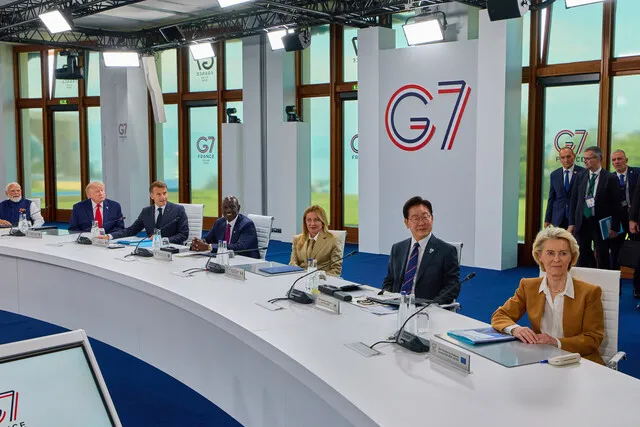
President Lee Jae-myung’s remarks on the “Global AI Basic Society” and technology aid for developing nations at the G7 Outreach Summit ostensibly advocate for international solidarity and humanitarian assistance. However, looking beneath the surface from an investor’s perspective reveals a highly sophisticated, multi-dimensional strategy: positioning South Korea to seize control of critical nodes in the global supply chain—specifically AI semiconductors, defense, and space robotics—amid the emerging New Cold War paradigm (geopolitical risks).
We analyze the macroeconomic scenarios for the four core industries tied to this statement from an investor’s standpoint and present an optimized strategy.
💻 A Multi-Dimensional Analysis of the Investment Scenarios Behind the G7 Comments
1. Geopolitical Risks and the Maritime Alliance’s Line of Defense: The Inevitable Expansion of K-Defense
President Lee’s emphasis on South Korea’s responsibility and partnership as an “aid-giving nation” on the G7 stage paradoxically signals that South Korea is the only “manufacturing hub” capable of filling the security vacuum for its allies (the maritime alliance).
- Scenario: With the rumored annexation of Taiwan by the continental power (China) aligning with North Korea’s aggressive military buildup, tensions in the Asia-Pacific region are reaching a boiling point. As manufacturing capacities in the US and Europe remain depleted, South Korea’s defense industry is being tasked with a role that goes beyond simple weapon exports—acting as the “core arsenal” for the maritime alliance’s defensive line.
- Investment Key: K-Defense products (such as the K2 Black Panther tank, FA-50 fighter jet, and Chunmoo MRLS), which have proven their cost-effectiveness and rapid delivery capabilities, will lock in long-term supply contract structures linked with Southeast Asian (Indonesia), Middle Eastern, and European partnerships.
2. Expanding the AI Semiconductor Cartel: South Korea as a Monopoly Breaker
The stated justification of “sharing the fruits of AI technology development with all nations” can, paradoxically, be interpreted as a determination to disrupt the exclusive AI semiconductor cartel dominated by specific companies (such as Nvidia) and specific countries, thereby building a brand-new ecosystem.
- Scenario: Armed with overwhelming technological dominance in memory semiconductors (HBM4 and next-generation PIM), South Korea is the ideal partner to provide a “cost-effective and accessible AI infrastructure” to developing nations and European G7 countries.
- Investment Key: As Big Tech and global governments establish their own “Sovereign AI” networks to mitigate supply shortages and the prohibitive costs of Nvidia chips, the value of the supply chain centered around Samsung Electronics and SK Hynix will become even more entrenched.
3. Deepening the AI Robotics Industry: Market Preemption via ODA (Official Development Assistance)
The technical and electrical training provided to Ethiopian youth (via the LG Vocational Training School) and the support for Indonesian startups are preliminary groundwork designed to lay the human resource and market foundations for a South Korean-styled AI robotics ecosystem.
- Scenario: For the robot industry to take root, it requires more than just exporting hardware; it demands local infrastructure and talent capable of operating and maintaining it. South Korea’s proactive approach to training local personnel through ODA is a strategic move to naturally graft South Korean robotic infrastructure onto the smart factory and logistics automation markets of Southeast Asia and Africa in the future.
- Investment Key: This will serve as a government-driven catalyst to expand the global footprint of manufacturing-based robotics (such as Hyundai Rotem, Doosan Robotics, etc.) and AI autonomous driving software firms.
4. SpaceX Space and Lunar Base Pioneering: A Valuation Explosion for Space Robotics
The most massive future value stems from the convergence of the “SpaceX-driven Space Economy” and the “Space Robotics” that will support it.
- Scenario: As the construction of lunar bases and the development of space resources like Helium-3 pick up momentum, the entities pioneering these extreme environments (the deep sea and outer space) where human activity is impossible will ultimately be “AI-powered robots.”
- Investment Key: South Korea’s highly advanced defense technologies (precision control, rugged durability) and AI semiconductor capabilities are highly likely to secure a spot as a primary source supplying core subsystems (robotic arms, exploration rovers, autonomous control modules) for lunar and Martian projects driven by global space enterprises like SpaceX.
💡 Final Takeaway for Investors
These G7 remarks are not mere diplomatic rhetoric. South Korea has provided hints of a massive triangular strategy: [Securing allied defense with K-Defense] + [Breaking the monopoly cartel with AI Semiconductors] + [Preempting developing markets and space exploration with Robotics]. A strategy that takes a split approach—focusing on short-term momentum in defense and AI semiconductors, and long-term growth potential in space robotics—appears highly viable.
Leave a Reply