
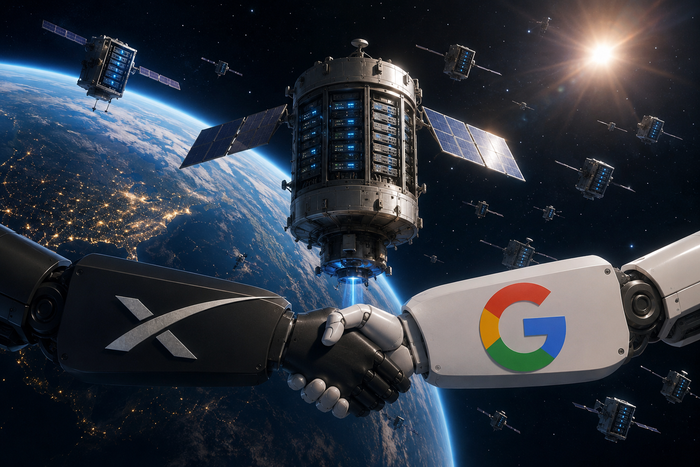
The “space data center” plan envisioned by Elon Musk and SpaceX is not just a temporary fad. It is a highly practical project advancing with concrete designs and production facility plans aimed at bypassing terrestrial power shortages and environmental regulations.
Here are some fascinating, newly revealed details about this exciting initiative.
🛰️ Key Highlights of SpaceX’s ‘Space AI Data Center’
1. ‘AI1’: The AI-Dedicated Satellite with Monstrous Specs
The physical specifications of ‘AI1’, the first-generation AI data center satellite unveiled by SpaceX, are beyond imagination.
- Wings Wider than a Boeing 747: Its total wingspan when fully deployed reaches approximately 70 meters.
- Space-Grade Power Consumption: Each satellite consumes an average of 120 kW (up to 150 kW) of power. This is a staggering amount of energy, equivalent to running an entire high-end terrestrial AI server rack (such as Nvidia’s GB300) in space.
- Flexible Chip Integration: Designed to be chip-agnostic, it features a modular architecture that allows swapping in AI chips not just from Nvidia, but from various partner companies.
2. Why Space Instead of Earth?
Behind this seemingly reckless challenge lie clear physical and economic rationales.
- Infinite Power (Solar): It can generate solar power 365 days a year without interference from clouds or the atmosphere, far more efficiently than on Earth.
- Natural Cooling Advantage: Space is a vacuum with no air to transfer heat. While convective cooling is impossible, heat can be directly radiated into deep space through massive radiators. This eliminates the need for water- and power-intensive cooling towers used in terrestrial data centers.
- Bypassing Land Regulations and Power Shortages: With the recent AI boom pushing terrestrial power grids to their limits, this is an ingenious bypass strategy to generate power and compute entirely off-planet.
3. Mass Production Hub: The ‘Gigasat Factory’
To realize this massive infrastructure, SpaceX is constructing a dedicated manufacturing plant called the ‘Gigasat Factory’ in Bastrop, Texas. As early as late 2027, it plans to churn out thousands of AI satellites annually to deploy them into orbit. The primary transportation vehicle to deliver these into space will, of course, be the super-heavy reusable rocket, ‘Starship’.
SpaceX Falcon 9 Reusability & Cost Collapse Analysis
⚠️ Is It All Just a Rosy Future? (Challenges to Overcome)
Of course, space data centers are not a silver bullet. The industry faces significant skepticism and concern.
- Latency Issues: Even at the speed of light, transmitting data up to space and downloading the computed results back down introduces minute delays that can hinder real-time services. (Even OpenAI’s Sam Altman dismissed the idea as “ridiculous”.)
- Space Debris and Environmental Pollution: Environmental groups have recently urged the FCC (Federal Communications Commission) to halt approvals, demanding rigorous investigations into orbital debris and atmospheric pollution caused by millions of satellites blanketed in Low Earth Orbit (LEO).
The ‘Starmind’ project and the AI1 satellite constellation (expected to reach up to 1 million units) currently being fleshed out by SpaceX are double-edged swords carrying extreme environmental risks alongside technological breakthroughs.
The concern over ozone layer depletion from alumina pollution during atmospheric reentry of 1 million LEO satellites, as well as the Kessler syndrome (cascading space debris collisions), is a real, scientific warning—not just empty worry.
We analyze the environmental risks, the complex interests of the Global Supply Chain, and the viability of Subsea Data Centers as a highly practical terrestrial alternative.

🌐 US Government (FCC) Approval Viability and Regulatory Barriers
Skepticism dominates regarding whether the US government will actually approve SpaceX’s massive 1-million-satellite AI1 plan.
- Strong Pushback from Environmental Groups (NEPA Lawsuits): Environmental groups (such as Earthjustice and PEER) have filed legal petitions against the FCC, demanding they halt individual satellite approvals and first conduct a Programmatic Environmental Impact Statement (PEIS) to assess the cumulative impact of 1 million satellites on Earth’s atmosphere and orbit.
- Geopolitical Supply Chain Monopoly Checks: The US government is wary of a single entity (SpaceX) completely monopolizing global AI compute infrastructure and orbital territory. National security issues and the control of advanced AI semiconductors (like Nvidia and Tesla’s proprietary chips) are heavily tied to this, making it highly likely that the FCC and federal agencies will impose extremely strict approval conditions or tight annual launch quotas.
🌊 The Realistic Alternative: Backtracking to Subsea Data Centers
If SpaceX’s Gigasat Factory in Bastrop, Texas, faces regulatory bottlenecks preventing infinite satellite scaling, Big Tech and the global supply chain will have no choice but to turn to the most practical and eco-friendly alternative: Subsea Data Centers.
1. Why Are Subsea Data Centers the Ultimate Alternative?
- Ultra-Efficient Natural Cooling: By utilizing cold deep-sea water directly, subsea setups offer far more efficient and stable thermal management compared to radiative cooling in space.
- Direct Integration with Green Energy Grids: They can easily integrate with marine renewable energy infrastructures, such as offshore wind and tidal power, to build a 100% carbon-neutral power supply chain.
- Low Latency: Over 40% of the world’s population lives within 100 km of a coastline. Subsea edge data centers connected directly to subsea fiber-optic cables offer incomparably lower latency than Starlink laser links routing through space orbit.
2. Pivoting Gigasat’s Architecture to Subsea
It is highly feasible for companies like SpaceX or Microsoft (which has a proven track record with Project Natick) to pivot the Gigasat Factory’s production lines from “space satellite manufacturing” to “standardized, sealed subsea AI server capsule manufacturing” to secure a sustainable supply chain.
The encapsulation technology required to withstand harsh vacuum and thermal environments in space is engineeringly very similar to the waterproofing and high-pressure resistance needed for deep-sea environments.