
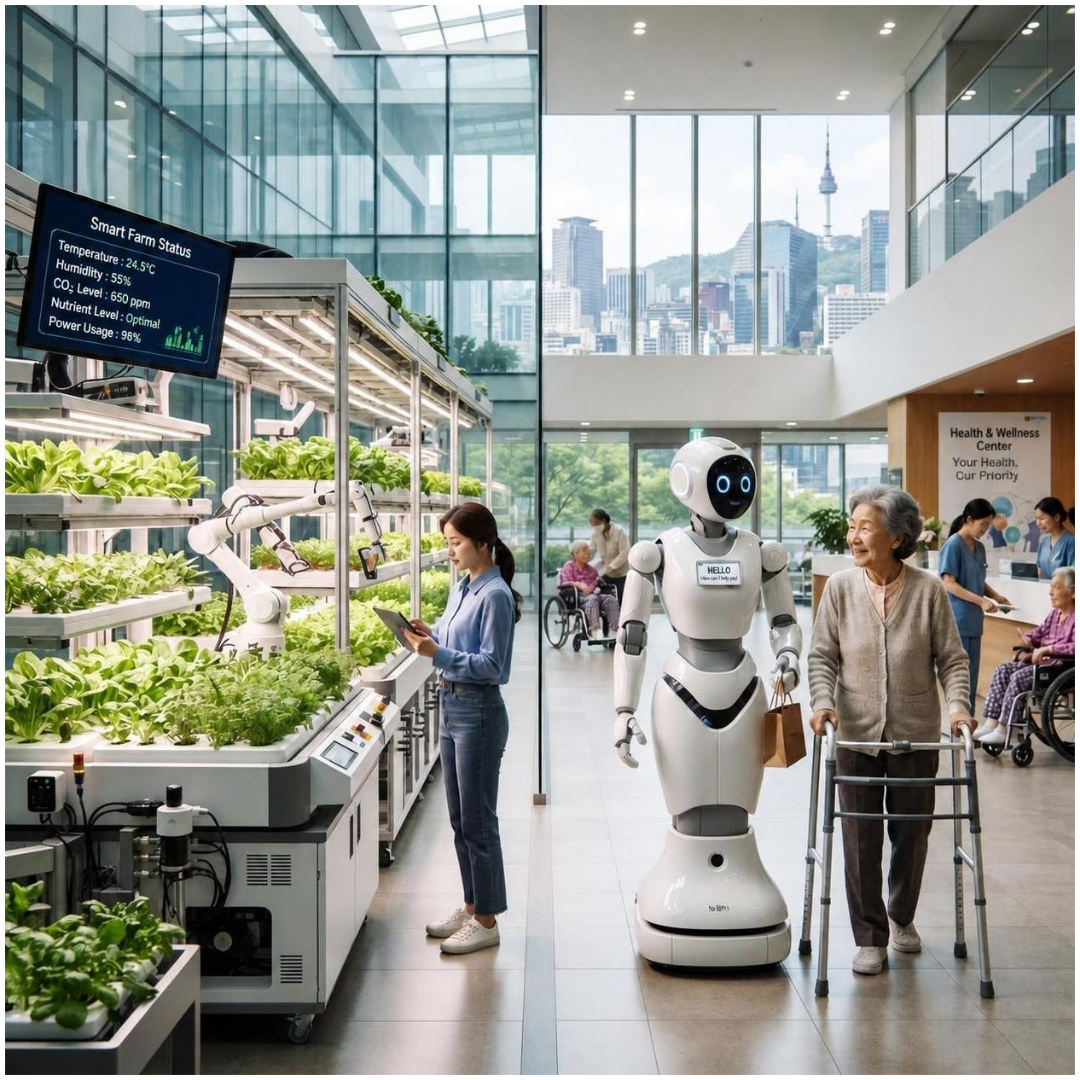
In the face of a global environmental crisis, smart farming—which safeguards “food,” the core of human survival—and healthcare/silver care humanoid robots—which overcome physical limitations—will serve as the dual pillars of the 2030s technological paradigm.
This report provides a multi-dimensional analysis of the global roadmaps and investment opportunities for these two critical industries, which aim to enhance human survival and quality of life without disrupting natural ecosystems.
1. Global Smart Farming Yield Share & Regional Roadmaps
Currently, the share of smart farming (vertical farms, precision greenhouses, etc.) in global agricultural output varies by crop, but is estimated to be around 2% to 5% (early stage) of the overall global crop market. However, its share is rapidly rising in high-value fresh produce sectors such as leafy greens, strawberries, and tomatoes. With the establishment of clean energy grids by 2032, rapid mass-market adoption is projected.
💡 Regional Support Policies & Cost-Reduction Roadmaps
| Country/Region | Key Support Policies & Action Roadmaps | Core Cost-Reduction Strategies |
| European Union (EU) | “Farm to Fork” Strategy Provides massive subsidies for carbon-reducing smart precision agriculture through Common Agricultural Policy (CAP) funds. | Lowers operational expenses (OPEX) by 100% integrating renewable energy (solar, geothermal) with smart farm operations. |
| United States | Inflation Reduction Act (IRA) & Farm Bill Invests billions of dollars in Climate-Smart Agriculture. Offers tax incentives for constructing vertical farms near urban areas. | Minimizes labor costs by introducing aeroponics (which reduces water usage by 95%) and AI-driven autonomous harvesting robots. |
| Middle East (Saudi Arabia/UAE) | Food Security Strategy (Vision 2030) Overcomes desert climates by funding up to 70% of smart farm installation costs, integrated with national gigaprojects like NEOM. | Reduces capital expenditure (CAPEX) by localizing seawater desalination infrastructure and high-efficiency LED lighting technology. |
| South Korea | Measures for Growing Agriculture into a Future Growth Industry Establishes “Smart Farm Innovation Valleys” led by the Ministry of Agriculture, Food and Rural Affairs; offers long-term, low-interest loans and R&D funding for young startups. | Resolves chronic rural labor shortages and high wage costs through the commercialization of “physical AI-based autonomous robots” and “follower robots.” |

2. Innovation Beyond Food: Healthcare & Silver Care Humanoid Roadmap
Once a stable food supply is secured through smart farming, the next challenge humanity faces is an aging population and caregiving gaps. In the medical and silver care sectors, humanoid robots designed to assist the elderly and people with disabilities will transcend being mere tools of convenience to become essential infrastructure for “preserving human dignity.”
[Humanoid Commercialization Roadmap] 2026–2028: Deployment in Manufacturing & Logistics (Replacing simple, repetitive labor) ▼ 2029–2031: Domestic Assistance & Light Daily Care (Pilot introduction in elderly households) ▼ 2032–2035: Mass Adoption of Specialized Medical & Rehab Humanoids (AI-powered patient care)
① Core Technologies of Medical & Care Humanoids
- Soft Robotics & Tactile Sensors: To safely support and lift patients without causing injury, robots require soft actuators that mimic human muscles instead of rigid metal joints, alongside skin tactile sensors capable of detecting micro-pressures.
- Multimodal AI: These systems analyze patients’ facial expressions, vocal tones, and subtle groans in real time to understand pain levels and emotional states, delivering empathetic psychological care.

② Core Investment Hot Spots
- AI-Powered Core Chips & Actuator Manufacturers: The value chain of ultra-precision motors (harmonic drives) that act as humanoid joints, and on-device AI semiconductors that serve as the brain.
- Battery Density & Power Management Systems: Companies specializing in high-density battery technologies (such as solid-state batteries) that enable continuous operation for at least 8 hours, even under heavy payloads.
- Care Service Platforms & Software Providers: Medical security and control software integrated into robot hardware to sync patient medical data with hospital systems in real time.
