
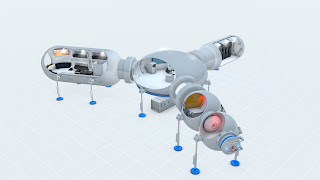
Underwater Housing Modules and AI Data Centers

Subsea Data Centers (SDCs): Capex-to-Opex Shift and AI Thermal Recycling
This presentation-level analysis explores the economic transition of subsea data centers (SDCs) from experimental prototypes to high-value industrial assets in 2026. We focus on the “Capex-to-Opex” shift and the emerging frontier of AI Thermal Recycling—turning massive GPU heat into usable energy.
I. Investment Profile: Construction Costs for Subsea Shelters
While building on the seabed requires high-tech materials, the Net Present Value (NPV) of a subsea project in 2026 often exceeds land-based equivalents due to the elimination of land acquisition and mechanical cooling costs.
1. Capex Breakdown (Construction & Deployment)
Subsea “homes” for AI require a higher initial investment in structural integrity.
- Pressure Hull Engineering: ~$15M–$25M per 5MW pod. High-strength POSCO-grade corrosion-resistant steel and carbon-fiber composites drive this cost.
- Deployment & Submerged Logistics: ~$5M per pod. This includes heavy-lift vessels and autonomous underwater vehicle (AUV) anchoring.
📊 Terrestrial vs. Subsea Comparison
| Cost Category | Land-Based (10MW) | Subsea Shelter (10MW) |
|---|---|---|
| Land / Permitting | $10M – $30M (High) | ~$1M (Maritime Lease) |
| Cooling Infrastructure | $15M (Chillers/Towers) | $3M (Heat Exchangers) |
| Structural / Shell | $8M (Standard Warehouse) | $35M (Pressure Vessel) |
| Operational Lifetime | 10–15 Years | 20+ Years (Nitrogen Sealed) |
II. Specific Power Generation Efficiency: Utilizing AI Waste Heat
As of 2026, the industry is moving beyond “passive cooling” to Waste-Heat-to-Power (WHTP). By utilizing the temperature delta (ΔT) between high-density AI chips and cold seawater, operators can recover significant energy.
1. Thermal Gradient & The Organic Rankine Cycle (ORC)
AI servers (NVIDIA B200/B300) operate at ~80°C. Seawater at 30m depth is ~15°C. This 65°C gradient is the “fuel” for subsea energy recovery.
- Technology: Miniaturized Organic Rankine Cycle (ORC) systems integrated into the pod’s thermal loop.
- Recovery Rate: Modern 2026 ORC systems can reclaim 7–12% of the waste heat and convert it back into electricity.
- Net Gain: For a 10MW pod, roughly 800kW–1MW can be self-generated, effectively lowering the pod’s “External Power Dependency.”
2. Cost per kW (Recycled Energy)
The Levelized Cost of Electricity (LCOE) for this recovered energy is remarkably low once the infrastructure is in place.
- Recovery Cost: ~$0.04 – $0.06 per kWh.
- Grid Comparison: In major AI hubs (U.S., Korea), grid power for data centers costs ~$0.10 – $0.15 per kWh.
- Efficiency Metric: By utilizing waste heat, the PUE (Power Usage Effectiveness) effectively drops below 1.0 (to ~0.92) because the facility is generating a portion of its own operational power from its own inefficiency.
III. Investment Value: The “Oman & Ulsan” Logic
Why are Korean firms like Hyundai E&C and Samsung Heavy Industries aggressively funding this?
- Grid Independence: AI clusters in 2026 are frequently blocked by “Power Grid Queues.” Subsea centers can be deployed next to offshore wind farms, bypassing terrestrial grid wait times.
- Hardware Longevity: The nitrogen-filled, oxygen-free environment inside a subsea shelter reduces chip failure rates by ~800%. This adds an estimated $12M in value over a 5-year cycle by reducing server replacement costs.
- Real Estate Arbitrage: In land-scarce regions (Yongin, Seoul, Singapore), the “Maritime Real Estate” is effectively free, allowing for massive scale-up that is physically impossible on land.
IV. Summary Checklist for Investors (May 2026)
- [ ] ROI Horizon: Typically 3.5 to 4.2 years, compared to 6 years for high-density land centers.
- [ ] Sustainability Premium: Eligible for maximum Carbon Credits due to zero fresh water consumption and heat-to-power recycling.
- [ ] Strategic Moat: South Korean shipbuilders currently hold the “Structural IP” for these pods, creating a high barrier to entry for Chinese and U.S. competitors who lack shipyard-scale fabrication.
💡 A Quick Peer-to-Peer Note: While “Waste Heat to Power” sounds like a perpetual motion machine, remember that the 10% recovery is the current physical limit in 2026 due to the laws of thermodynamics.
It doesn’t replace the main power feed, but it acts as a massive “Efficiency Rebate” that makes the subsea model the most profitable AI infrastructure on the planet right now.