
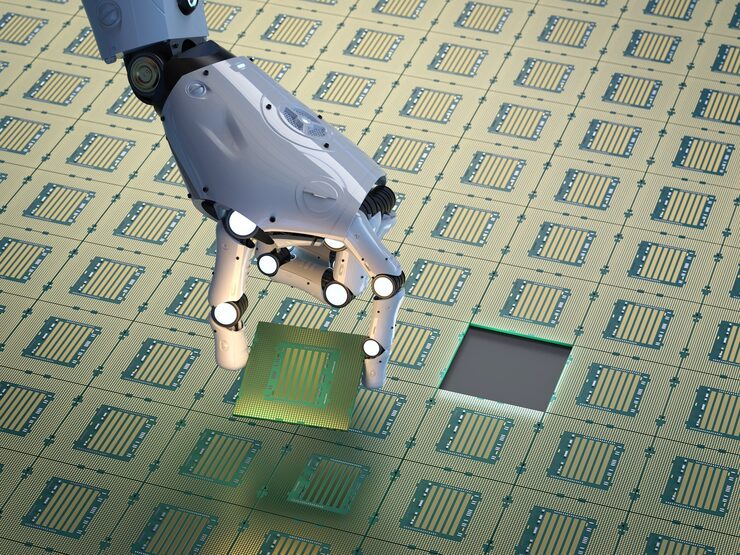
While the market is currently volatile due to a short-term sentiment dip caused by a “narrative shift (from faith to numbers)” facing the semiconductor sector, mid-to-long-term investors must look closer. Attention should be focused on the emergence of a massive “Next Wave” of demand that will offset the “AI infrastructure overcapacity” theory, alongside the subsequent restructuring of the supply chain.
Based on this perspective, we present a comprehensive technical report analyzing multidimensional, macro-level transformations, including the long-term roadmap leading up to 2032, humanoid robotics, and space data centers.
The Semiconductor Supercycle Hidden Behind the Meta Shock: How 2032 Humanoids and Space Data Centers Will Reshape the Future Supply Chain
The domestic semiconductor market recently suffered an unprecedented crash due to overlapping concerns: news of Meta reviewing an entry into the cloud business and fears of supply expansion from Chinese memory manufacturers. While short-term investors interpret this as the “bursting of the AI bubble,” mid-to-long-term investors should view it as a clash between short-term narrative noise and a structural paradigm shift.
This report delivers a multidimensional analysis of the fundamental changes in the global semiconductor supply market from the perspective of technology development roadmaps and future industries.
1. Next-Generation Semiconductor Technology Roadmap: The Direction of Quality and Price Competition
The current AI semiconductor market, centered around HBM (High Bandwidth Memory), is fast approaching the physical limits of process miniaturization. Moving forward, the ultimate battleground will shift from mere speed competition to energy efficiency (EE) and the capability to supply customized (ASIC) chips.
- The Commercialization of PIM (Processor-in-Memory): PIM technology, which executes computations directly inside the memory, resolves data bottlenecks and drastically reduces power consumption. As Big Tech companies advance their proprietary AI chips, market share will become increasingly locked down by firms possessing superior capabilities in custom PIM and advanced HBM, rather than commodity D-RAM.
- 3D Packaging and the Foundry Ecosystem: Companies that pioneer advanced packaging technologies and stabilize GAA (Gate-All-Around) processes will secure a definitive edge in quality competition. While China’s pursuit of legacy (commoditized) memory may disrupt lower-end markets, a stark technological gap remains, serving as a high barrier to entry for the ultra-high-performance AI chip market.
2. 2032 Humanoid Robot Commercialization and Explosive Semiconductor Demand
Although short-term anxieties persist regarding Meta’s surplus LLM (Large Language Model) computing resources, the widespread commercialization of humanoid robots by 2032 will generate semiconductor demand that completely dwarfs current data center requirements.
- The Arrival of “Moving Data Centers”: A single humanoid robot must process vast streams of real-time sensor data, including vision, tactile feedback, and spatial awareness. This translates into an explosive surge not only for high-performance On-Device AI chips embedded within the robots themselves but also for the Edge Cloud infrastructure required to control and train them.
- Hardware-Software Convergence: By 2032, humanoids will be deployed far beyond factory manufacturing floors into logistics and the service industry. The ultimate winners will be the semiconductor companies that successfully frontrun the supply chain for highly reliable, highly efficient memory and system semiconductors demanded by global robot manufacturers like Tesla (Optimus).

3. Pushing Beyond Earth: The Advance of Space Data Centers
The expansion of the space economy—driven by the maturation of SpaceX’s Starlink network, lunar resource exploration, and the construction of private space stations—is opening up a brand-new infrastructure frontier: the “Space Data Center.”
- Overcoming the Limits of Terrestrial Data Centers: As ground-based data centers face mounting crises over massive power consumption and cooling demands, data centers utilizing the ultra-low temperatures of outer space are actively being pursued as viable alternatives.
- Radiation-Hardened Semiconductors for Space Environments: Space data centers and Inter-Satellite Laser (ISL) communication infrastructure require specialized radiation-hardened chips and next-generation compound semiconductors (such as SiC and GaN) capable of withstanding intense cosmic radiation and extreme temperature fluctuations. This will emerge as a highly profitable, high-margin market that maximizes the value-add of existing memory semiconductor technologies.
4. Implications for Mid-to-Long-Term Investors: A Future Proven by “Numbers”
The current market crash is a natural growing pain that occurs when valuation benchmarks transition from “pure expectation” to “concrete financial performance.”
While supply expansions from Chinese firms like CXMT and YMTC may slow down price increases for commodity memory used in mid-to-low-end smartphones and PCs, the “Next Wave” markets—such as humanoids, space technology, and AI autonomous driving—require ultra-high performance and extreme reliability. These sectors will remain an oligopoly securely controlled by a select few leading semiconductor giants.
Rather than being swayed by short-term chart fluctuations, a highly effective strategy for long-term investors is to focus heavily on companies backed by rock-solid fundamentals—those uniquely capable of supplying the core chips that will power the apex of future industries.