
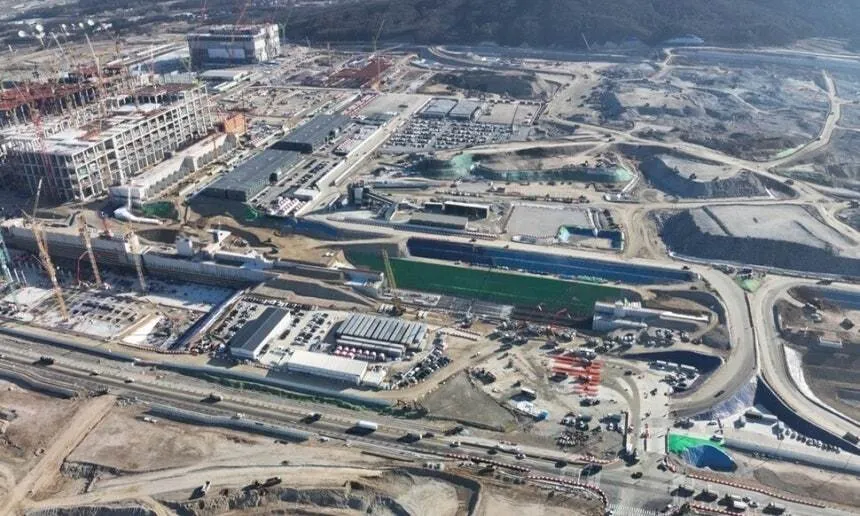
The Great Southern Semiconductor Shift Triggered by RE100 and AI Humanoids: Global Supply Chain Investment Roadmap
As infrastructure bottlenecks in the Yongin Cluster collide with intense RE100 (100% Renewable Energy) pressure from global Big Tech, the axis of South Korea’s semiconductor industry is rapidly shifting toward the Honam region (Jeonnam and Gwangju), anchoring the ‘Southern Semiconductor Innovation Belt.’ In particular, Samsung’s initiative for a ‘100% Humanoid Assembly and Production Line (Physical AI)’ and SpaceX’s mass production plans for Starlink and Starship are fundamentally altering the global manufacturing paradigm.
Under the government’s state agenda of ‘5 Mega-Regions and 3 Special Autonomous Provinces (5 Poles, 3 Specials),’ we analyze the multidimensional perspectives and the global production and corporate valuation roadmaps that investors must watch closely.
1. Three Key Investment Perspectives for Investors
In this macro shift, where government tax incentives converge with corporate survival strategies, investors must secure positions based on the following key perspectives:
- The Presence of an ‘ESG Premium’ via RE100 Self-Sufficiency: Global Big Tech companies are demanding strict RE100 compliance across their entire supply chains. The abundant solar and offshore wind infrastructure in the Jeonnam region goes beyond simple cost savings—it is an absolute prerequisite to prevent exclusion from the global supply chain. Fabs in the Honam region will set the global standard for eco-friendly manufacturing.
- Geographical Restructuring of the Value Chain for Materials, Parts, and Equipment (SMR): With front-end fabs and back-end (packaging) lines being built simultaneously in Honam, the southward migration of the semiconductor ecosystem—previously concentrated in the capital metropolitan area—has begun. Massive cascade investments are expected in companies securing bases in Honam for equipment maintenance, ultra-precision sensors, semiconductor gases, and logistics.
- Accelerated Transition to Humanoid-Based ‘Unmanned Factories’: Samsung’s push for 100% humanoid assembly and production lines is a disruptive innovation aimed at solving the chronic shortage of specialized R&D talent in regional provinces. By directly bypassing human recruitment limitations through robotics (Physical AI), companies specializing in actuators, reducers, and vision AI stand to become the ultimate beneficiaries.
2. Global Production Roadmap Aligned with SpaceX Mass Production
The accelerating mass production of SpaceX’s aerospace infrastructure (Starlink subsystems, spacecraft parts) is triggering an explosion in demand for space-grade, highly reliable semiconductors and high-performance computing chips, linking directly with South Korea’s Southern Belt.
[SpaceX Mass Production (Starship/Starlink)] │ (Explosive demand for space-grade high-reliability semiconductors & Physical AI chips) ▼[Southern Semiconductor Innovation Belt] ├── Jeonnam/Gwangju: Front-end Fabs (HBM, AI Semis) + Advanced Packaging (Humanoid Unmanned Production) ├── Gumi: Semiconductor Materials & Parts (Wafers and core substrates like SK Siltron) └── Busan: Power Semiconductors (Power efficiency optimization for spacecraft and satellites)
- Interlocking Demand for Ultra-High-Performance Packaging: SpaceX’s AI-driven low Earth orbit satellite network (Starlink) and spacecraft production lines require radiation-hardened chips and advanced packaging (2.5D/3D Stacking) that can withstand extreme environments. Connected with the Advanced Packaging Validation Center being established in Gwangju, this creates a high-tech supply chain linking North America and Asia.
- Global Supply Chain Multi-homing: For global Big Tech and space ventures like SpaceX looking to mitigate geopolitical risks and reduce dependency on Taiwan (TSMC), South Korea’s Southern Belt—backed by RE100 infrastructure and government subsidies (the Korean version of the IRA)—will serve as a highly attractive alternative production hub.
3. Corporate Valuation Roadmap
This timeline outlines strategies to maximize value at each phase of big tech investments, driven by government policies such as special growth-engine subsidies and the 150 trillion KRW National Growth Fund.
| Phase | Expected Timeline | Key Events & Strategies | Target Investment Sectors |
| Phase 1: Infrastructure Attraction | 2026 – 2027 | Site selection, securing power grids/water supply, and detailing tax incentive frameworks. | Honam-region renewable energy (solar/wind) developers, power infrastructure (transmission/distribution, HVDC) companies. |
| Phase 2: Fab Construction & Equipment Inflow | 2027 – 2029 | Procurement orders for Samsung and SK Hynix’s Southern front-end/back-end production facilities. | Core front-end equipment (domestic SMR for lithography and etching), advanced packaging (TSV equipment for HBM) companies. |
| Phase 3: Mass Production & Physical AI Convergence | 2030+ | Full-scale operation of 100% humanoid-based smart factories, commencing shipments to the global supply chain. | Humanoid robot components (ultra-precision sensors, actuators, reducers), factory automation AI software companies. |
Investor Guideline: Asset revaluations will initially favor frontrunner conglomerates in the Southern Belt (Samsung Electronics, SK Hynix), as they bypass the land compensation delay risks of the Yongin Cluster and capitalize on rapid infrastructure tax exemptions (up to 100%). Following this, robot SMR companies rooted in Physical AI at the foundation of the value chain are expected to drive long-term valuation multiple expansion.