
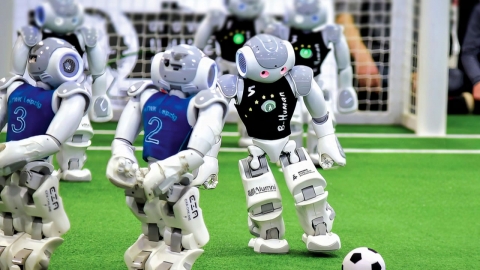
The World’s largest robotics competition, RoboCup, held for the first time at Songdo Convensia in Incheon, South Korea, is far more than a mere technical contest for university students. It serves as an empirical showcase proving that “Physical AI and peaceful human coexistence,” breaking the boundaries between terrestrial and space industries, has reached a critical tipping point. Inha University’s humanoid soccer robot, which makes human-like decisions to shoot, and Incheon National University’s household value robot that folds laundry are just the prelude to a massive era of Robot Economics that humanity is about to welcome.
From an investor’s multi-dimensional perspective, this report analyzes the current status of labor-replacement technologies bridging Earth and space, focusing on Boston Dynamics’ commercialization push for its next-generation electric Atlas and the AI humanoid roadmap of Unitree Robotics, which has recently emerged as the nucleus of the global market fueled by Shanghai IPO momentum.
1. Global Developers’ Status: The Super-Gap Roadmap of Unitree and Boston Dynamics
The global humanoid industry has evolved past the hardware competition of merely “walking and running.” It has entered an evolutionary stage of autonomous decision-making by integrating a massive robotic brain known as the Vision-Language-Action (VLA) Model.
- Unitree Robotics (The Pioneer of Price Destruction & Ecosystem Monopoly): Unitree has shattered the high-cost barrier of industrial robot frames by mass-distributing its ‘Unitree G1’ and next-generation ‘H2’ lineups at around $16,000 (approx. 22 million KRW). In doing so, it is monopolizing the “standard platform for physical AI training” across universities and tech research institutes worldwide. Recently, by fusing advanced Teleoperation and XR wearable interface technologies, it has evolved to a stage where robots learn subtle human hand movements in real-time.
- Boston Dynamics (Electric Atlas Entering Performance-Driven Mass Production): Completely redesigned with electric motor actuators instead of hydraulic systems, the next-generation Atlas has already secured a mass deployment of over 25,000 units across Hyundai and Kia global factories. This represents the pinnacle of a “Capability-first” strategy that directly replaces human labor on the industrial shop floor.

2. From Earth to Deep Space: Lunar Base Construction and the Feasibility of Unmanned Space Labor
As proven at the Songdo RoboCup, as robotic precision reaches human-like levels, this technology extends beyond terrestrial factories to become the core driving force behind the US Artemis II project and continental powers’ Lunar Base construction roadmaps.
The Structural Shift:
[Terrestrial: Factory/Household VLA Learning] ➔ [Space: Orbit/Lunar South Pole Deployment] ➔ [Autonomous Primary Base Infrastructure Construction & Resource Mining]
- The Space Vanguard Replacing Humans: In outer space, the survival cost for humans is astronomically high due to extreme radiation, vacuums, and cryogenic temperatures. Consequently, hybrid space robots—combining a humanoid upper body with an active suspension wheeled lower base—have recently emerged as the definitive alternative. They have reached a technological readiness level (TRL 7 or higher) capable of perfectly executing autonomous labor, such as excavating regolith at the lunar south pole and building hydrogen/water infrastructure before human astronauts even arrive.
- Peaceful Coexistence and the Capital Perspective: Long-term global long funds and value investors are heavily investing in a peaceful, co-existing autonomous robot (Co-bot) ecosystem that “shares” hazardous labor and extreme environments rather than “displacing” humans. This triggers a structural mega-boom that drives the marginal cost of labor productivity down close to zero, neutralizing general employment anxieties.
3. Mid-to-Long Term Core Value Stocks to Preempt from an Investor’s View
As Incheon City has officially declared its vision to nurture Songdo as a hub for the AI robotics industry, the opening of RoboCup acts as a catalyst triggering a massive re-rating of advanced hardware and software robotics value stocks that have previously been undervalued in the Korean stock market.
① Large-Cap Mass-Production Robots Linked to Global Automotive Platforms: Rainbow Robotics
- Investment Approach: Rainbow Robotics is a key partner in Samsung Group’s equity investment and transition toward unmanned factory processes. Just as Hyundai Motor Group acquired Boston Dynamics, Rainbow Robotics is a first-mover poised to capture the full benefit of hardware BoM (Bill of Materials) compression and execute a stock price quantum jump when Samsung’s large-scale AI humanoid and wearable robot mass-production lines materialize.
② Super-Gap Value Stocks in AI Vision and Reducer Solutions: Neuromeka, Samick THK
- Investment Approach: The most highlighted areas at this year’s RoboCup Confex & Expo are actuators and precision reducers, which function as robotic joints. According to McKinsey analysis, 40% to 60% of a robot’s cost originates from this drivetrain. Neuromeka’s compact AI control technology and Samick THK’s precision component capabilities will establish a proprietary supply moat amidst the global trend of manufacturing cost reductions.
③ Aerospace and Satellite Network Convergence Stocks: Hanwha Systems, LIG Nex1
- Investment Approach: The core of lunar base construction and deep-space robot control relies on “ultra-low latency communication networks” and “satellite defense.” When global robots, including Unitree, operate in space territories, Korea’s top-tier defense and satellite value chain—which supplies low-Earth orbit (LEO) satellite communication antennas and cyber security systems to control them—will become an essential asset for long-term asset managers to lock into their portfolios.
💡 Investor Takeaways: Final Portfolio Strategy
| Market Noise | Real Capital Market Signal | Investor Action Guidelines |
| “Robots playing soccer is just a simple gimmick or sideshow.” | Accelerated Learning: Open-source VLA data accumulated through RoboCup is forming a “ChatGPT momentum” for physical AI that can be instantly ported to either homes or outer space. | Exclude simple theme-driven component stocks; buy core actuator and integrated robot platform companies securely anchored in conglomerate supply chains. |
| “Unmanned robotization will slow down youth employment and worsen social conflict.” | Expansion into Space Economy: Terrestrial surplus capital and technology are creating a massive new blue ocean—lunar resource mining and space infrastructure—expanding the overall economic pie for humanity. | Do not panic-sell over temporary political employment noise; maintain long-term positions in global security and aerospace-converged robotics leaders. |
📌 Final Macro Conclusion
The kickoff of the Incheon Songdo RoboCup and Unitree’s price-disruptive AI humanoid distribution roadmap serve as a flare signaling that robots are no longer laboratory toys. Instead, they have established themselves as “practical proprietary economic assets that destroy terrestrial manufacturing costs and act as proxies for securing space resources.”
As predicted by Bank of America (BoA), global capital is executing a massive money move to preempt the humanoid market, which is projected to explode to an annual volume of 1.2 million units by 2030. Rather than panic selling during short-term market volatility, investors should proactively Buy the Dip on South Korea’s super-gap robotics platforms and premium component value stocks—the protagonists of the upcoming aerospace and robot democratization boom—to maximize long-term capital gains.
Leave a Reply